

Time: Oct 31 2026 Views: 6
A 70 CFM 8 Bar diesel rotary screw air compressor powered by a Perkins 403D-15 engine is a compact compressed-air solution for construction, agricultural maintenance, mobile servicing, and industrial work in locations without reliable electricity.
With a nominal airflow capacity of approximately 2.0 m³/min and a working pressure of 8 Bar (116 PSI), this compressor is intended for applications where portability, independent diesel power, and appropriately sized compressed-air output are important.
However, buyers often face a practical question:
Is a 70 CFM diesel compressor sufficient, or should they choose a larger 185 CFM model?
The answer depends on pneumatic tool consumption, operating pressure, simultaneous equipment use, duty cycle, and future expansion requirements.
This guide examines the Perkins-powered 70 CFM compressor, explains its typical applications, and compares it with a 185 CFM diesel air compressor to help contractors and equipment buyers select the right machine.
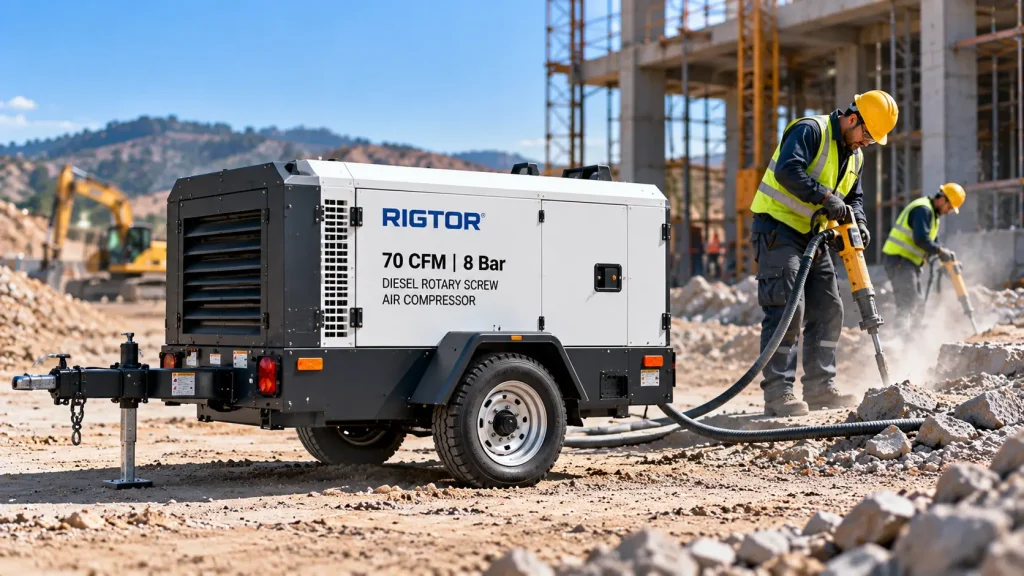
A 70 CFM diesel air compressor uses an onboard diesel engine to drive a rotary screw compression system.
Unlike an electrically powered compressor, it can operate independently of a fixed electrical supply.
This makes it suitable for remote worksites, agricultural operations, field maintenance, and temporary construction activities.
| Parameter | Configuration |
|---|---|
| Nominal Airflow | 70 CFM |
| Metric Airflow | Approximately 1.98 m³/min |
| Nominal Working Pressure | 8 Bar |
| Pressure in PSI | Approximately 116 PSI |
| Diesel Engine | Perkins 403D-15 |
| Engine Displacement | Approximately 1.5 L |
| Compressor Technology | Oil-injected rotary screw |
| Engine Cooling | Liquid-cooled |
| Equipment Category | Compact diesel air compressor |
| Primary Applications | Construction, agriculture, field maintenance, rental |
Specification note: Buyers should confirm that the stated 70 CFM is Free Air Delivery (FAD) measured at the rated 8 Bar operating pressure. Actual compressor performance and the installed engine rating must be verified using the manufacturer's technical documentation.
CFM means cubic feet per minute.
It describes the volume of air delivered over time under a specified measurement condition.
A capacity of 70 CFM is equivalent to approximately 1.98 m³/min.
However, airflow ratings must be compared under equivalent conditions.
For pneumatic equipment, the relevant figure is the air delivered at the required operating pressure.
A working pressure of 8 Bar is approximately 116 PSI.
This pressure range is compatible with many industrial pneumatic applications, provided the connected tools are designed for it.
The compressor must also compensate for pressure losses through hoses, regulators, filters, and other components.
The Perkins 403D-15 is a compact, three-cylinder industrial diesel engine from the Perkins 400 Series.
Its approximately 1.5-liter displacement makes it suitable for various industrial power applications where equipment dimensions and engine packaging matter.
| Feature | Description |
|---|---|
| Engine Model | Perkins 403D-15 |
| Engine Family | Perkins 400 Series |
| Cylinder Configuration | Three-cylinder inline |
| Displacement | Approximately 1.5 L |
| Aspiration | Naturally aspirated |
| Cooling | Liquid-cooled |
| Fuel System | Mechanical diesel fuel system |
| Rated Output | Depends on the specific engine rating and configuration |
Selecting a diesel engine for a screw compressor requires careful matching between engine output and compressor shaft-power demand.
The manufacturer must consider:
The presence of a Perkins 403D-15 engine does not, by itself, establish the compressor's actual airflow or continuous-duty capability.
These must be verified for the complete equipment package.
Engine accessibility is especially important for compact industrial equipment.
Buyers should evaluate access to the oil filter, fuel filters, cooling system, belts, and routine inspection points.
They should also confirm local availability of compatible Perkins replacement parts and service support.
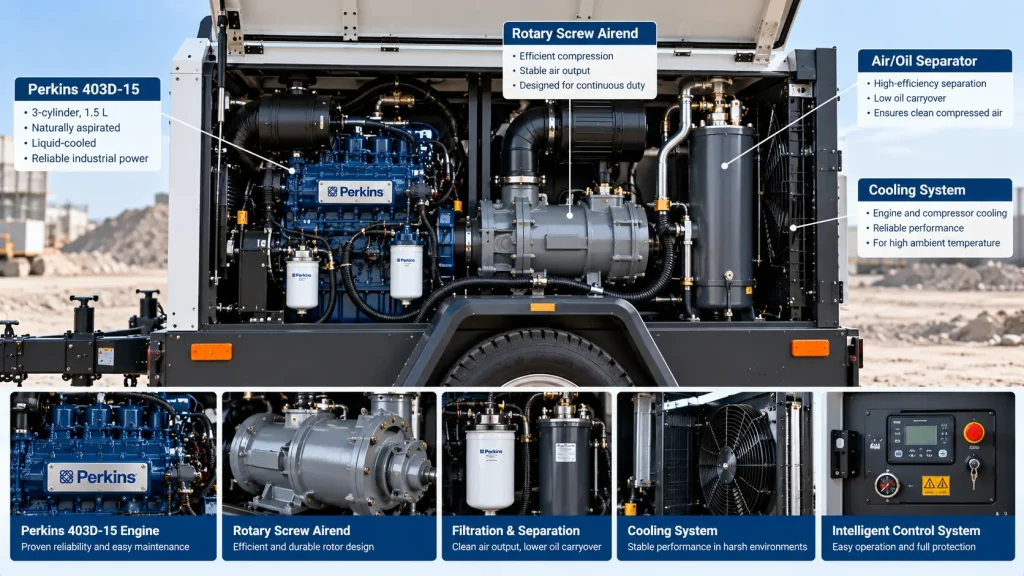
The compressor operates through an integrated engine, air compression, lubrication, cooling, and control system.
The Perkins engine supplies mechanical power to the compressor airend.
Ambient air enters through an intake filter that helps prevent dust and debris from reaching the compression system.
Two intermeshing rotors compress the incoming air.
Oil injection assists with lubrication, sealing, and heat removal.
The compressed air and injected lubricant pass through a separation system.
The separated lubricant returns to the compressor oil circuit.
The diesel engine uses a liquid-cooling system.
The compressor also requires appropriate oil cooling to manage heat generated during compression.
Compressed air is delivered through the outlet connection to the connected pneumatic equipment.
The system's pressure controls help regulate operation within its approved limits.
This is one of the most important questions for buyers.
A 70 CFM compressor can support a range of pneumatic equipment, but compatibility depends on the actual air consumption and working pressure of each tool.
The following values are broad illustrative ranges, not universal specifications.
| Pneumatic Equipment | Illustrative Air Demand | Suitability for 70 CFM |
|---|---|---|
| Small pneumatic impact wrench | 5–15 CFM average, depending on duty cycle | Often suitable |
| Pneumatic ratchet or small air tool | 4–10 CFM | Often suitable |
| Small air drill | 10–25 CFM | Potentially suitable |
| Small pneumatic breaker | 20–45 CFM | Depends on model |
| Larger pneumatic breaker | 45–80+ CFM | Requires careful verification |
| Abrasive blasting nozzle | Varies widely with nozzle size and pressure | Only selected small configurations |
| Multiple pneumatic tools | Combined demand varies | Must calculate simultaneous consumption |
Important: Tool manufacturers may publish average consumption, consumption at a specified duty cycle, or continuous free-air demand. These figures are not interchangeable.
A tool requiring 60 CFM continuously leaves very little capacity margin on a nominal 70 CFM compressor.
A compressor may provide enough nominal airflow but still be unsuitable if the required pressure exceeds its rated capability.
For example, a tool requiring 10 Bar cannot be correctly supplied by an 8 Bar compressor.
Similarly, long hoses and undersized connections can cause pressure losses that reduce tool performance.
A 70 CFM compressor is generally better suited to modest compressed-air demand.
When several tools operate simultaneously, their combined consumption may exceed the available capacity.
The required compressor size should be calculated using the actual simultaneous air demand, not simply the number of tools.
Small construction projects may require compressed air for pneumatic tools, equipment servicing, and maintenance work.
A compact diesel compressor can be useful where temporary electrical power is unavailable.
Agricultural operations often involve machinery repairs in fields, workshops, and remote locations.
A diesel-powered compressor can support suitable pneumatic maintenance tools without relying on grid electricity.
Field service teams may need compressed air for equipment servicing and selected pneumatic tools.
The required compressor configuration depends on transport arrangements, tool consumption, and operating conditions.
Rental businesses may offer compact diesel compressors to contractors who need independent compressed air for temporary work.
For rental applications, maintenance access, durability, transportability, and spare-parts availability are important purchasing considerations.
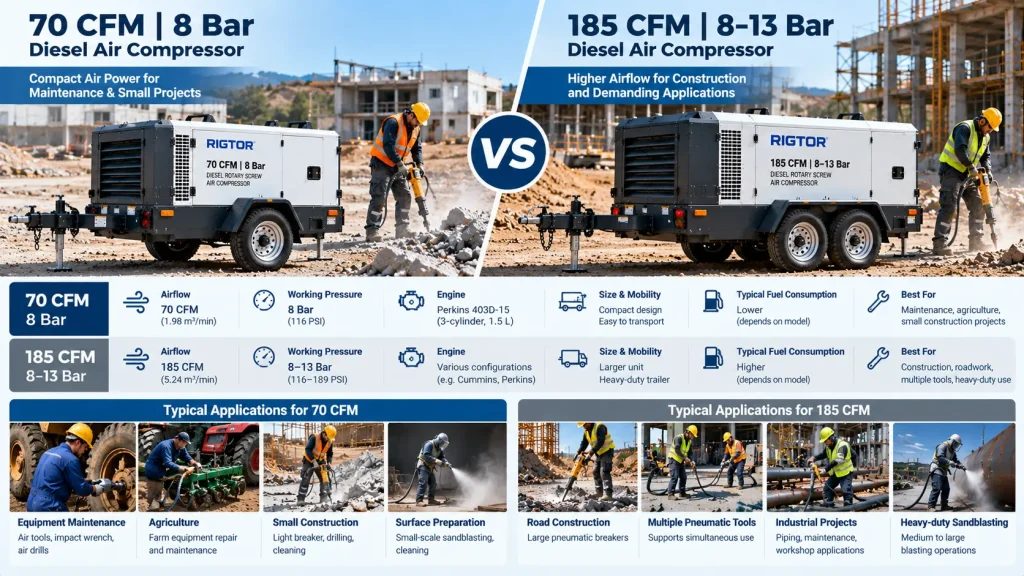
Both compressor sizes can support portable industrial operations.
However, they serve different airflow requirements.
| Parameter | 70 CFM / 8 Bar | 185 CFM Diesel Compressor |
|---|---|---|
| Nominal Airflow | 70 CFM | 185 CFM |
| Metric Airflow | 1.98 m³/min | 5.24 m³/min |
| Working Pressure | 8 Bar | Depends on selected model |
| Engine | Perkins 403D-15 | Depends on configuration |
| Product Positioning | Compact independent air supply | Higher-capacity portable air supply |
| Typical Applications | Small construction, agriculture, maintenance | Construction, roadwork, rental, higher-demand pneumatic tools |
| Multiple-Tool Capability | Limited by available airflow | Greater nominal airflow capacity |
| Equipment Size | Compact configuration possible | Generally larger compressor system |
| Selection Priority | Modest air demand and mobility | Higher air demand and simultaneous use |
The 185 CFM compressor provides approximately 2.64 times the nominal airflow of the 70 CFM model.
However, its actual operating pressure must be confirmed before making a direct performance comparison.
The 70 CFM model is intended for relatively modest compressed-air requirements.
The 185 CFM model provides substantially more nominal airflow.
This additional capacity may be useful for larger pneumatic tools or multiple tools operating simultaneously.
A 70 CFM compressor may be suitable for small maintenance jobs and selected construction tools.
A 185 CFM compressor is more appropriate when the total air demand exceeds the smaller unit's capacity.
For example, a contractor using one small pneumatic tool may not require a 185 CFM compressor.
However, a roadwork crew using a large breaker or multiple pneumatic tools may need the additional airflow.
A compact 70 CFM compressor may offer advantages where equipment size and transport space are limited.
A 185 CFM compressor generally requires a larger compression and power system.
Nevertheless, actual weight, dimensions, trailer configuration, and lifting requirements must be compared using manufacturer data.
A larger compressor is not automatically less economical in every application.
Actual fuel consumption depends on engine rating, compressor efficiency, operating pressure, and load conditions.
The correct comparison is the fuel required to complete the same work under equivalent conditions.
The smaller compressor may have a lower purchase price and lower absolute service-material requirements, depending on the specific models.
However, total cost of ownership also includes fuel, downtime, transport, spare parts, and productivity.
An undersized compressor may create greater project costs if it cannot support the required tools.
Compressor selection should begin with the air demand of the connected equipment.
| Application Requirement | Selection Guidance |
|---|---|
| One small pneumatic tool | Evaluate 70 CFM |
| Agricultural equipment servicing | Evaluate 70 CFM |
| Small remote construction work | Evaluate 70 CFM if tool demand fits |
| One large pneumatic breaker | Verify tool consumption; 185 CFM may be more suitable |
| Multiple pneumatic tools | Evaluate 185 CFM or calculate total demand |
| Larger road maintenance project | Evaluate 185 CFM |
| Small abrasive blasting operation | Calculate nozzle demand before choosing |
| Future expansion to higher air demand | Consider additional capacity |
A farm maintenance team uses a pneumatic impact wrench and other small air tools intermittently.
If the equipment's actual consumption and pressure requirements are within the compressor's verified capacity, the 70 CFM model may be appropriate.
A road maintenance contractor operates a high-consumption pneumatic breaker for extended periods.
The 70 CFM model may be insufficient, depending on the breaker specifications.
A 185 CFM compressor may offer a more suitable airflow capacity.
Suppose two tools each require 45 CFM continuously.
Their combined air demand is:
45 + 45 = 90 CFM
A nominal 70 CFM compressor would be undersized even before accounting for operating margin.
A 185 CFM compressor could be considered, provided its pressure and delivered airflow match the application.
Buyers should use the following process.
Obtain each tool's air-consumption specification at its intended operating pressure.
Identify which tools will operate at the same time.
Add the continuous air requirements of simultaneously operating tools.
Consider hose pressure drops, connection restrictions, leakage, and other relevant losses.
A capacity margin can help accommodate normal demand variations.
The required margin depends on the application and should not replace accurate sizing calculations.
Confirm the compressor's actual delivered airflow at the required pressure.
This is more important than comparing nominal CFM ratings alone.
Fuel cost is an important factor for portable diesel compressors.
Actual consumption depends on engine configuration, compressor loading, working pressure, and operating conditions.
Hourly Fuel Cost = Fuel Consumption (L/h) × Diesel Price (per Liter)
Consider the following hypothetical example:
| Parameter | Compact Compressor | Larger Compressor |
|---|---|---|
| Illustrative Fuel Consumption | 4 L/h | 9 L/h |
| Illustrative Diesel Price | $1.20/L | $1.20/L |
| Calculated Hourly Fuel Cost | $4.80 | $10.80 |
| Calculated Cost for 8 Hours | $38.40 | $86.40 |
These values are hypothetical and do not represent verified fuel-consumption figures for the Perkins 403D-15 compressor or any particular 185 CFM model.
A smaller compressor may consume less fuel per hour.
However, if it cannot provide enough compressed air, the connected tools may operate inefficiently or fail to complete the intended work.
Therefore, buyers should evaluate fuel cost alongside productivity and equipment compatibility.
Routine maintenance helps protect the diesel engine, rotary screw airend, and associated systems.
| Component | Maintenance Focus |
|---|---|
| Perkins 403D-15 engine | Oil, filters, fuel system, coolant |
| Compressor airend | Lubrication, temperature, abnormal noise |
| Air intake filter | Dust restriction and contamination |
| Compressor oil | Correct grade, level and condition |
| Air/oil separator | Differential pressure and oil carryover |
| Cooling system | Radiator, hoses, airflow and coolant |
| Drive system | Coupling or belt condition, where applicable |
| Control system | Pressure settings, alarms and protective functions |
| Air hoses | Damage, leaks and connection security |
Before operation, check engine and compressor fluid levels, visible leaks, intake-filter condition, cooling airflow, and warning indicators.
Follow the actual Perkins engine manual and compressor manufacturer's instructions.
Service intervals depend on the installed components, operating hours, and environmental conditions.
Shut down the compressor, isolate energy sources, allow hot components to cool, and fully depressurize the air system before servicing.
Never disconnect pressurized air lines or open pressure-retaining components while the system is under pressure.
Possible causes include excessive tool demand, air leaks, restricted intake filters, or compressor-control problems.
Check the actual tool consumption, regulator settings, hose dimensions, and compressor output.
Possible causes include dirty cooling passages, insufficient lubricant, cooling-system faults, or operation outside approved limits.
Potential causes include separator problems, incorrect oil level, or oil-return faults.
Possible causes include battery condition, fuel supply, electrical faults, or engine-related issues.
Troubleshooting should follow the relevant engine and compressor manuals.
Before purchasing a compact diesel compressor, international buyers should confirm the availability of replacement parts and technical assistance.
Request the exact engine identification information to ensure correct replacement-part selection.
Confirm availability of air filters, oil filters, separator elements, compressor lubricant, seals, and sensors.
Obtain operating instructions, maintenance schedules, spare-parts information, and applicable electrical diagrams.
Clarify whether the supplier provides remote troubleshooting, replacement-part identification, and technical guidance.
Request written warranty terms covering the diesel engine and compressor package.
Also confirm applicable engine emissions requirements for the destination market.
A 70 CFM 8 Bar diesel compressor can supply compressed air for selected pneumatic tools used in small construction, agricultural maintenance, mobile servicing, and remote industrial work.
It depends on the breaker's air consumption and working pressure. Some smaller pneumatic breakers may be compatible, while larger breakers can require more than 70 CFM.
The primary difference is nominal airflow capacity. A 185 CFM compressor provides approximately 2.64 times the airflow of a 70 CFM compressor, making it more suitable for higher-demand applications when its working pressure is compatible.
It may support selected small blasting configurations. The required airflow depends heavily on nozzle diameter, blasting pressure, and nozzle condition. Larger blasting operations often require substantially more air.
The Perkins 403D-15 is a compact industrial diesel engine platform. Its suitability depends on the specific engine rating and correct matching with the compressor airend.
A smaller compressor may consume less fuel per hour, but actual consumption depends on the engine, pressure, load, and efficiency. Buyers should compare verified operating data and total work completed.
Service intervals depend on the diesel engine, compressor components, lubricant, operating hours, and environment. Follow the applicable engine and compressor maintenance manuals.
Buyers should verify airflow at 8 Bar, engine rating, fuel consumption, dimensions, weight, cooling arrangement, tool compatibility, maintenance requirements, emissions compliance, spare-parts availability, and warranty terms.
A 70 CFM 8 Bar diesel rotary screw air compressor powered by the Perkins 403D-15 engine provides a compact independent compressed-air solution for selected construction, agricultural, maintenance, and remote industrial applications.
Its nominal 2.0 m³/min airflow capacity makes it relevant to buyers who need compressed air without the size and capacity of a larger compressor.
However, the correct compressor must be selected according to the actual pneumatic equipment.
Compared with a 185 CFM diesel compressor, the 70 CFM model is better aligned with modest air demand, while the 185 CFM model offers greater airflow capacity for larger tools and simultaneous equipment use.
The right compressor is not necessarily the largest one. It is the machine that delivers sufficient airflow and pressure for the intended work with appropriate reliability and operating cost.
RIGTOR provides diesel air compressor solutions for industrial and field applications.
Contact our team with your pneumatic tool specifications, required airflow, working pressure, and project conditions to discuss a suitable compressor configuration.

Behind Every Critical Project.
@ 2026-2026 Rigtor Industry. All Rights Reserved.
 EN
 ES
 PT
 AR