
Time: Nov 3 2026 Views: 5
Remote mining operations depend on more than excavators, drilling rigs, and haul trucks. Reliable power, compressed air, temporary lighting, and site monitoring are also essential to keeping work moving.
When a mine expands into a new working area, contractors often face several infrastructure challenges at once:
For mining contractors, these challenges create costs beyond equipment purchasing. Delayed deployment, interrupted work, emergency repairs, and inefficient equipment relocation can all affect project schedules.
At RIGTOR, we approach temporary mining infrastructure as a coordinated equipment system rather than a collection of independent machines.
Our equipment portfolio includes diesel generator sets, mobile lighting towers, portable diesel screw air compressors, and mobile surveillance systems.
The objective is to help contractors deploy essential infrastructure efficiently, maintain reliable operations, and control long-term equipment ownership costs.
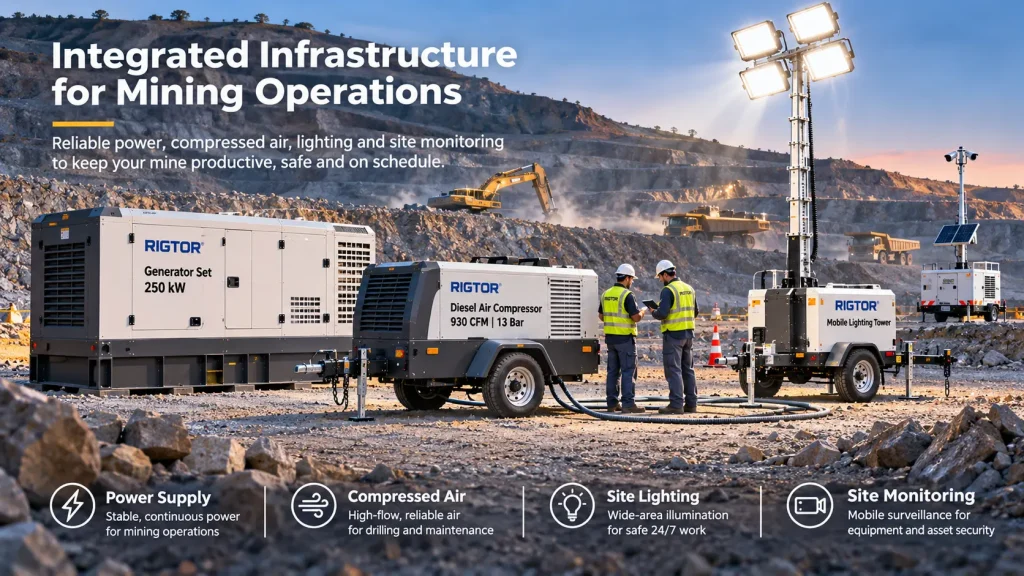
Before production or construction activities begin, contractors may need to arrange temporary electrical distribution, position compressors, establish lighting, and test the equipment.
When these systems arrive separately or require extensive field integration, deployment can take longer.
A compressor shutdown can interrupt pneumatic equipment. A generator failure can affect temporary electrical loads. Inadequate lighting may prevent planned nighttime work from proceeding safely.
The operational impact depends on whether the affected equipment is critical to the project.
Mining environments expose equipment to dust, vibration, variable temperatures, and extended operating hours.
Remote sites may also have limited access to spare parts and qualified technicians.
Consequently, maintenance planning and equipment accessibility can be just as important as initial machine specifications.
As mining advances, contractors may need to reposition compressors, lighting towers, and temporary generators.
Transport dimensions, lifting points, connection arrangements, and commissioning procedures influence the time required for each move.
Rather than selecting every machine independently, RIGTOR can help customers plan the required equipment around the actual operating conditions.
Temporary generators provide electrical power for appropriately sized field equipment, maintenance facilities, site offices, and other loads.
Generator selection must consider starting currents, load variation, environmental conditions, and the required operating duty.
Diesel, solar, and hybrid lighting configurations can be evaluated according to operating hours, lighting requirements, and available energy resources.
For mining applications, tower placement should be based on photometric performance, ground conditions, glare control, and approved wind limits.
Portable diesel compressors provide independent compressed air for compatible pneumatic tools and drilling equipment.
RIGTOR's discussed product range includes compact models such as 70 CFM units and larger configurations such as 930 CFM / 13 Bar and 1250 CFM / 35 Bar.
Actual airflow, pressure, and engine matching must be verified for each selected configuration.
A 70 CFM compressor may be appropriate for selected maintenance tools, while high-volume drilling operations can require substantially larger compressors.
Mobile surveillance trailers can support temporary observation of remote equipment yards, storage areas, and site access points.
Camera coverage, communications availability, power autonomy, and environmental protection must be planned for each location.
The main opportunity is to reduce unnecessary field integration.
For example, a contractor deploying a new drilling support area may otherwise need to coordinate several separate equipment deliveries, arrange temporary power connections, position lighting, and conduct multiple commissioning activities.
A coordinated equipment plan can simplify this process.
Stage 1 — Site Assessment
Review electrical loads, compressed-air demand, working pressure, operating hours, lighting requirements, access roads, environmental conditions, and site safety requirements.
Stage 2 — Equipment Configuration
Select generator capacity, compressor output, lighting tower configuration, and any required monitoring equipment.
Stage 3 — Pre-Delivery Preparation
Where included in the agreed scope, complete factory inspections, equipment checks, documentation preparation, and configuration verification before shipment.
Stage 4 — Site Deployment
Position equipment, establish safe electrical and air connections, stabilize lighting towers, and conduct commissioning checks.
Stage 5 — Maintenance Planning
Prepare service schedules, identify critical spare parts, and establish troubleshooting procedures.
This approach does not eliminate the need for qualified site installation or commissioning. Its value is in reducing avoidable coordination problems and preparing the equipment for the intended application.
The following is a modeled project scenario, not a documented RIGTOR customer installation. Equipment quantities, timelines, and costs are assumptions used to demonstrate how a mining contractor could evaluate a deployment.
A hypothetical mining contractor is developing a new working area at a remote open-pit mine.
The contractor needs temporary infrastructure for equipment maintenance, selected pneumatic operations, and nighttime work.
The project is expected to operate for 12 months, with equipment relocated as the working area changes.
The contractor faces three operational problems:
| Equipment | Illustrative Configuration | Intended Function |
|---|---|---|
| Diesel Generator | 50 kW class, subject to load study | Temporary electrical supply |
| Mobile Lighting Towers | 2 × 7m towers with 4 × 400W LED fixtures each | Selected nighttime work areas |
| Diesel Screw Compressor | 930 CFM / 13 Bar class, subject to air-demand verification | Compatible pneumatic operations |
| Mobile Surveillance Trailer | 1 unit, configuration to be determined | Temporary equipment-yard monitoring |
The 930 CFM compressor is selected for this illustration only. The actual compressor would need to match the site's tools and pressure requirements.
The 50 kW generator is likewise a planning assumption, not a confirmed project requirement.
Step 1 — Engineering Review
The contractor supplies an electrical load list, pneumatic equipment specifications, working-area drawings, and expected operating schedule.
RIGTOR reviews the equipment configuration and identifies outstanding technical requirements.
Step 2 — Equipment Preparation
The equipment is inspected against the agreed specifications. Operating manuals, maintenance information, and spare-parts references are prepared.
Step 3 — Delivery Coordination
The customer and supplier agree on delivery sequence, lifting requirements, unloading arrangements, and commissioning responsibilities.
Step 4 — Installation and Commissioning
Qualified site personnel position and stabilize the equipment, establish connections, and complete the required operational and safety checks.
Step 5 — Ongoing Support
Maintenance personnel use the agreed inspection schedule and spare-parts plan to manage routine servicing and troubleshooting.
The following comparison assumes the contractor is evaluating two procurement and deployment approaches.
Option A: A conventional multi-supplier package using established European or American equipment brands.
Option B: A coordinated RIGTOR equipment package with pre-planned interfaces and documentation.
Both options are assumed to satisfy the same technical and safety requirements.
| Deployment Activity | Option A | Option B |
|---|---|---|
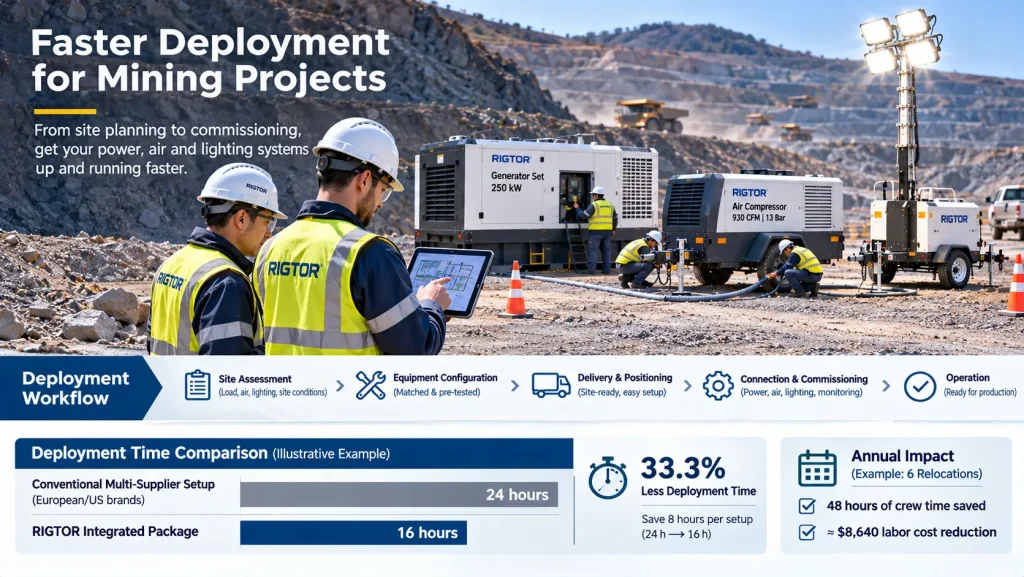
| Delivery coordination and equipment checks | 6 hours | 4 hours |
| Positioning and connections | 10 hours | 6 hours |
| Testing and commissioning | 8 hours | 6 hours |
| Total site work | 24 hours | 16 hours |
<text>Modeled deployment labor reduction: 8 hours, or 33.3%.</text>
This example assumes equal crew sizes and no differences in site access or regulatory requirements.
The reduction comes from better preparation and coordination, not from an inherent speed advantage of one equipment brand.
Suppose the contractor carries out six comparable deployments or major relocations during the year.
| Metric | Modeled Result |
|---|---|
| Time saved per deployment | 8 hours |
| Number of deployments | 6 |
| Total crew time saved | 48 hours |
| Crew size | 3 technicians |
| Labor rate | $60 per technician-hour |
| Estimated labor savings | $8,640 |
If these activities are on the project's critical path, the reduced deployment time may also support an earlier start to planned work.
However, labor-hours saved and calendar-days saved are different measures. A 48-hour reduction in total deployment work does not automatically mean the mine finishes six days earlier.
A meaningful comparison must consider total ownership cost rather than purchase price alone.
European and American equipment manufacturers offer established product lines, service networks, and technical support capabilities.
RIGTOR's potential commercial advantage must therefore be evaluated through a like-for-like comparison of:
For this example, assume the contractor compares the same four-module equipment package under two maintenance plans.
| Annual Cost Category | Conventional Package | RIGTOR Package |
|---|---|---|
| Filters, lubricants and routine consumables | $7,200 | $6,000 |
| Planned replacement parts | $5,800 | $4,800 |
| Maintenance labor | $9,600 | $8,400 |
| External service and travel | $6,400 | $4,800 |
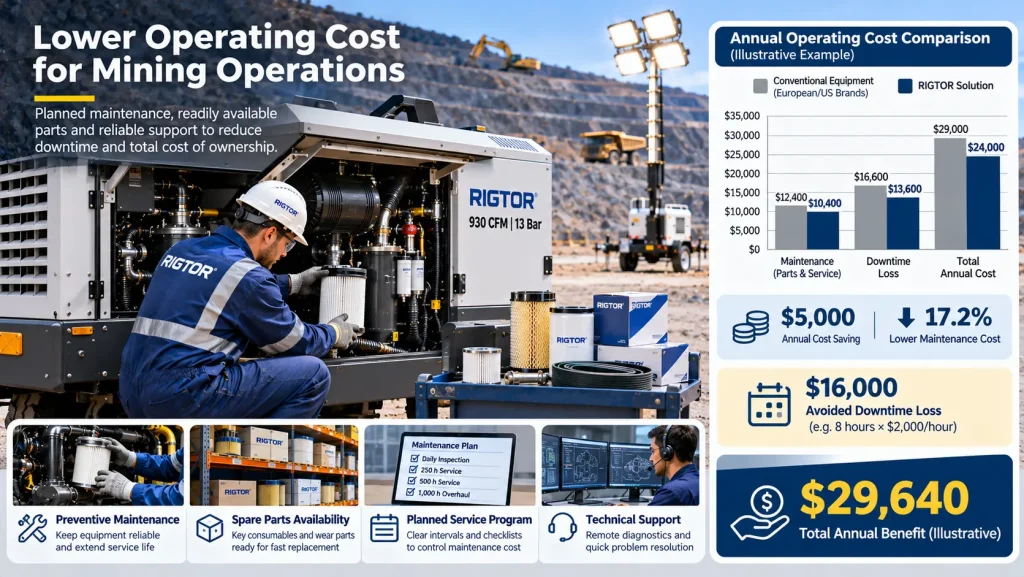
| Total Annual Maintenance Cost | $29,000 | $24,000 |
<text>Modeled annual maintenance saving: $5,000, or approximately 17.2%.</text>
These figures are hypothetical budget inputs, not RIGTOR quotations, verified maintenance records, or measured competitor costs.
The lower-cost scenario assumes compatible parts can be sourced economically and the site team can complete more routine work without external service visits.
It does not assume that RIGTOR equipment has longer service intervals or fewer failures.
For a remote mining contractor, a low-priced replacement part offers little benefit if it arrives too late.
A practical spare-parts package may include engine filters, compressor consumables, belts where applicable, sensors, electrical protection components, and other items identified through a failure-risk review.
The correct stock list should be based on the equipment's actual bill of materials and expected service conditions.
Equipment downtime can affect mining productivity, particularly when critical operations depend on a single machine.
Preventive maintenance, spare-parts availability, and clearly defined service procedures can help reduce the duration and consequences of failures.
Assume a mining support operation has an estimated interruption cost of $2,000 per hour.
If better maintenance preparation prevents or shortens a total of eight hours of production-impacting interruption during the year:
8 hours × $2,000/hour = $16,000
This is a modeled avoided-interruption value, not a demonstrated RIGTOR performance result.
It should be counted only when the downtime would actually have affected production or incurred measurable project costs.
A practical maintenance plan should include equipment-specific inspection procedures, spare-parts identification, fault diagnosis information, and defined escalation contacts.
For critical applications, the contractor should also consider standby equipment or redundancy.
No single maintenance plan can guarantee uninterrupted operation.
Combining the previous modeled figures:
| Cost-Saving Opportunity | Estimated Annual Value |
|---|---|
| Deployment and relocation labor | $8,640 |
| Routine maintenance and service | $5,000 |
| Avoided production-impacting downtime | $16,000 |
| Total Modeled Annual Benefit | $29,640 |
This total is conditional on all three benefits occurring and being independently measurable.
It excludes equipment purchase-price differences, fuel consumption, financing, freight, import duties, insurance, taxes, and residual value.
A complete procurement decision should compare these additional costs over the expected equipment life.
The strongest schedule benefit may come from making equipment available earlier when a new mining area is ready for work.
For example, if improved deployment coordination removes one full day from a critical-path mobilization, the contractor may be able to begin the affected operation one day earlier.
However, that result depends on site readiness, labor availability, permits, equipment commissioning, and the overall project schedule.
It should not be treated as a guaranteed outcome.
From a manufacturing and supply perspective, maintainability should be considered before equipment reaches the site.
Routine service points should be evaluated for safe access, including engine filters, compressor consumables, electrical panels, and cooling-system components.
Oversized equipment may create unnecessary capital and operating costs.
Undersized equipment may suffer poor productivity or be unsuitable for the application.
Correct sizing is therefore a major part of lifecycle cost control.
Equipment-specific manuals and spare-parts references help maintenance teams identify components and plan servicing.
Dust, altitude, ambient temperature, and operating duration must be considered during equipment selection.
For example, high-altitude operation may require engine derating, while dusty environments can increase filtration maintenance requirements.
Before procurement, customers should confirm which maintenance activities can be performed locally and which require specialist assistance.
A mining contractor should evaluate equipment over its complete ownership period.
A simplified total cost of ownership calculation is:
TCO = Acquisition + Transport + Installation + Fuel + Maintenance + Downtime + Disposal − Residual Value
A lower initial purchase price may be attractive.
However, poor equipment matching, unavailable spare parts, excessive fuel consumption, or long repair delays can offset the initial saving.
Conversely, a competitively priced equipment package with appropriate technical specifications and a workable maintenance plan may offer strong long-term value.
The comparison must be supported by actual quotations, fuel data, maintenance records, and service commitments.
Before selecting equipment, we recommend that mining contractors provide:
With this information, the equipment package can be evaluated against actual operating requirements rather than generic capacity ratings.
Mobile equipment can reduce the need for permanent infrastructure during temporary operations. Coordinated equipment preparation and clearly defined installation requirements can also reduce field integration work. Actual savings depend on the project.
That cannot be established without comparing specific models under equivalent operating conditions. RIGTOR can be evaluated on acquisition cost, parts, service access, fuel consumption, and total ownership cost.
The correct compressor depends on the pneumatic equipment. Small maintenance tools may use relatively low airflow, while high-pressure drilling applications can require substantially larger compressors.
Yes, when the lighting system is appropriately designed for the work area. Tower placement, illuminance, glare, stability, and site safety requirements must be evaluated.
Correct equipment sizing, preventive maintenance, critical spare-parts planning, trained technicians, and early identification of faults can help control maintenance expenditure.
A generator package must be sized to the actual loads. Temporary generators may support selected mining equipment and infrastructure, but powering an entire operation depends on its electrical requirements and the designed generation system.
A credible calculation requires deployment labor records, equipment purchase quotations, fuel consumption, maintenance expenditure, downtime records, and the value of affected operations.
For remote mining operations, reliable temporary infrastructure is essential to keeping projects moving.
Diesel generators, mobile lighting towers, portable air compressors, and mobile surveillance systems can support mining contractors as work areas expand or relocate.
From RIGTOR's perspective, the objective is not simply to supply equipment at a competitive purchase price.
It is to help customers select appropriate configurations, prepare for efficient deployment, and establish practical maintenance support.
The illustrative project in this guide shows how coordinated deployment and maintenance planning could create measurable financial value.
Actual results must be confirmed through project-specific engineering, quotations, and operating records.
Need temporary power, lighting, compressed air, or mobile surveillance for a remote mining project?
Share your site requirements, operating conditions, and equipment specifications with RIGTOR to discuss a coordinated equipment solution.

Behind Every Critical Project.
@ 2026-2026 Rigtor Industry. All Rights Reserved.
 EN
 ES
 PT
 AR