

Time: Oct 31 2026 Views: 6
A 7m diesel-powered mobile LED light tower with four 400W floodlights is a portable lighting solution designed for construction sites, mining operations, road maintenance, emergency response, and other outdoor locations without reliable access to electricity.
Combining a diesel generator, telescopic mast, and high-output LED floodlights, this type of mobile lighting tower provides elevated illumination for temporary work areas.
The configuration includes a 7-meter telescopic mast and four 400W LED floodlights, delivering a combined rated lighting power of 1,600 watts.
However, choosing the right lighting tower involves more than comparing mast height and LED wattage.
Buyers should also evaluate lighting coverage, illumination uniformity, fuel runtime, mast stability, transport requirements, maintenance accessibility, and operating costs.
This guide explains how a 7m diesel LED lighting tower works, where it is used, how to evaluate its performance, and how it compares with a 9m mobile lighting tower.
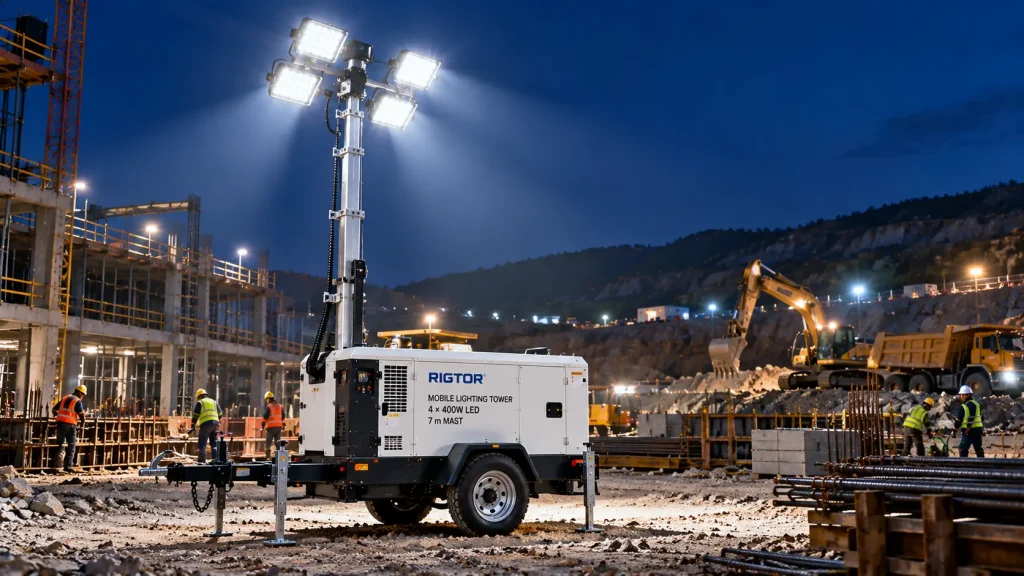
A 7m diesel LED light tower is a mobile outdoor lighting system that uses an onboard diesel generator to power elevated LED floodlights.
Its telescopic mast allows the lighting fixtures to be raised above ground level, helping distribute light across a larger work area.
The portable configuration makes it suitable for projects where lighting equipment must be relocated as work progresses.
| Parameter | Configuration |
|---|---|
| Product Type | Diesel-Powered Mobile LED Lighting Tower |
| Mast Height | 7 meters |
| Lighting Fixtures | 4 × 400W LED Floodlights |
| Total Rated LED Power | 1,600W |
| Power Source | Integrated Diesel Generator |
| Mast Design | Telescopic |
| Mobility | Portable Outdoor Configuration |
| Primary Applications | Construction, Mining, Roadwork, Emergency Response |
Specification note: The mast lifting mechanism, generator rating, engine model, fuel tank capacity, runtime, luminous flux, wind resistance, and trailer configuration must be confirmed for the specific model.
Diesel lighting towers are designed for locations where grid electricity is unavailable, unreliable, or impractical.
They provide an independent source of electricity for temporary lighting.
Compared with fixed lighting installations, portable diesel towers can be moved between construction zones, drilling sites, and temporary work areas.
This mobility is particularly valuable for contractors and rental companies.
A diesel lighting tower integrates several mechanical and electrical systems.
The diesel engine drives an electrical generator that supplies power to the LED lighting system.
The generator must provide sufficient output for the lighting load, starting characteristics, electrical losses, and any approved auxiliary loads.
Although the four LED floodlights have a combined nominal rating of 1,600W, the generator's required capacity depends on the complete electrical system.
The tower uses four LED floodlights to illuminate the surrounding work area.
Depending on the fixture design, the lights may be adjustable to direct illumination toward different working zones.
LED floodlights offer several potential advantages over traditional lighting technologies, including efficient light conversion, fast illumination, and reduced routine lamp replacement.
Actual performance depends on the selected LED fixtures and drivers.
The telescopic mast raises the lighting fixtures above the ground.
A higher mounting position can improve light distribution and reduce obstructions in certain site layouts.
Mast lifting mechanisms may include manual winches, electric systems, or hydraulic systems.
The actual lifting arrangement must be confirmed for the product being purchased.
Portable lighting towers may use trailer-mounted or other transportable configurations.
Where fitted, stabilizers or outriggers help support the equipment during operation.
The tower must be deployed according to the manufacturer's leveling, stabilization, and wind-limit instructions.
The control system manages generator and lighting operation.
Depending on the configuration, protection may include circuit breakers, engine shutdown protection, and electrical fault monitoring.
One of the most important questions from lighting tower buyers is:
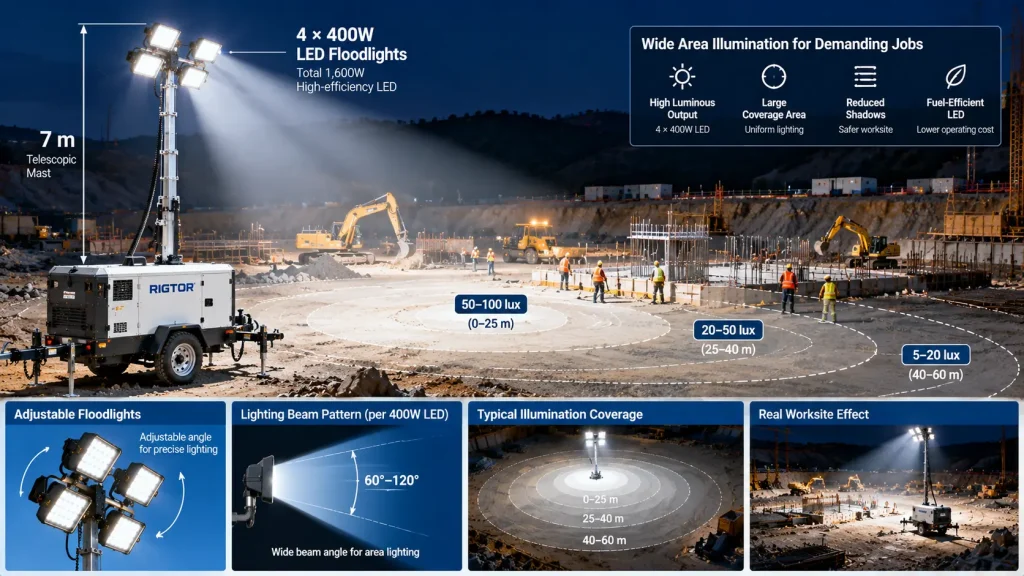
How much area can a 7m tower with four 400W LED lights cover?
The answer cannot be determined from wattage alone.
Wattage measures electrical power consumption.
Luminous flux, measured in lumens, describes the total visible light emitted by a source.
The combined electrical rating of four 400W fixtures is 1,600W.
However, the actual lumen output depends on the luminous efficacy of the complete LED fixtures.
For illustration, if a fixture achieved 130 lumens per watt, a 400W fixture would produce approximately 52,000 lumens.
Four such fixtures would produce approximately 208,000 lumens.
This is an illustrative calculation, not a verified luminous-flux rating for the RIGTOR lighting tower.
Effective lighting coverage depends on several factors:
A narrow beam can provide higher illuminance over a smaller area.
A wider beam may cover more ground but distribute the available light less intensely.
Lux measures illuminance at a surface.
One lux equals one lumen per square meter.
For industrial projects, lighting requirements should be based on the actual task and applicable workplace lighting standards.
General site circulation, equipment maintenance, and detailed assembly work may require different illumination levels.
Buyers should request a lighting distribution diagram or photometric report showing the expected illuminance at different distances.
This is more useful than a single marketing claim about maximum coverage area.
A properly designed lighting layout considers both average illuminance and uniformity.
Construction projects frequently require temporary lighting during early morning, evening, or overnight operations.
A portable lighting tower can illuminate work zones, material-handling areas, equipment access routes, and temporary construction facilities.
The 7m mast offers an elevated mounting position while remaining a relatively compact configuration.
Mining and quarry operations often take place in remote areas where permanent electrical infrastructure is limited.
Diesel lighting towers can provide temporary illumination around equipment service areas, material handling zones, and selected work locations.
For large open areas, several towers may be required to achieve appropriate coverage and uniformity.
Road maintenance crews often work at night to reduce traffic disruption.
A portable lighting tower can provide illumination for pavement repairs, roadside maintenance, and temporary work zones.
Deployment must account for traffic safety, glare, equipment stability, and worker visibility.
Emergency operations may require lighting in locations affected by power interruptions or damaged infrastructure.
A diesel lighting tower can provide independent temporary illumination for response teams and support areas.
Fuel availability, deployment time, and maintenance readiness are particularly important in these situations.
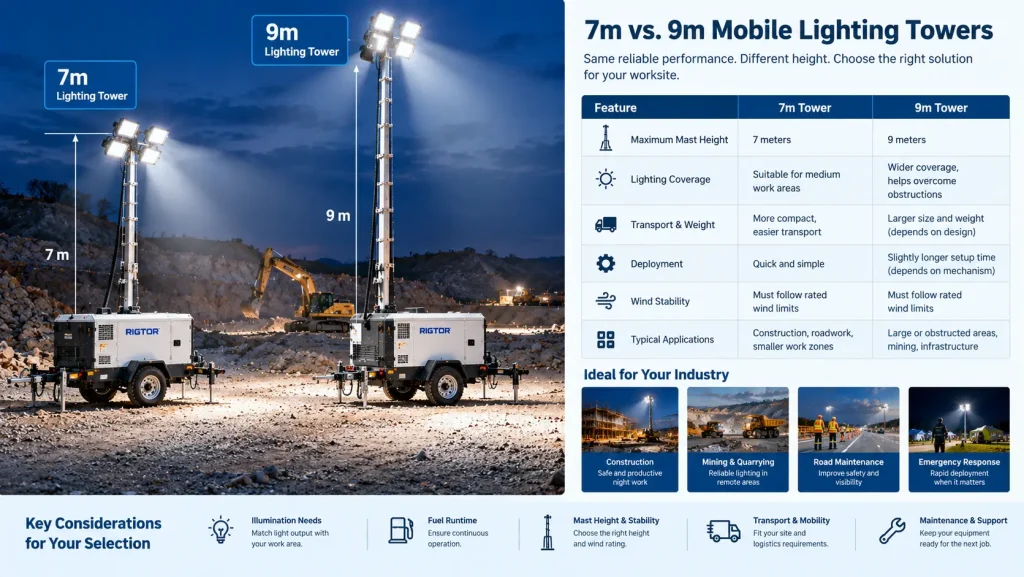
Both 7m and 9m lighting towers are used for temporary outdoor illumination.
The main difference is the available mounting height.
However, a taller mast does not automatically mean a better lighting system.
| Selection Factor | 7m Lighting Tower | 9m Lighting Tower |
|---|---|---|
| Maximum Mast Height | 7 meters | 9 meters |
| Typical Positioning | Compact temporary lighting | Higher-elevation area lighting |
| Light Distribution | Depends on fixture output and beam angle | Depends on fixture output and beam angle |
| Transport Considerations | May support a more compact design | Depends on collapsed mast and trailer design |
| Deployment | Depends on lifting mechanism and stabilizers | Depends on lifting mechanism and stabilizers |
| Wind Stability | Must follow rated wind limits | Must follow rated wind limits |
| Suitable Projects | Construction, roadwork, smaller work zones | Larger or more obstructed work areas where height helps |
A 9m tower places its lights two meters higher than a 7m tower.
This can help distribute light over obstacles and potentially support wider illumination patterns.
However, the actual coverage depends on the fixture optics and aiming angles.
Increasing the mounting height changes the distance and angle between the light source and the illuminated surface.
For the same fixtures and aiming arrangement, raising the lights can reduce illuminance at certain locations while improving distribution elsewhere.
Therefore, higher mounting height should not be treated as an automatic improvement in brightness.
A 7m tower may be attractive where a compact equipment package is preferred.
However, transport dimensions depend on the collapsed mast, trailer, generator enclosure, and overall design.
Likewise, deployment time depends on whether the mast uses manual, electric, or hydraulic lifting.
A taller mast can introduce different wind-loading requirements.
The complete tower design, stabilizer arrangement, wind rating, and operating instructions determine safe use.
Buyers should compare verified wind limits rather than assume that one height is universally safer.
A 7m tower may be a practical choice for construction zones, road maintenance, equipment service areas, and projects where a compact mobile lighting solution is preferred.
A 9m tower may be worth considering when additional mounting height helps overcome site obstructions or improves the required lighting layout.
For both configurations, a photometric comparison using the intended LED fixtures provides the strongest basis for selection.
Fuel runtime is one of the most important purchasing factors for rental companies and contractors.
A lighting tower that can operate through the required work shift without refueling may reduce interruptions.
However, actual runtime depends on the complete generator system.
Fuel consumption is influenced by:
A simplified estimate is:
Estimated Runtime = Usable Fuel Capacity ÷ Average Fuel Consumption
For example, consider a hypothetical lighting tower with:
Estimated runtime:
60 ÷ 1.5 = 40 hours
These values are illustrative and do not represent verified specifications for the 7m RIGTOR lighting tower.
Actual runtime should be based on the manufacturer's fuel-consumption data and usable fuel capacity under the intended operating conditions.
LED fixtures can provide useful illumination with relatively low electrical power compared with certain older lighting technologies.
However, actual fuel savings depend on the generator configuration and the lighting system being compared.
A diesel generator operating at a very low load may not achieve its best fuel efficiency.
Therefore, the generator and lighting load should be matched appropriately.
The telescopic mast is one of the most important structural components of a mobile lighting tower.
Before raising the mast, position the tower on suitable ground and deploy the stabilizers according to the manufacturer's instructions.
Never operate the mast above the manufacturer's approved wind limit.
Wind ratings may differ depending on mast height, fixture configuration, and stabilizer deployment.
Inspect the area for overhead power lines, structures, and other obstacles before raising the mast.
Maintain the required electrical clearances.
Inspect the mast sections, lifting cables or hydraulic components, locking devices, and mounting connections according to the maintenance instructions.
Lower and secure the mast before moving the equipment.
The tower must not be transported with the mast extended unless specifically designed and approved for such operation.
Regular maintenance helps keep the generator, mast, and lighting system ready for field operation.
| Component | Maintenance Focus |
|---|---|
| Diesel Engine | Engine oil, filters, coolant where applicable, fuel system |
| Generator | Electrical connections, insulation condition, output checks |
| LED Floodlights | Lens cleanliness, mounting brackets, electrical connections |
| Telescopic Mast | Mast sections, lifting mechanism, locking devices |
| Trailer and Stabilizers | Tires where fitted, supports, fasteners, structural condition |
| Fuel System | Fuel quality, leaks, filters and tank condition |
| Electrical Controls | Switches, circuit breakers, warning indicators |
| Cooling and Ventilation | Airflow passages, radiator where fitted, debris removal |
Before operation, inspect the fuel level, visible leaks, mast condition, electrical cables, fixture mounts, stabilizers, and control indicators.
Follow the diesel engine, generator, and lighting tower manuals for maintenance intervals.
Do not assume that all diesel lighting towers have the same engine service schedule.
LED fixtures generally require less routine lamp replacement than some conventional lighting systems.
However, lenses, seals, mounting hardware, drivers, and wiring still require inspection.
The lifting mechanism should be inspected for wear, corrosion, damage, and correct operation.
Only qualified personnel should repair structural or lifting-system defects.
Possible causes include electrical supply faults, circuit protection trips, loose connections, driver problems, or fixture failure.
Verify the generator output and electrical controls before replacing components.
Possible causes include fuel-system problems, engine protection faults, overheating, or electrical issues.
Review the engine and controller fault information.
Potential causes depend on the lifting mechanism.
These may include mechanical obstruction, cable or winch problems, hydraulic faults, or damaged locking components.
Do not force a defective lifting system.
Uneven coverage may result from incorrect fixture aiming, unsuitable beam angles, site obstructions, or insufficient lighting equipment.
Adjust the lighting layout based on actual work-area requirements.
Possible causes include generator-load mismatch, engine maintenance problems, unnecessary auxiliary loads, or incorrect operating conditions.
Compare measured fuel consumption with the manufacturer's rated data.
International buyers should evaluate maintenance and service requirements before purchasing a mobile lighting tower.
Confirm the installed engine model and availability of compatible oil filters, fuel filters, belts, and other service parts.
Ask whether individual LED fixtures, drivers, lenses, and electrical connectors can be replaced.
Confirm availability of lifting cables, winch components, hydraulic parts where applicable, mast locks, and structural service parts.
Request wiring diagrams, generator documentation, controller instructions, and spare-parts information.
Obtain written warranty terms and clarify the process for technical support, spare-parts identification, and warranty claims.
Before purchasing, buyers should evaluate the following factors:
For projects involving multiple lighting towers, the layout should be planned to minimize dark areas, excessive glare, and unnecessary overlap.
A 7m diesel LED lighting tower provides temporary outdoor illumination for construction sites, mining operations, road maintenance, emergency response, and other locations where fixed electrical lighting is unavailable or impractical.
Four 400W LED floodlights have a combined nominal electrical power of 1,600W. The actual luminous flux and effective lighting coverage depend on the fixtures' performance and optical design.
Coverage depends on luminous flux, beam angle, mast height, fixture orientation, required lux level, and site conditions. Buyers should request photometric data rather than rely only on wattage.
A 7m tower may suit projects prioritizing compact temporary lighting. A 9m tower provides additional mounting height that may help in certain site layouts. The better choice depends on illumination requirements, transport conditions, and the actual tower design.
Runtime depends on usable fuel capacity, engine fuel consumption, generator load, and operating conditions. Buyers should request verified runtime data for the intended lighting configuration.
Only within the manufacturer's specified wind limits and deployment conditions. Proper stabilizer use and mast positioning are essential. The mast should be lowered when required by the operating instructions.
Maintenance includes diesel engine servicing, generator inspection, LED fixture checks, mast and lifting-system inspection, fuel-system maintenance, and examination of stabilizers and electrical controls.
Rental companies should evaluate transportability, ease of deployment, fuel runtime, maintenance access, replacement-part availability, operating safety, equipment durability, and the total cost of ownership.
A 7m diesel-powered mobile LED lighting tower with four 400W floodlights offers a portable solution for temporary outdoor illumination.
Its combination of a telescopic mast, onboard diesel generator, and 1,600W nominal LED lighting capacity makes it relevant to construction, mining, road maintenance, and emergency operations.
However, reliable lighting performance depends on more than mast height and electrical wattage.
Buyers should evaluate verified luminous flux, photometric coverage, fuel runtime, mast stability, transport requirements, and maintenance support.
When comparing 7m and 9m lighting towers, the correct choice depends on the worksite layout and lighting requirements rather than mast height alone.
The best mobile lighting tower is the one that provides the required illumination safely and efficiently under actual operating conditions.
RIGTOR provides mobile lighting solutions for temporary construction, mining, infrastructure maintenance, and other field operations.
Contact our team with your required lighting area, mast height, operating hours, and project conditions to discuss an appropriate diesel-powered lighting tower configuration.

Behind Every Critical Project.
@ 2026-2026 Rigtor Industry. All Rights Reserved.
 EN
 ES
 PT
 AR