
Time: Nov 3 2026 Views: 3
Application-Based Compressor Selection, DTH Drilling Requirements, Field Equipment Layout and Factory Manufacturing Solutions
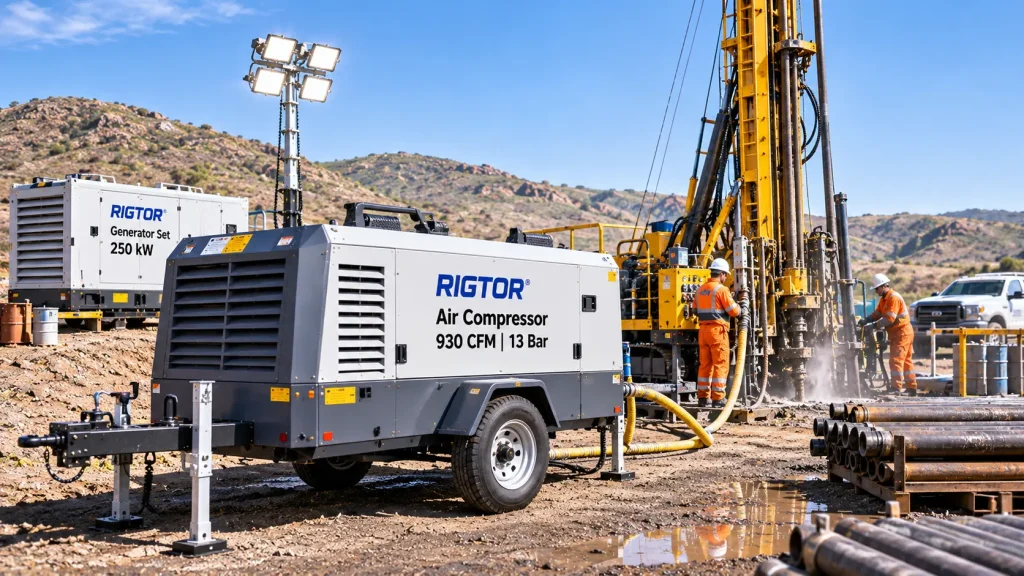
Water well drilling and mineral exploration projects frequently operate in remote locations where reliable compressed air and independent power are essential.
For contractors using down-the-hole (DTH) drilling systems, the air compressor is one of the most important pieces of equipment on site.
It provides compressed air to operate the DTH hammer and transport drill cuttings out of the borehole.
However, selecting a drilling compressor is not simply a matter of choosing the highest CFM or the highest working pressure.
The required compressor capacity depends on several factors:
An incorrectly matched compressor can reduce drilling efficiency, increase operating costs or prevent the drilling system from performing as intended.
RIGTOR approaches drilling equipment supply from a manufacturer's perspective: evaluate the drilling application, identify the required pressure and airflow, select a compatible compressor configuration and verify the equipment specifications before delivery.
In addition to diesel screw air compressors, RIGTOR supplies diesel generators, mobile lighting towers and surveillance systems that can support remote drilling projects.
This article explains how these systems can be configured around the requirements of water well and exploration drilling contractors.
Water well drilling and exploration drilling are not identical operations.
The drilling method, borehole conditions and equipment requirements can vary significantly.
| Drilling Application | Main Operating Requirements | Equipment Selection Priorities |
|---|---|---|
| Domestic Water Wells | Variable depth and ground conditions | Compressor mobility, appropriate airflow and pressure |
| Agricultural Water Wells | Larger water supply requirements | Drilling method, borehole diameter, operating efficiency |
| Industrial Water Wells | Project-specific depth and diameter | Continuous-duty suitability and drilling capacity |
| Mineral Exploration Drilling | Formation-dependent drilling methods | Compressor compatibility with drilling system |
| Geotechnical Investigation | Borehole sampling and investigation | Correct equipment for selected drilling method |
| Remote Drilling Camps | Temporary power and site support | Generator, lighting and maintenance logistics |
Compressed-air equipment is particularly relevant to air drilling and DTH drilling.
Other drilling methods, including certain rotary mud, diamond core and sonic drilling systems, have different primary equipment requirements.
RIGTOR's compressor recommendations must therefore begin with the actual drilling method.
In a typical DTH drilling system, compressed air is delivered from the surface compressor through the drill string to the hammer.
The air drives the hammer mechanism and helps carry rock cuttings toward the surface.
Air pressure must be sufficient for the hammer's specified operating requirements after accounting for pressure losses.
Higher pressure is not automatically better.
The hammer, drill string and all pressure-containing components must be suitable for the selected operating pressure.
Airflow must support the hammer's air consumption and adequate removal of drill cuttings.
Insufficient airflow may result in poor hole cleaning, increased drilling difficulty and reduced performance.
A compressor capable of delivering a high volume of air at relatively low pressure may not operate a high-pressure DTH hammer.
Conversely, a compressor designed for high pressure may not provide sufficient airflow for a large-diameter drilling application.
The correct compressor is selected at a defined operating point:
Required Delivered Airflow at Required Working Pressure
This is why complete compressor performance data is more useful than a single nominal CFM figure.
CFM describes volumetric airflow.
For drilling applications, the rated free air delivery (FAD), its reference conditions and the operating pressure should be confirmed.
A compressor's nominal displacement should not be confused with verified delivered airflow.
Pressure must match the requirements of the drilling equipment.
For reference:
These are approximate gauge-pressure conversions when Bar values are expressed as barg.
Larger boreholes generally require more air for cuttings transport, although actual demand depends on the drilling method and annular geometry.
Greater depth can increase the complexity of air delivery and cuttings removal.
However, drilling depth alone does not determine compressor pressure.
Groundwater inflow, hammer requirements, formation conditions and drill-string losses must also be considered.
The diesel engine must provide sufficient power for the compressor at the specified pressure and airflow.
Engine-airend matching is particularly important for high-pressure compressor configurations.
High temperatures and altitude may affect engine output, compressor cooling and available air delivery.
The selected model must be checked against the actual site conditions.
Drilling projects may involve extended operating hours.
Engine ratings, cooling capacity, maintenance intervals and compressor operating limitations must be appropriate for the intended duty.
RIGTOR's portable diesel screw compressor portfolio includes different airflow and pressure classes.
The following table provides an application-oriented overview.
| Compressor Class | Potential Application | Important Verification |
|---|---|---|
| 70 CFM / 8 Bar | Small pneumatic tools and auxiliary tasks | Not generally a primary compressor for larger DTH drilling |
| 185 CFM Class | Selected pneumatic tools and smaller air-demand tasks | Confirm rated pressure and tool compatibility |
| 285 CFM / 10 Bar | Selected lower-pressure drilling or auxiliary applications | Verify hammer airflow and pressure requirements |
| 930 CFM / 13 Bar | Higher-airflow drilling applications where pressure requirements permit | Confirm simultaneous rated FAD at 13 Bar |
| 1,250 CFM / 35 Bar | Specialized high-pressure, high-air-demand drilling applications | Verify rated FAD at 35 Bar, engine power and complete system suitability |
Important: These are equipment classes for engineering evaluation, not universal drilling recommendations.
The simultaneous airflow and pressure ratings of the selected model must be confirmed through its technical datasheet and applicable test information.
Deep or demanding DTH drilling applications may require higher operating pressure.
However, increasing pressure also increases the power demand on the compressor system.
For high-pressure units, RIGTOR's engineering review should consider:
A high-pressure compressor should be selected as a complete engineered system rather than by engine brand or maximum pressure alone.
The following is a hypothetical project used to explain equipment selection. It is not a documented RIGTOR customer installation.
A water well drilling contractor is working in a remote agricultural region.
The project involves multiple boreholes with variable geological conditions.
The contractor uses a DTH drilling rig for suitable rock formations.
| Parameter | Illustrative Requirement |
|---|---|
| Application | Agricultural water well drilling |
| Drilling Method | DTH drilling |
| Planned Borehole Diameter | Approximately 200 mm |
| Target Depth | Approximately 180 m |
| Operating Schedule | 10 hours/day |
| Site Conditions | Remote location with limited utility power |
| Support Equipment | Temporary power, lighting and equipment monitoring |
The diameter and depth are illustrative and do not establish the required compressor capacity.
The contractor provides the hammer manufacturer's performance information.
For this hypothetical example, assume the selected drilling system requires approximately:
These are illustrative input requirements, not universal specifications for a 200 mm borehole or a 180 m drilling depth.
The contractor and equipment engineers evaluate pressure losses through the hoses, drill string and other components.
The compressor outlet pressure may need to exceed the pressure required at the hammer.
The required margin must be calculated rather than assumed.
A 930 CFM / 13 Bar class compressor could be considered for preliminary review.
However, its suitability depends on whether the selected model can actually deliver the required airflow at the necessary compressor outlet pressure under site conditions.
If the pressure margin or delivered airflow is insufficient, a different compressor configuration is required.
The contractor provides ambient temperature, altitude, operating hours and fuel availability.
The selected compressor must be checked for applicable derating and cooling limitations.
Before finalizing the equipment order, RIGTOR and the customer review the compressor's verified operating point, engine configuration, control system and service requirements.
The final recommendation must be supported by model-specific performance data and the drilling equipment manufacturer's requirements.
Although the air compressor is the primary focus of this application, remote drilling projects may require additional equipment.
Generators can provide power for temporary offices, lighting auxiliaries, communications, selected pumps and maintenance equipment.
The drilling rig's own power requirements must be reviewed separately.
A generator should not be assumed capable of powering a complete drilling rig without a verified electrical load schedule.
Lighting towers can support evening operations, equipment servicing and access routes.
RIGTOR offers diesel, solar and hybrid configurations.
For example, a 7m lighting tower with four 400W LED floodlights has a nominal lighting load of 1,600W.
Actual lighting coverage must be determined from photometric performance and the site layout.
Remote drilling sites may contain compressors, generators, fuel systems, drilling tools and spare parts.
Mobile surveillance equipment can support monitoring of designated storage areas and access points.
Communications coverage, power autonomy and environmental conditions must be evaluated.
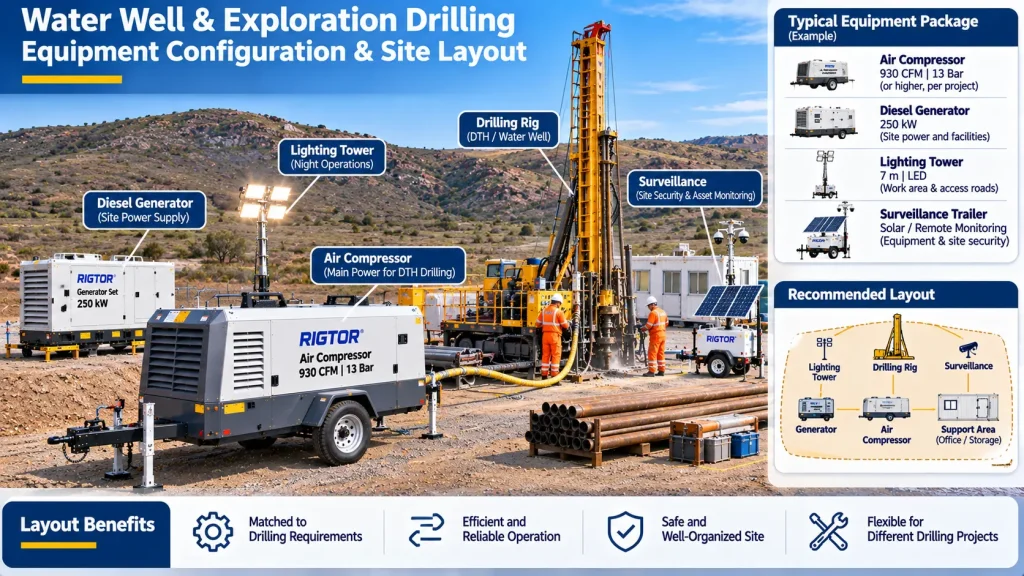
Based on the illustrative project, the following package may be considered.
| Equipment | Preliminary Configuration | Intended Function |
|---|---|---|
| Diesel Air Compressor | 930 CFM / 13 Bar class | Supply the selected DTH drilling system, subject to verification |
| Diesel Generator | 20–30 kW class | Power selected support facilities and equipment |
| Mobile Lighting Tower | 1 × 7m diesel LED tower | Support selected nighttime work areas |
| Mobile Surveillance Trailer | 1 unit, if required | Monitor equipment storage and site access |
This package is an engineering discussion example.
It must not be interpreted as a confirmed equipment match or a fixed drilling solution.
The compressor selection depends on verified delivered airflow, operating pressure and drilling conditions.
Correct equipment placement supports drilling operations, maintenance access and site safety.
The drilling contractor should develop a layout that accounts for the drilling rig, air compressor, generator, lighting tower, fuel arrangements and access routes.
                REMOTE WATER WELL DRILLING SITE
                       (NOT TO SCALE)

              ┌──────────────────────────┐
              │       DRILLING RIG       │
              │                          │
              │   Borehole / DTH Hammer  │
              └────────────┬─────────────┘
                           │
                    Drill String
                           │
                 Compressed-Air Line
                           │
              ┌────────────▼─────────────┐
              │    DIESEL AIR COMPRESSOR │
              │       930 CFM CLASS     │
              └──────────────────────────┘

  ┌──────────────────┐     ┌──────────────────┐
  │ DIESEL GENERATOR │     │ MOBILE LIGHTING  │
  │ Support Power    │     │ TOWER            │
  └──────────────────┘     └──────────────────┘

  ┌──────────────────┐     ┌──────────────────┐
  │ SPARE PARTS /    │     │ SURVEILLANCE /   │
  │ SERVICE AREA     │     │ SITE ACCESS      │
  └──────────────────┘     └──────────────────┘

              VEHICLE ACCESS / EQUIPMENT ROUTE
The drawing illustrates functional relationships only.
Final positions, clearances, hose routes and safety controls must be established by the drilling contractor according to actual site conditions.
The compressor should be located where the air line can be routed safely to the drilling rig.
Long hoses and unnecessary restrictions can create pressure losses.
The contractor should evaluate the hose diameter, length, pressure rating and connection arrangements.
Equipment placement must consider moving drill strings, rotating machinery, lifting operations and designated exclusion zones.
Diesel compressors and generators require appropriate airflow for combustion and cooling.
Exhaust should be directed away from occupied work areas and air intakes.
Technicians need access to filters, service panels, lubrication points and other maintenance locations.
Hoses and cables should be routed away from vehicle movements and mechanical hazards wherever possible.
Lighting towers should illuminate the required work area without creating excessive glare for drill operators.
Ground stability, mast clearance and wind conditions must be considered.
Fuel storage and refueling procedures must comply with applicable environmental and site safety requirements.
Special care is required near water sources and environmentally sensitive areas.
As an equipment manufacturer, RIGTOR's responsibility is to translate drilling requirements into an appropriate machine configuration.
The customer provides:
The diesel engine must provide sufficient output to operate the compressor at the required duty point.
For high-pressure models, the engine-airend relationship is particularly important.
A technically appropriate design must consider operating pressure, delivered airflow, efficiency, thermal load and engine performance.
Compressors operating in high ambient temperatures require suitable cooling capacity.
Cooling performance must be evaluated under the selected model's rated conditions.
The compressor's pressure-control components and protective devices must be appropriate for the specified working pressure.
Depending on the model and transport requirements, RIGTOR can review skid or trailer configurations.
The final arrangement must consider weight, dimensions, towing requirements, stability and service access.
Potential options, subject to model availability and engineering review, may include:
Not every option is available for every compressor model.
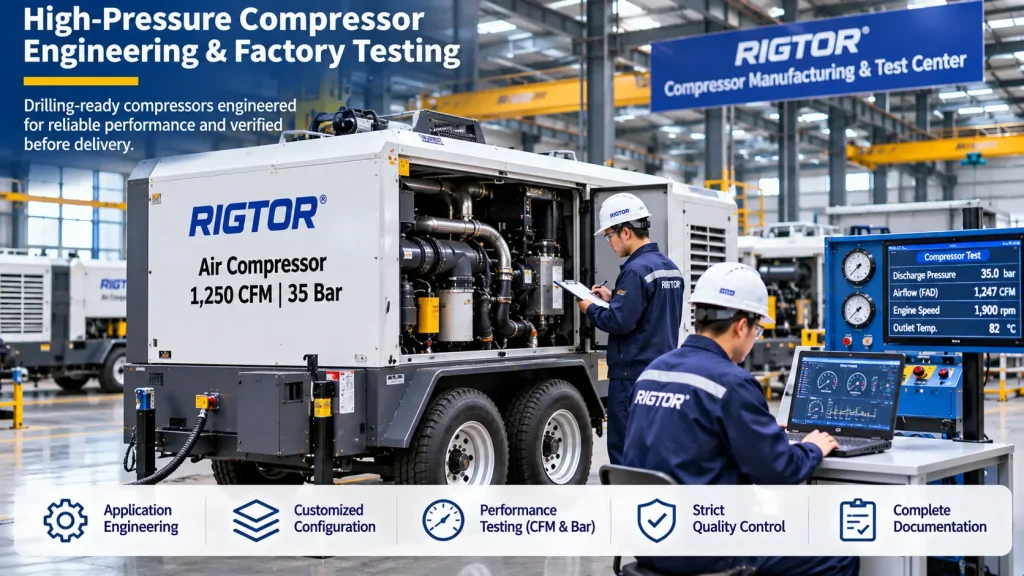
Drilling contractors rely on compressors operating under demanding conditions.
For that reason, factory verification is an important part of the purchasing process.
Relevant checks may include:
Manufacturing checks should address applicable mechanical, electrical and pressure-system requirements.
Depending on the model and agreed test procedure, the factory inspection plan may include:
Pressure Verification
Confirm pressure-control operation and relevant protective functions.
Airflow Performance
Verify delivered airflow at the specified operating point using an appropriate measurement method.
Temperature Monitoring
Check operating temperatures during the agreed test conditions.
Control System Verification
Confirm starting, stopping, alarms and applicable control functions.
Leak Inspection
Inspect relevant air and fluid connections.
Customers should agree in advance on the required inspection records, performance reports, operating manuals and spare-parts documentation.
A compressor should not be represented as delivering its nominal CFM at its nominal maximum pressure unless this is supported by the applicable rated performance data.
Remote drilling projects may be located far from equipment service facilities.
Preventive maintenance and spare-parts planning are therefore particularly important.
Dusty drilling environments can increase the importance of intake-filter inspection and maintenance.
Compressor lubricant and engine oil must be maintained according to the applicable equipment requirements.
Radiators, coolers and airflow passages should be inspected for contamination and restrictions.
Oil-injected screw compressors require appropriate air/oil separation and related maintenance.
High-pressure hoses, fittings and connections must be inspected and maintained according to their ratings and applicable safety requirements.
Depending on the selected model, the contractor may prepare stocks of:
RIGTOR can discuss the required spare-parts list during equipment procurement.
Specific availability, pricing and lead times should be confirmed for each model.
The lowest purchase price does not necessarily produce the lowest operating cost.
Drilling contractors should evaluate:
Assume a compressor operates:
Annual fuel consumption:
35 × 10 × 250 = 87,500 liters.
Annual fuel cost:
87,500 × $1.20 = $105,000.
These are hypothetical figures, not RIGTOR compressor performance claims.
Actual fuel consumption depends on the selected compressor, pressure, airflow demand, engine efficiency and operating conditions.
An oversized compressor may create unnecessary acquisition and operating costs.
An undersized compressor may limit drilling performance.
The correct equipment should be selected around the required operating point and expected duty.
RIGTOR supplies diesel screw compressors and complementary field infrastructure equipment.
Our approach emphasizes several areas relevant to drilling contractors.
Equipment evaluation starts with the drilling method, hammer requirements and operating conditions.
Different pressure and airflow classes allow customers to evaluate configurations for different applications.
Available engine, control, mounting and other configuration options can be reviewed according to the project requirements.
Inspection and testing requirements can be agreed as part of the equipment order.
Generators, lighting towers and surveillance systems can be supplied for suitable remote drilling support applications.
Technical documentation and spare-parts requirements can be discussed before delivery.
For drilling contractors, the objective is to obtain equipment that matches the job rather than selecting machinery based on nominal capacity alone.
Water well and exploration drilling operations require equipment selected around the actual drilling method and site conditions.
For DTH drilling, the diesel air compressor is a critical component.
Its delivered airflow and working pressure must match the hammer, drill string and borehole requirements.
RIGTOR approaches compressor supply from a manufacturing and application-engineering perspective.
We review the customer's drilling requirements, evaluate suitable compressor configurations, discuss factory options and establish appropriate inspection requirements.
Diesel generators, lighting towers and surveillance systems can also support remote drilling operations where required.
The objective is to provide properly specified equipment for the drilling application—not simply the largest available compressor.
The required compressor depends on the drilling method, DTH hammer specifications, borehole diameter, depth, groundwater conditions and pressure losses. The final selection must be based on delivered airflow at the required pressure.
A 930 CFM class compressor may be considered for certain drilling applications, but suitability depends on its verified delivered airflow at the required pressure and the drilling system's actual demand.
CFM describes airflow, while Bar describes pressure. DTH drilling requires both sufficient airflow and sufficient pressure at the operating point.
Not necessarily. Pressure requirements depend on the hammer, groundwater conditions, pressure losses and drilling method. Depth is one factor, not the sole determining factor.
Such a compressor class may be relevant to specialized high-pressure drilling, but the actual model must be verified for simultaneous airflow and pressure, engine performance and compatibility with the drilling equipment.
RIGTOR can review requirements involving engine selection, pressure and airflow configurations, mounting arrangements and controls, subject to the selected model and engineering feasibility.
Depending on the project, diesel generators, mobile lighting towers and temporary surveillance systems may support site operations alongside the primary drilling equipment.
Placement should consider air hose routing, pressure losses, exhaust, ventilation, moving machinery, maintenance access and the site's safety plan.
Relevant checks include delivered airflow at the required pressure, pressure-control functions, operating temperatures, leaks and protective systems. Testing conditions and acceptance criteria should be documented.
Correct sizing, preventive maintenance, appropriate operating practices, spare-parts planning and monitoring of actual fuel consumption can help control costs.
Diesel Air Compressors for Water Well, DTH and Selected Exploration Drilling Applications
Share your drilling method, hammer specifications, borehole requirements, operating conditions and required airflow and pressure.
RIGTOR can review suitable compressor configurations and complementary field equipment for your project.
Contact RIGTOR for a Drilling Compressor Configuration Proposal.

Behind Every Critical Project.
@ 2026-2026 Rigtor Industry. All Rights Reserved.
 EN
 ES
 PT
 AR