
Time: Nov 3 2026 Views: 2
Application-Based Equipment Selection, Pipeline Worksite Layout, Factory Customization and Technical Support
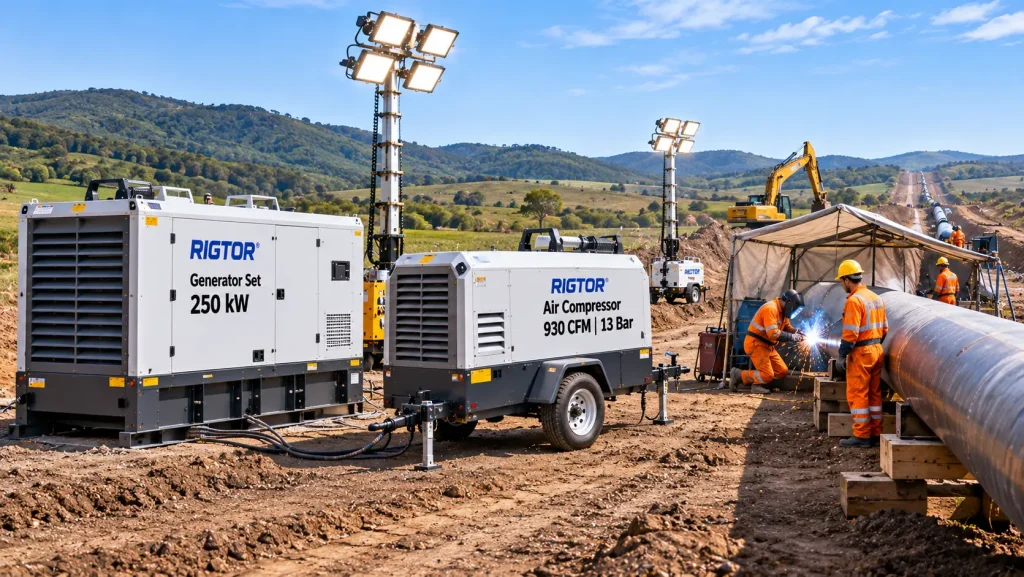
Pipeline construction and maintenance projects present a unique set of equipment challenges.
Unlike conventional construction sites, pipeline operations often extend across long distances, involve multiple temporary work zones and require equipment to be relocated as construction progresses.
Contractors may need temporary electrical power for welding equipment and support facilities, compressed air for selected tools and pipeline processes, mobile lighting for nighttime operations, and surveillance systems for equipment storage areas.
However, the equipment requirements vary significantly between pipeline installation, welding support, surface preparation, pressure testing, drying and routine maintenance.
A diesel compressor suitable for pneumatic tools may not provide the airflow, pressure or air quality required for pipeline drying. A generator sized only for continuous electrical loads may be unable to handle the starting characteristics of welding equipment or motors.
RIGTOR supplies diesel generator sets, portable diesel screw air compressors, mobile lighting towers and mobile surveillance systems for temporary pipeline field operations.
As an equipment manufacturer and supplier, our approach begins with the contractor's operating requirements.
We review the intended applications, determine the required equipment specifications, discuss appropriate configurations and define manufacturing and testing requirements before delivery.
This article explains how RIGTOR equipment can be selected and arranged to support pipeline construction and maintenance projects.
Pipeline projects consist of multiple stages, each with different equipment requirements.
| Pipeline Activity | Typical Equipment Requirements | Main Engineering Considerations |
|---|---|---|
| Right-of-Way Preparation | Temporary power, lighting and selected pneumatic tools | Mobility, access and environmental conditions |
| Pipe Installation & Welding | Generator sets and work-zone lighting | Welding load characteristics, power quality and duty |
| Surface Preparation & Coating | Compressed air and electrical power | Air quality, airflow, pressure and coating specifications |
| Pipeline Cleaning & Pigging | Specialized compressed-air systems where applicable | Pipeline volume, pig velocity, pressure and procedure |
| Pipeline Drying | Appropriate air supply and treatment equipment | Dew point, moisture removal, flow and operating pressure |
| Pipeline Pressure Testing | Project-specific testing equipment | Test medium, pressure limits, applicable codes and safety |
| Pipeline Repair & Maintenance | Portable power, compressors and lighting | Rapid deployment, tool compatibility and site access |
| Remote Equipment Storage | Surveillance and temporary power | Communications, monitoring coverage and autonomy |
Not every pipeline project requires all four RIGTOR product categories.
The appropriate equipment combination depends on the actual construction or maintenance activities.
Before recommending equipment, RIGTOR reviews the project's technical and operational requirements.
The customer provides information about:
For temporary power applications, the contractor should provide a complete electrical load schedule.
This includes welding equipment, auxiliary pumps, power tools, temporary facilities and other connected loads.
The customer identifies the actual compressed-air process, required delivered airflow, operating pressure and air quality.
Pipeline drying and cleaning may require additional equipment or specialist engineering beyond a standard portable compressor.
The contractor and equipment supplier review the location of generators, compressors, lighting towers, access routes and maintenance areas.
RIGTOR reviews the available equipment models, engine and component options, control requirements, transport arrangements and agreed factory inspection procedures.
The equipment order should define technical documentation, spare-parts requirements, warranty terms and any agreed support arrangements.
Pipeline construction sites often lack access to permanent electrical infrastructure.
Diesel generators can provide independent power for temporary facilities, selected welding equipment, lighting systems and auxiliary machinery.
The contractor should identify:
Consider a temporary pipeline construction worksite with the following loads.
| Electrical Equipment | Illustrative Running Demand |
|---|---|
| Welding-related equipment | 30 kW |
| Auxiliary tools | 8 kW |
| Temporary office and communications | 5 kW |
| Selected lighting and support loads | 4 kW |
| Total Connected Running Demand | 47 kW |
These are hypothetical values.
Actual welding equipment may have nonlinear loading, variable duty cycles and significant transient demands.
A 75–100 kW class diesel generator could be evaluated as an initial candidate, but final sizing requires the actual electrical load profile and generator performance data.
| Parameter | Selection Requirement |
|---|---|
| Rated Power | Prime or standby rating appropriate to duty |
| Voltage | Match connected equipment |
| Frequency | 50 Hz or 60 Hz |
| Alternator | Suitable for load characteristics |
| Voltage Regulation | Evaluate under expected load changes |
| Engine | Match duty, environment and service requirements |
| Cooling | Check ambient temperature and altitude |
| Fuel Capacity | Calculate from operating hours and fuel-consumption data |
| Control System | Confirm required protection and monitoring |
| Enclosure | Consider noise, weather and maintenance access |
Depending on the selected model and engineering scope, RIGTOR can review voltage, frequency, engine selection, enclosure, control and connection requirements.
Compressed air is used in several pipeline-related activities, but the required equipment varies considerably.
Portable compressors may support compatible pneumatic tools used during construction and maintenance.
Selection depends on tool airflow, working pressure and simultaneous operation.
Compressed air may be used with suitable abrasive blasting equipment or other surface-preparation systems.
The required airflow depends on the nozzle, operating pressure and number of blasting operators.
Air quality and moisture control may be important for the coating specification.
Some pipeline cleaning and pigging operations use compressed air to propel equipment through the line.
The air system must be engineered for the pipeline volume, operating pressure, flow rate, pigging procedure and associated hazards.
Compressed air may be used for selected pipeline drying operations.
However, drying performance depends on more than compressor capacity.
The system may require:
A standard oil-injected diesel compressor should not be assumed to provide air that meets a specified pipeline cleanliness or dryness requirement.
Pressure testing requires specialized procedures and suitable equipment.
The test medium, maximum allowable pressure, pressure-containing components and applicable codes must be established by qualified personnel.
Compressed-air pressure testing can present substantial stored-energy hazards.
RIGTOR's standard portable compressors must not be presented as complete pipeline pressure-testing systems without a verified engineered configuration.
RIGTOR's diesel screw compressor range includes multiple pressure and airflow classes.
| Compressor Class | Potential Pipeline Application | Critical Verification |
|---|---|---|
| 70 CFM / 8 Bar | Selected small pneumatic tools | Actual tool consumption |
| 185 CFM Class | General pneumatic maintenance | Required pressure and simultaneous demand |
| 285 CFM / 10 Bar | Higher-demand tools and selected surface preparation | Delivered airflow at working pressure |
| 930 CFM / 13 Bar | High-airflow applications where pressure requirements permit | Simultaneous FAD and pressure rating |
| 1,250 CFM / 35 Bar | Specialized high-pressure applications | Full performance curve, process compatibility and safety |
The values identify equipment classes for technical discussion.
They do not establish that every compressor can simultaneously deliver its nominal airflow at its nominal maximum pressure.
The actual rated operating point must be verified from the selected model's technical data.
First: Determine the Process
Is the compressor used for pneumatic tools, blasting, cleaning, drying or another operation?
Second: Calculate Air Demand
Determine the required airflow at the point of use.
Third: Confirm Pressure
Account for the required working pressure and system losses.
Fourth: Specify Air Quality
Identify filtration, moisture and oil-content requirements.
Fifth: Review Operating Conditions
Consider ambient temperature, altitude, duty cycle and equipment location.
Sixth: Verify the Equipment
Confirm the compressor's performance and compatibility before ordering.
The following example is hypothetical and intended to demonstrate equipment configuration. It is not a documented RIGTOR customer installation.
A pipeline contractor is installing a new transmission pipeline through a remote region.
The project involves multiple temporary construction work zones.
The contractor requires:
| Parameter | Illustrative Requirement |
|---|---|
| Pipeline Type | Onshore transmission pipeline |
| Pipe Diameter | 600 mm |
| Work Zone Length | Approximately 300 m |
| Daily Operation | 12 hours |
| Site Conditions | Remote construction corridor |
| Equipment Relocation | Multiple times during project |
| Power Demand | Approximately 47 kW running load |
| Compressed-Air Demand | To be confirmed from selected tools |
The pipeline diameter and work-zone length do not independently determine compressor capacity.
| Equipment | Illustrative Configuration | Function |
|---|---|---|
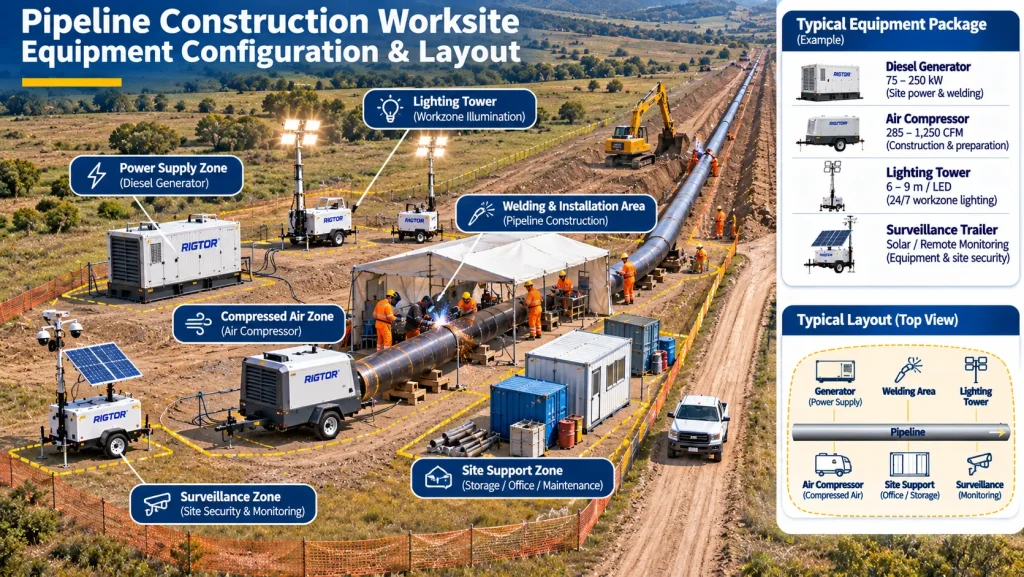
| Diesel Generator | 75–100 kW class | Welding support and temporary electrical loads |
| Diesel Air Compressor | 285 CFM / 10 Bar class | Selected pneumatic tools and compatible surface-preparation work |
| Mobile Lighting Towers | 2 × 7m diesel LED units | Work-zone lighting |
| Mobile Surveillance Trailer | 1 unit | Temporary equipment compound monitoring |
This package is intended for general construction support.
It does not include specialized pipeline drying, pigging or pressure-testing equipment.
Those activities require separate engineering reviews.
Pipeline projects differ from fixed industrial sites because the work zone moves along the route.
The equipment layout should support safe operation and efficient relocation.
             PIPELINE CONSTRUCTION CORRIDOR
                       NOT TO SCALE

  PIPELINE ALIGNMENT ===================================

      [PIPE INSTALLATION / WELDING WORK ZONE]
                       |
               Temporary Power
                       |
                [GENERATOR]
                       |
              Cable Distribution

   [LIGHT TOWER A]               [LIGHT TOWER B]
          |                             |
          |       WORK ZONE             |
          |                             |

    [AIR COMPRESSOR] ---- Air Hose ---- [TOOLS /
                                        SURFACE PREP]

    [EQUIPMENT STORAGE] ---- [SURVEILLANCE TRAILER]

    [SERVICE / REFUELING AREA]

  -----------------------------------------------------
              VEHICLE ACCESS / HAUL ROAD
  -----------------------------------------------------
The diagram illustrates equipment functions rather than exact physical positions.
The contractor must establish safe clearances, access routes, environmental controls and equipment placement.
Generators and compressors should be positioned where transport vehicles and maintenance personnel can access them without interfering with pipeline construction activities.
Power cables and air hoses should be routed to avoid heavy equipment paths and unnecessary crossings.
Appropriate protection is required where crossings cannot be avoided.
Diesel equipment should be located with suitable ventilation and exhaust management.
Lighting towers should illuminate the welding, inspection or maintenance areas without creating excessive glare.
Welding, lifting, excavation, pressure testing and other operations may require designated exclusion zones.
Equipment must be positioned according to the approved site safety plan.
The equipment arrangement should support safe disconnection, securing, loading and movement to the next work zone.
Pipeline contractors may operate several crews along different sections of the route.
A standardized equipment package can help simplify procurement and relocation.
Potential equipment:
Suitable for selected maintenance and repair activities where the equipment ratings match the task.
Potential equipment:
Suitable for selected construction support applications.
Potential equipment:
The actual configuration depends on the specific operation.
Specialized pipeline drying, pigging or testing should be engineered as a complete process rather than treated as a standard compressor package.
Pipeline contractors often operate in different countries, climates and project environments.
Standard equipment configurations may not match every requirement.
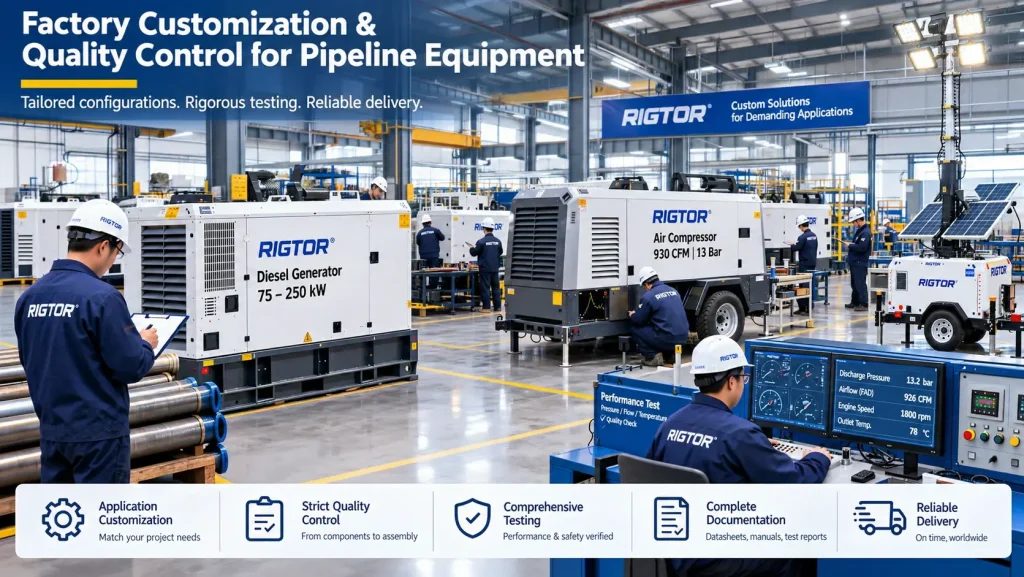
As a manufacturer and supplier, RIGTOR can review application-specific equipment requirements.
Potential configuration considerations include:
Potential considerations include:
Potential considerations include:
Potential considerations include camera arrangement, communications, energy storage and monitoring requirements.
All customization options depend on the selected model and engineering feasibility.
For pipeline contractors, equipment must operate across changing locations and demanding field conditions.
Factory quality control helps establish that equipment meets the agreed manufacturing and performance requirements.
Relevant components are checked against the approved equipment specification.
Mechanical, electrical and structural assembly requirements are reviewed.
Diesel Generators
Electrical output, control and protection functions are checked under the agreed test procedure.
Diesel Air Compressors
Pressure, airflow and operating functions are verified according to the selected model and agreed acceptance criteria.
Mobile Lighting Towers
Mast, stabilizer, electrical and lighting functions are checked.
Mobile Surveillance Systems
Power, camera and communications functions are checked.
Customers should confirm the required:
The exact inspection scope and supplied documents should be defined in the equipment purchase agreement.
Pipeline projects may be located far from established service facilities.
A machine failure can affect work crews, transport schedules and other project activities.
Preventive maintenance and spare-parts planning are therefore important.
Review engine service intervals, filters, cooling systems, electrical connections and operating records.
Inspect intake filters, lubricant systems, air/oil separation components, cooling systems and pressure controls.
Inspect mast mechanisms, stabilizers, fixtures, cables and power systems.
Contractors should prepare appropriate service kits based on equipment models, operating hours and project duration.
RIGTOR can discuss maintenance documentation, parts requirements and troubleshooting procedures as part of equipment procurement.
Specific parts lead times, warranty coverage and service commitments must be confirmed for the selected models and destination market.
Equipment costs should be evaluated over the complete project rather than by purchase price alone.
Relevant costs include:
Assume a contractor relocates a temporary equipment package 20 times during a pipeline project.
Two deployment approaches are compared.
| Metric | Independently Coordinated Equipment | Standardized Equipment Package |
|---|---|---|
| Setup and checks per relocation | 5 hours | 3.5 hours |
| Number of relocations | 20 | 20 |
| Total setup duration | 100 hours | 70 hours |
| Crew size | 3 technicians | 3 technicians |
| Labor cost per technician-hour | $60 | $60 |
| Total Deployment Labor Cost | $18,000 | $12,600 |
Illustrative labor savings: $5,400.
This is a hypothetical calculation.
It assumes the standardized package reduces coordination and setup work while maintaining equivalent safety and commissioning requirements.
It does not represent measured RIGTOR performance or guaranteed project savings.
When equipment configurations, documentation and deployment procedures remain consistent, contractors may reduce repeated planning work.
Actual savings depend on the project, equipment selection and operating practices.
Pipeline projects often require more than a single equipment purchase.
Contractors may need multiple equipment types, project-specific configurations and consistent supply across different work zones.
RIGTOR's manufacturing and supply approach focuses on five areas.
| Capability | Value for Pipeline Contractors |
|---|---|
| Multiple Equipment Categories | Coordinate power, compressed air, lighting and monitoring procurement |
| Application-Based Selection | Match equipment to actual construction or maintenance tasks |
| Factory Customization | Review model-specific configurations and transport arrangements |
| Quality-Control Planning | Define inspection and functional testing requirements |
| Maintenance Preparation | Plan documentation, service items and spare-parts requirements |
The objective is to help contractors obtain appropriately configured equipment for their pipeline operations.
Pipeline construction and maintenance require temporary equipment that can operate reliably across changing work locations.
Diesel generators provide independent power.
Portable diesel air compressors support selected pneumatic and pipeline-related applications.
Mobile lighting towers illuminate temporary work zones.
Surveillance systems can help monitor equipment compounds and access areas.
However, equipment must be selected according to the actual application.
Pipeline cleaning, drying and pressure testing may require specialized engineering and additional process equipment.
RIGTOR approaches pipeline equipment supply from a manufacturing perspective: understand the project, evaluate equipment requirements, review suitable configurations and define factory inspection procedures.
The goal is to provide equipment configured for the pipeline work—not simply to supply machines by nominal capacity.
Pipeline contractors may need diesel generators, portable air compressors, mobile lighting towers and temporary surveillance systems. The exact equipment depends on the construction activity and site conditions.
Generator size depends on the welding equipment's electrical characteristics, duty cycle, simultaneous loads and starting requirements. A detailed electrical load review is required.
Some pipeline cleaning processes use compressed air, but the compressor and associated system must be engineered for the pipeline conditions and cleaning procedure.
A 930 CFM class compressor may be evaluated for selected applications, but drying also requires suitable pressure, air treatment, dew-point control and a verified process design.
Only if the complete equipment and procedure are specifically engineered and approved for the intended test. A standard portable compressor is not automatically a complete pressure-testing system.
Standardized equipment packages, documented setup procedures, coordinated transport and advance site planning may reduce avoidable relocation work.
Yes. Mobile lighting towers can support selected nighttime construction and maintenance work, subject to appropriate lighting design and site safety requirements.
RIGTOR can review model-specific requirements for electrical configurations, compressor specifications, mounting arrangements, controls and branding.
Customers should request appropriate generator electrical tests, compressor performance checks, lighting tower functional tests and relevant inspection documentation.
Customers should provide the pipeline activity, electrical loads, compressed-air requirements, site conditions, operating hours, applicable standards and transport requirements.
Diesel Generators. Portable Air Compressors. Mobile Lighting. Temporary Surveillance.
Share your pipeline construction or maintenance requirements with RIGTOR.
Our team can review suitable equipment configurations, available factory customization options and the technical documentation required for your project.
Contact RIGTOR for a Pipeline Equipment Configuration Proposal.

Behind Every Critical Project.
@ 2026-2026 Rigtor Industry. All Rights Reserved.
 EN
 ES
 PT
 AR