

Time: Oct 25 2026 Views: 17
How China-based manufacturers help security companies, contractors, and equipment distributors source customizable mobile video surveillance solutions.
Security requirements are changing across construction sites, mining operations, industrial facilities, and remote infrastructure projects. Traditional fixed CCTV installations are not always practical, particularly when electricity, network connectivity, and permanent mounting structures are unavailable.
This has increased interest in mobile surveillance systems that can be transported, positioned, and relocated as operational requirements change.
For security equipment distributors, rental companies, contractors, and system integrators, selecting the right equipment is only part of the purchasing decision. Finding a reliable mobile video surveillance manufacturer is equally important.
A capable manufacturing partner should understand more than cameras. Trailer structure, power generation, battery storage, telescopic mast engineering, electrical integration, and environmental durability all influence how reliably a mobile security system performs.
RIGTOR, a China-based industrial equipment manufacturer, focuses on mobile infrastructure equipment for demanding field operations, including configurable surveillance trailer solutions.
This guide explains how mobile CCTV systems work, their main applications, and what international buyers should consider when sourcing equipment directly from a manufacturer.
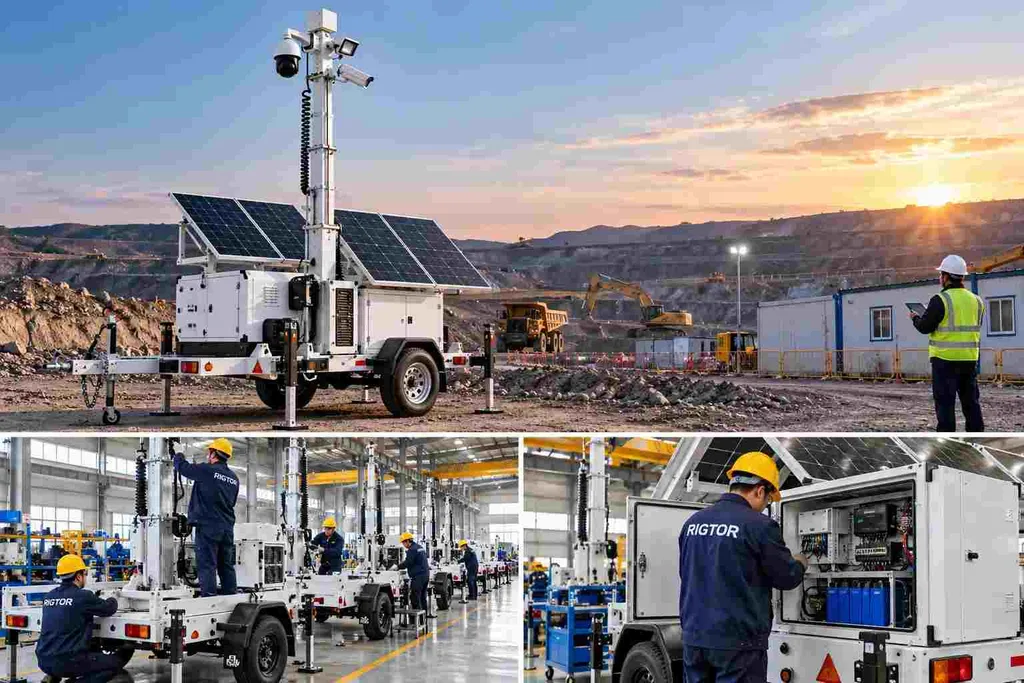
Mobile surveillance systems are transportable security platforms designed to provide video monitoring in locations where permanent surveillance infrastructure is unavailable, impractical, or unnecessary.
Unlike conventional fixed CCTV installations, these systems can be relocated between construction projects, industrial facilities, temporary storage areas, and remote operating sites.
A typical mobile video security system may include:
Depending on the configuration, a mobile surveillance unit can operate independently of an existing electrical grid.
Solar-powered systems use photovoltaic panels to charge onboard batteries. The stored energy supplies the cameras, communications equipment, and other electrical loads.
Where solar generation is insufficient, suitable systems may incorporate external charging or generator backup.
This flexibility makes mobile surveillance equipment useful for temporary and remote security applications.
The main difference between mobile CCTV and traditional surveillance is deployment flexibility.
Fixed CCTV systems generally require permanent installation, including mounting structures, electrical connections, network infrastructure, and cable routing.
These installations work well in factories, commercial buildings, and other permanent facilities.
However, temporary projects introduce different requirements.
Construction sites change as work progresses. Mining equipment moves between operating areas. Emergency response locations may need monitoring before permanent infrastructure can be installed.
Mobile CCTV trailers address these situations by combining the principal surveillance components into a transportable platform.
Rapid deployment
Trailer-mounted equipment can reduce the amount of permanent infrastructure required before surveillance begins.
Relocatable security coverage
A single unit can be moved between different project locations when monitoring requirements change.
Independent power options
Solar panels, batteries, and optional backup power allow operation in locations without reliable grid electricity.
Remote accessibility
With compatible communication equipment and network coverage, operators can access live video and recorded footage remotely.
Flexible equipment configuration
Camera types, mast height, power capacity, and communication equipment can be selected according to project requirements.
These advantages are particularly relevant to security contractors managing multiple temporary sites.
The performance of a mobile surveillance trailer depends on the engineering of the entire platform, not simply the specifications of its cameras.
The trailer provides the physical foundation for the surveillance system.
Important considerations include structural strength, equipment protection, towing compatibility, corrosion resistance, and stability during deployment.
A properly engineered trailer should account for the combined weight of the batteries, solar panels, mast, cameras, and electrical equipment.
The design must also consider transportation loads and wind conditions when the mast is raised.
For manufacturers, mechanical design is therefore a critical part of product development.
The mast elevates the surveillance equipment to improve visibility across the monitored area.
Depending on the model, the mast may use manual, electric, or hydraulic lifting mechanisms.
Mast height should be selected according to the required field of view, camera capabilities, site layout, and operating conditions.
A taller mast does not automatically guarantee better surveillance. Camera resolution, optical zoom, mounting stability, and obstruction management also influence monitoring effectiveness.
Power-system design is one of the most important considerations for off-grid mobile security surveillance.
A typical solar-powered configuration includes photovoltaic panels, a charge controller, batteries, electrical protection, and power distribution equipment.
System sizing should begin with the actual electrical load.
For example, cameras, communication routers, recording devices, lighting, and alarm equipment may all require different amounts of energy.
The manufacturer must then consider expected operating hours, local solar conditions, battery autonomy, and charging efficiency.
A well-designed system balances power generation, storage capacity, and equipment consumption rather than relying on solar panel wattage alone.
Mobile surveillance platforms can support different camera technologies depending on system compatibility.
Common options include:
Recording can be managed through onboard network video recorders, edge storage, or supported cloud-based systems.
The appropriate configuration depends on monitoring requirements, network availability, storage duration, and the customer's preferred video management platform.
Remote monitoring commonly uses 4G or 5G cellular connections.
Some applications may require Wi-Fi integration, external antennas, or satellite communication solutions.
The communication system should be selected according to the deployment region, available network coverage, bandwidth requirements, and cybersecurity considerations.
For international buyers, compatibility with local mobile network frequencies and SIM arrangements should be confirmed before ordering.
Mobile surveillance equipment serves a broad range of industries.
Construction sites frequently contain valuable machinery, tools, materials, and temporary storage facilities.
Because project layouts change over time, fixed CCTV infrastructure may be inconvenient.
Mobile surveillance trailers can provide monitoring around equipment storage areas, access roads, temporary offices, and construction boundaries.
As the project progresses, the surveillance unit can be repositioned to cover new areas.
Mining operations often take place far from permanent electrical and communication infrastructure.
Mobile surveillance systems can support monitoring of equipment storage, temporary facilities, access points, and remote operating areas.
Solar-powered configurations may be useful where conventional power connections are unavailable, provided the energy system is correctly sized for local conditions.
Road maintenance, pipeline construction, utility repair, and other infrastructure projects frequently require temporary equipment deployment.
Mobile CCTV units can provide visual monitoring without requiring permanent installation at every work location.
Industrial contractors and rental companies often operate temporary storage areas containing valuable equipment.
A mobile video security system can help monitor entrances, perimeter areas, and equipment movements.
Emergency response locations and temporary operational facilities may require rapid situational awareness.
Transportable surveillance platforms can provide additional visual information when compatible power and communications infrastructure is available.
The specific configuration should reflect the operational requirements and applicable regulations.
For international equipment buyers, there is an important distinction between purchasing a finished surveillance service and sourcing equipment from a manufacturer.
Security service providers typically focus on monitoring, installation, rental contracts, or alarm response.
A CCTV mobile trailer manufacturer, by contrast, focuses on the physical equipment platform and its production.
This distinction matters to distributors, rental companies, and system integrators that want to build their own equipment fleets or supply products under their own brands.
Working directly with a manufacturer can provide better visibility into trailer construction, material selection, component installation, and assembly processes.
Buyers can discuss structural dimensions, mast arrangements, battery compartments, and other mechanical requirements before production.
Different markets require different surveillance platforms.
A distributor serving construction contractors may prioritize compact trailers and straightforward deployment.
An industrial security integrator may require greater battery capacity, additional camera mounting positions, or compatibility with an existing video management system.
Manufacturer-level customization helps align the equipment with these requirements.
Distributors may prefer surveillance trailers that carry their own brand identity.
Depending on the manufacturing agreement, OEM customization may include:
This can help distributors develop a recognizable product offering without establishing their own trailer manufacturing operation.
For rental companies and security equipment distributors, consistent supply is often as important as the initial purchase price.
A manufacturing relationship can support repeat orders, spare-parts planning, model consistency, and future product development.
Buyers should verify the supplier's production capacity, quality procedures, and after-sales arrangements before committing to large orders.
RIGTOR focuses on industrial equipment designed for temporary and remote field operations.
Its product portfolio includes diesel generators, mobile lighting towers, portable air compressors, and mobile surveillance trailers.
This broader equipment focus is relevant because a surveillance trailer is not simply a camera mounted on wheels.
It combines structural engineering, electrical power, outdoor equipment protection, and operational mobility.
RIGTOR approaches mobile surveillance equipment as a complete field-deployment platform.
The key considerations include trailer construction, mast arrangement, power-system integration, component accessibility, and transportability.
The objective is to provide equipment that can be configured around the operational needs of distributors, contractors, and security system integrators.
International buyers may require different combinations of solar panels, batteries, camera mounting positions, and communication equipment.
RIGTOR can discuss project-specific configurations based on the intended application and available product options.
Final equipment specifications should be confirmed through technical drawings, component lists, and approved quotations.
For distributors seeking a China-based manufacturing partner, RIGTOR offers a potential sourcing route for branded mobile surveillance equipment.
OEM requirements can be reviewed according to order quantity, mechanical design, selected components, and production feasibility.
Professional buyers should evaluate the actual manufacturing process before placing orders.
Important areas include structural fabrication, electrical assembly, mechanical stability, functional testing, and inspection documentation.
RIGTOR encourages buyers to define these requirements during the technical and commercial review so that the agreed equipment specification can be evaluated before shipment.
Specific testing standards, certification documents, and inspection arrangements should be confirmed for each product and destination market.
When researching the best providers of mobile surveillance units, buyers should look beyond promotional claims and compare suppliers using measurable criteria.
The lowest quotation does not necessarily represent the lowest operating cost.
A more effective evaluation considers engineering capability, component quality, customization flexibility, and long-term support.
1. Manufacturing or service-provider business model
Determine whether the company manufactures the trailer, assembles purchased components, distributes equipment, or primarily provides monitoring services.
2. Mechanical engineering capability
Request information about trailer construction, mast design, transportation dimensions, and deployed stability.
3. Power-system engineering
Ask for solar generation capacity, battery specifications, total electrical load, and calculated operating autonomy.
4. Camera compatibility
Confirm whether the system supports the required cameras, recording devices, and video management software.
5. Customization capability
Discuss OEM branding, trailer dimensions, electrical arrangements, and regional requirements.
6. Quality documentation
Request applicable inspection records, technical drawings, product documentation, and certification evidence.
7. Spare parts and technical support
Understand which replacement components are available and how technical issues will be handled after delivery.
8. Commercial terms
Compare minimum order quantities, production lead times, warranty conditions, packaging, and shipping arrangements.
A manufacturer that provides clear technical documentation and realistic operating specifications is generally easier to evaluate than one relying mainly on broad performance claims.
Before requesting a quotation, buyers should prepare a short technical specification.
The most useful questions include:
These details help the manufacturer propose a more appropriate configuration.
For solar-powered equipment, location and energy consumption are particularly important. Battery autonomy should be calculated rather than assumed.
For export projects, towing regulations, electrical standards, and telecommunications requirements should also be reviewed for the destination market.
Mobile surveillance system is a broad term covering transportable video security equipment.
A mobile CCTV trailer is a specific type of mobile surveillance system mounted on a towable trailer.
Yes. Appropriately configured systems can use solar panels and battery storage. Actual operating autonomy depends on energy consumption, battery capacity, weather conditions, and the power-system design.
Customization may be possible, depending on the platform and selected components. Buyers should confirm camera compatibility, electrical load, mounting requirements, and software integration before production.
Yes. Transportable surveillance equipment can be useful for rental fleets because units can be relocated between customer projects. Fleet operators should evaluate durability, maintenance requirements, deployment procedures, and total ownership cost.
China-based manufacturing may offer access to established industrial component supply chains, equipment fabrication, and OEM production options.
However, buyers should evaluate individual manufacturers rather than assuming that country of origin alone determines quality or value.
Mobile surveillance systems combine video security, power management, structural engineering, and transportable equipment design.
For international buyers, selecting the right manufacturer means finding a partner that understands both the security application and the physical equipment required to support it.
RIGTOR provides a China-based manufacturing contact point for buyers seeking configurable mobile surveillance trailer solutions.
Whether you are an equipment distributor, security system integrator, rental company, or industrial project contractor, the first step is to define the intended application and technical requirements.
Looking for a mobile surveillance trailer manufacturer in China?
Contact RIGTOR to discuss your project requirements, available configurations, OEM options, and quotation details.
Request a Quote | Discuss Your Surveillance Trailer Project

Behind Every Critical Project.
@ 2026-2026 Rigtor Industry. All Rights Reserved.
 EN
 ES
 PT
 AR