

Time: Oct 26 2026 Views: 19
Understanding why 500 kW diesel generator sets are used in industrial projects, what they can power, and how to select the right equipment.
A 500 kW diesel generator is a substantial industrial power system capable of delivering up to 500 kilowatts of electrical power under its specified rating and operating conditions.
This power class is used in commercial facilities, manufacturing plants, construction projects, utility infrastructure, and remote industrial operations.
However, selecting a 500 kW generator involves more than matching a number on a specification sheet.
Buyers must understand the difference between prime and standby power, electrical load characteristics, fuel consumption, engine and alternator performance, and installation requirements.
From a diesel generator set manufacturer's perspective, these factors determine whether the equipment can deliver dependable power throughout its intended service life.
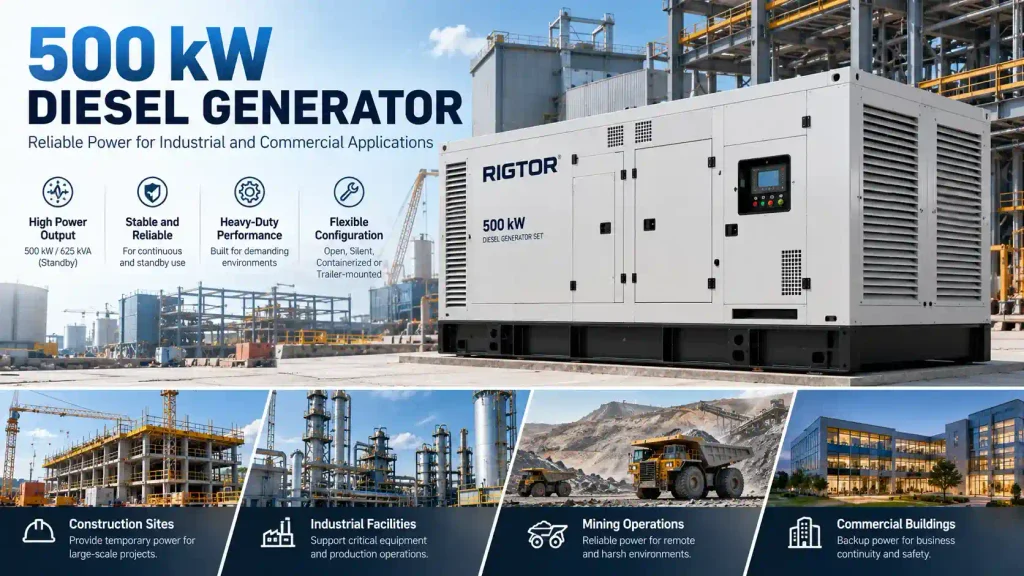
The 500 kW power class serves an important segment of the industrial generator market.
It offers significantly more capacity than small commercial generator sets while remaining available in standalone packaged configurations.
Several practical requirements drive interest in this power range.
Manufacturing plants and commercial facilities may require emergency power to maintain selected operations during utility interruptions.
A 500 kW standby generator can support substantial electrical loads, depending on the facility's actual demand.
However, it is not automatically capable of powering an entire factory. The required capacity depends on which equipment must remain operational.
Large construction projects may need electricity before permanent utility connections become available.
Diesel generators can supply temporary power for site distribution, lighting, pumps, construction equipment, and other electrical systems.
The generator must be sized according to both continuous operating loads and intermittent starting demands.
Mining, drilling support, infrastructure maintenance, and remote industrial facilities may operate far from established electrical networks.
In these environments, diesel generators provide an independent power source.
Fuel logistics, equipment accessibility, operating hours, and environmental conditions become especially important.
Commercial buildings, municipal facilities, and other critical operations may use 500 kW-class generators as part of their emergency or standby power systems.
These installations often require additional engineering considerations, including automatic transfer equipment, protection coordination, and compliance with applicable regulations.
A generator rated at 500 kW can deliver 500,000 watts of real electrical power at its specified rating.
For a three-phase generator with a rated power factor of 0.8:
500 kW ÷ 0.8 = 625 kVA
Therefore, a 500 kW generator is commonly associated with a 625 kVA rating.
However, kW and kVA describe different electrical quantities.
Both kW and kVA limits must be considered when selecting a generator.
Potential applications include:
The exact number of connected devices cannot be determined from the generator rating alone.
A 500 kW generator may support several moderate electrical loads, but a single large motor can create a substantial starting demand.
This makes a detailed load assessment essential.
One of the most important purchasing questions is whether the stated 500 kW refers to prime power or standby power.
These ratings are not interchangeable.
Standby-rated generator sets are intended for defined backup applications, typically during interruptions of the normal power source.
The permissible loading and operating conditions depend on the manufacturer's published rating and applicable standards.
Prime-rated generator sets are designed for applications in which the generator serves as a primary source of electricity under the conditions defined by its rating.
Prime power may be lower than the standby rating of the same generator set.
For example, a manufacturer may offer a generator with:
| Rating | Example Output |
| Standby Power | 500 kW |
| Prime Power | 455 kW |
| Standby Apparent Power | 625 kVA |
| Prime Apparent Power | Approximately 569 kVA |
These values illustrate one commercially available rating configuration and should not be assumed for every 500 kW generator.
A buyer requiring 500 kW of prime power may need a generator set with a higher standby rating.
Manufacturer's recommendation: Always specify the intended duty before selecting the engine and alternator combination.
A 500 kW generator's performance depends on the complete generator set, not only the diesel engine.
The diesel engine must deliver sufficient mechanical power to drive the alternator under the required load.
Important engine characteristics include:
The engine's available power may also be affected by ambient temperature and altitude.
The alternator converts mechanical power into electrical energy.
Its capacity, excitation system, insulation characteristics, and voltage regulation performance affect the generator's electrical output.
Correct alternator selection is especially important when the generator supplies motors, pumps, and other demanding loads.
For a conventional four-pole synchronous generator:
The engine governor helps regulate rotational speed, while the alternator excitation system and AVR help control voltage.
When the electrical load changes, both systems respond.
Industrial motors may draw several times their normal running current during direct-on-line starting.
The resulting demand can cause temporary voltage and frequency deviations.
A generator's ability to start motors depends on the alternator, engine response, excitation system, starting method, and permissible voltage dip.
A generator should not be selected solely by adding together the rated running power of connected motors.
Fuel consumption is a major operating cost for industrial generator users.
However, there is no universal fuel consumption figure for all 500 kW diesel generators.
Actual consumption depends on:
For illustration, a published 500 kW standby-rated generator specification may indicate approximately 139 liters per hour at full standby load.
This is an example from a particular generator model, not a universal figure for the 500 kW power class.
Fuel consumption should be evaluated using the exact engine and generator data sheet.
A generator rarely operates at precisely the same electrical load throughout the day.
Fuel consumption generally increases as output power increases, but fuel efficiency per kWh also changes with loading.
Buyers should compare consumption at several load points, such as 25%, 50%, 75%, and 100%, where manufacturer data is available.
For projects with long operating hours, differences in fuel consumption can materially affect lifecycle costs.
Industrial facilities may use 500 kW generators for standby power or defined independent power applications.
Relevant loads can include production equipment, motors, compressors, lighting, and facility support systems.
Temporary construction sites may require high-capacity electricity for multiple work areas.
A suitable generator configuration depends on the total site demand, distribution arrangement, operating schedule, and motor starting requirements.
Remote operations often require independent power for pumps, processing equipment, workshops, and temporary facilities.
Generator selection must account for dust, temperature, altitude, fuel delivery, and maintenance accessibility.
Commercial buildings and public facilities may require backup power for selected critical systems.
The final installation must be designed according to the relevant electrical codes, transfer requirements, and operational priorities.
Equipment rental companies may select generators in this power class for customers requiring substantial temporary electrical capacity.
For rental applications, transportability, control flexibility, service access, and durability can be particularly important.
From a manufacturer's perspective, a reliable industrial generator is the result of coordinated mechanical and electrical engineering.
The engine must provide sufficient mechanical power for the alternator at the required electrical rating.
The engineering team must consider the engine's operating speed, available power, ambient derating, and expected electrical load characteristics.
Large diesel engines produce substantial heat.
Radiator capacity, airflow paths, ventilation openings, and installation clearances must be considered during generator design.
Sound-attenuated enclosures introduce additional airflow and acoustic design requirements.
The control system provides operating information, engine monitoring, alarms, and protective functions.
Depending on project requirements, a generator may need automatic starting, remote monitoring, or synchronization equipment.
These functions must be supported by the selected controller and overall system configuration.
The engine and alternator must be correctly mounted and aligned.
Base-frame design, vibration isolation, piping connections, and maintenance access influence long-term equipment reliability.
A manufacturer should define appropriate verification procedures for each generator configuration.
Depending on the equipment and agreed requirements, testing may cover:
Buyers should request the applicable inspection and testing documentation before shipment.
A 500 kW diesel generator may be supplied in several physical configurations.
Open-type generator sets are suitable for installations where appropriate weather protection, ventilation, and acoustic arrangements are provided separately.
They can offer convenient maintenance access.
Sound-attenuated generator sets use specially designed enclosures to reduce operating noise.
Noise performance depends on the complete design and should be evaluated using specified measurement conditions.
Containerized configurations may be considered for projects requiring packaged equipment protection, transportation convenience, or integrated auxiliary systems.
The configuration must provide sufficient cooling, ventilation, service access, and exhaust arrangements.
Trailer-mounted systems may be useful for temporary power projects that require equipment relocation.
Transport dimensions, axle loads, towing regulations, and destination-market requirements must be reviewed.
Not every generator configuration is available with every engine or alternator combination.
Before requesting a quotation for a 500 kW diesel generator, buyers should provide the following information:
These details help manufacturers determine whether a 500 kW generator is appropriate or whether a different capacity is required.
RIGTOR is a China-based manufacturer of industrial generator sets and temporary infrastructure equipment.
Its broader product portfolio includes diesel generators, mobile lighting towers, diesel air compressors, and mobile surveillance trailers for construction, mining, and remote industrial operations.
For generator projects, equipment selection should begin with the buyer's electrical load, intended duty, and operating environment.
RIGTOR's generator product range provides a starting point for reviewing available power generation configurations.
Explore our Diesel Generator Systems for additional product information.
Buyers seeking a 500 kW-class generator should confirm the available model, engine and alternator options, applicable ratings, and customization requirements directly with the manufacturer.
At a rated power factor of 0.8, 500 kW corresponds to 625 kVA.
However, buyers must also confirm whether the stated rating is prime or standby power.
Possibly, but only if the factory's electrical demand, starting requirements, and operating conditions are within the generator's capabilities.
The correct size must be established through a load assessment.
It depends on the generator's published duty rating.
A standby-rated generator should not automatically be used as a continuously operating primary power source.
The frequency affects generator speed and compatibility with connected electrical equipment.
For a four-pole alternator, 50 Hz typically corresponds to 1,500 RPM, while 60 Hz corresponds to 1,800 RPM.
Fuel consumption varies by engine model and load.
Buyers should compare manufacturer-provided fuel consumption data at the relevant operating points.
There is no universally best engine.
Selection depends on the required rating, fuel efficiency, emissions compliance, service support, availability, and project budget.
A 500 kW diesel generator is a substantial industrial power system suitable for many commercial, construction, industrial, and remote power applications.
Its value comes not simply from the rated output but from its ability to supply the required electrical loads reliably under the intended operating conditions.
Buyers should pay particular attention to prime versus standby ratings, motor starting requirements, fuel consumption, voltage and frequency performance, and manufacturing quality.
Looking for a 500 kW Diesel Generator Manufacturer?
Explore RIGTOR's industrial diesel generator systems and contact our team with your project specifications to discuss suitable equipment configurations and quotation requirements.

Behind Every Critical Project.
@ 2026-2026 Rigtor Industry. All Rights Reserved.
 EN
 ES
 PT
 AR