

Time: Oct 26 2026 Views: 15
An Industrial Manufacturer's Guide to Generator Speed, Fuel Efficiency, Noise, Engine Life, Maintenance, and Operating Costs
When selecting a diesel generator, buyers often focus on power output, engine brand, and purchase price. However, another important specification is the generator's operating speed.
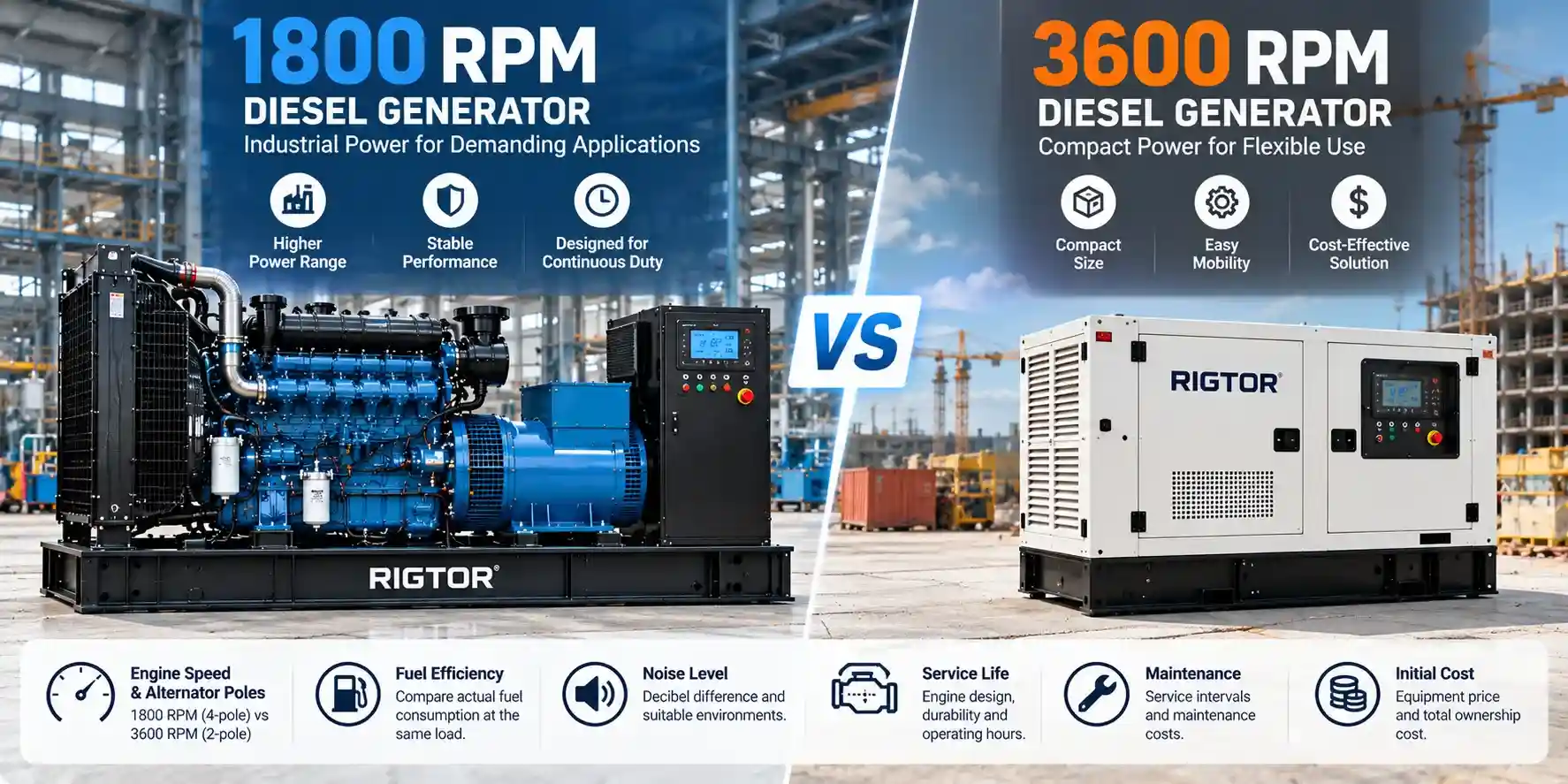
Two commonly discussed speeds in the North American 60 Hz market are 1800 RPM and 3600 RPM.
Both can produce 60 Hz electricity, but they typically use different alternator configurations and serve different equipment requirements.
An 1800 RPM diesel generator commonly uses a four-pole alternator and is widely found in industrial power applications. A conventional 3600 RPM generator generally uses a two-pole alternator and is frequently associated with smaller, compact power systems.
Does that mean 1800 RPM is always better?
Not necessarily.
The right choice depends on generator capacity, operating hours, fuel consumption, noise requirements, engine design, and total ownership costs.
This guide explains the engineering differences between 1800 RPM and 3600 RPM generators and how industrial buyers should evaluate them.
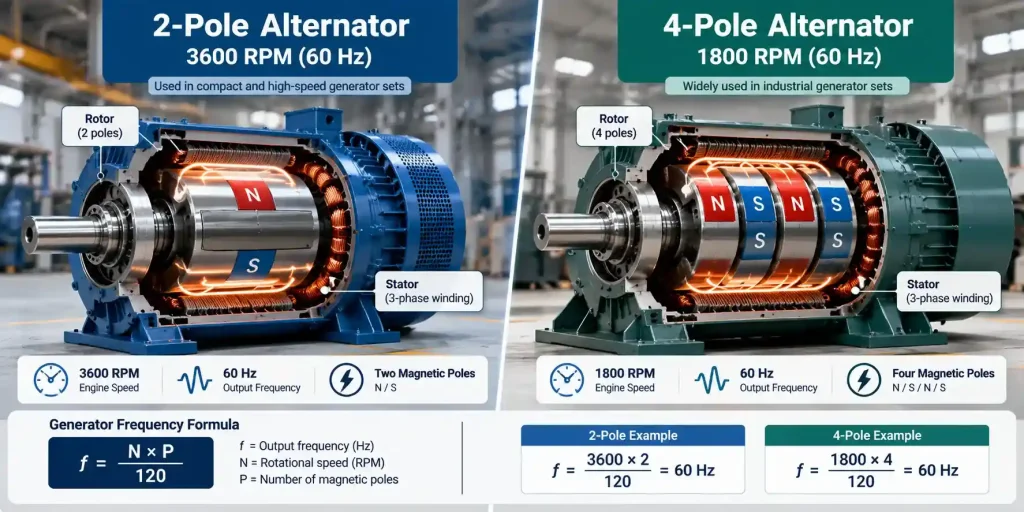
RPM stands for Revolutions Per Minute.
In a conventional fixed-speed diesel generator set, RPM describes how many times the engine crankshaft rotates each minute.
The diesel engine drives an alternator, converting mechanical rotation into electrical power.
In a directly coupled synchronous generator, electrical frequency depends on two factors:
The relationship is:
Frequency (Hz) = RPM × Number of Poles ÷ 120
For a 60 Hz electrical system:
| Alternator Configuration | Required Speed | Output Frequency |
| Two-pole alternator | 3600 RPM | 60 Hz |
| Four-pole alternator | 1800 RPM | 60 Hz |
| Six-pole alternator | 1200 RPM | 60 Hz |
This explains why two generators operating at different speeds can produce electricity at the same frequency.
Important: This relationship applies to conventional synchronous generators. Inverter generators may operate at variable engine speeds while electronically producing a stable output frequency.
The following table summarizes the typical characteristics of conventional generator sets in these two speed classes.
| Comparison | 1800 RPM Generator | 3600 RPM Generator |
| Typical alternator | Four-pole | Two-pole |
| Output frequency | 60 Hz | 60 Hz |
| Engine speed | Lower | Higher |
| Typical equipment class | Industrial and commercial | Compact and portable |
| Size and weight | Often larger | Often smaller |
| Noise characteristics | Often easier to control | May have more high-frequency mechanical noise |
| Fuel consumption | Depends on engine and load | Depends on engine and load |
| Service life | Depends on engine design and duty | Depends on engine design and duty |
| Initial cost | Often higher for comparable conventional packages | Often lower for compact packages |
| Typical operating duty | Standby, prime, or other specified ratings | Frequently intermittent or light-duty applications |
These are general market tendencies, not universal performance specifications.
A properly engineered 3600 RPM generator can outperform a poorly matched 1800 RPM generator in a particular application.
The comparison must therefore be based on actual equipment data rather than speed alone.
Industrial generators are often expected to supply substantial electrical loads for extended periods.
This creates requirements beyond basic electricity generation.
Many industrial diesel engines are designed to operate at relatively moderate speeds while delivering substantial torque.
An 1800 RPM generator set can use an engine and alternator combination designed for commercial or industrial service.
However, the engine's published standby, prime, or other duty rating must still be verified.
Operating at 1800 RPM does not automatically qualify a generator for continuous service.
Four-pole alternators are widely available across a broad range of industrial power ratings.
They are commonly used in generator sets supplying manufacturing facilities, commercial buildings, pumping stations, and construction sites.
For example, industrial 500 kW diesel generator sets are available in 1800 RPM, 60 Hz configurations.
This illustrates the relevance of 1800 RPM systems to substantial industrial loads.
Industrial generator sets are often designed with access to filters, cooling components, control equipment, and other service points.
These features are especially important when equipment operates in remote locations.
However, maintenance accessibility depends on the specific generator package and enclosure design, not merely its operating speed.
Fuel efficiency is one of the most frequently discussed differences between generator speeds.
It is tempting to assume that a slower engine always consumes less diesel.
But this is not a reliable engineering conclusion.
Fuel consumption depends on:
A 3600 RPM engine may be smaller and operate efficiently within its intended load range.
An 1800 RPM industrial engine may provide favorable fuel efficiency at its designed operating point.
The correct comparison requires actual manufacturer data.
For industrial buyers, fuel consumption per unit of generated electricity is often more informative than fuel consumption per hour.
For example:
Specific Fuel Consumption = Fuel Used (L) ÷ Electrical Energy Generated (kWh)
Consider two hypothetical generators:
| Generator | Electrical Output | Fuel Consumption | Specific Consumption |
| Generator A | 40 kW | 12 L/h | 0.30 L/kWh |
| Generator B | 40 kW | 10.8 L/h | 0.27 L/kWh |
Generator B consumes less fuel per unit of electricity under these assumed conditions.
However, these values are illustrative and do not represent actual 1800 RPM or 3600 RPM generator models.
Manufacturer's recommendation: Compare published fuel consumption at equivalent electrical output, load percentage, and duty conditions.
For high-hour projects, fuel efficiency differences can significantly influence operating costs.
Lower-speed generators are often associated with reduced mechanical noise.
This is partly because engine speed influences combustion-event frequency, mechanical excitation, and other noise sources.
However, generator noise is not determined by RPM alone.
Important factors include:
A 3600 RPM generator with an effective acoustic enclosure may be quieter at a specified measurement point than an unprotected 1800 RPM generator.
Therefore, buyers should compare verified sound pressure levels rather than assuming one speed class is always quieter.
Ask the manufacturer for:
For construction sites, commercial facilities, and noise-sensitive locations, enclosure design may be as important as engine speed.
Another common question is whether 1800 RPM generators last longer than 3600 RPM generators.
Lower rotational speed can reduce the number of mechanical operating cycles accumulated during a given period.
For example:
The higher-speed engine completes twice as many revolutions over the same operating time.
However, this does not mean its service life is automatically half as long.
Actual engine durability depends on:
An engine designed specifically for higher-speed operation may use components and engineering features suited to those conditions.
Conversely, an industrial engine designed for long operating hours may be optimized for lower-speed service.
Instead of asking only which RPM is better, buyers should request:
For industrial applications, these indicators are more useful than RPM alone.
Maintenance costs affect the total cost of generator ownership.
However, service intervals should always follow the engine manufacturer's recommendations.
Oil-change intervals depend on engine design, operating conditions, fuel quality, oil specifications, and maintenance requirements.
It is incorrect to assume that all 3600 RPM generators require more frequent oil changes.
Industrial generators may operate under high loads and demanding ambient conditions.
Radiator capacity, coolant maintenance, airflow, and temperature monitoring are important regardless of operating speed.
Alternator maintenance may involve:
The exact procedure depends on alternator construction and manufacturer instructions.
For a fair comparison, buyers should calculate the expected maintenance expense over the planned operating period.
A generator used for 100 hours annually has a very different maintenance profile from one used for 4,000 hours annually.
This difference can be more important than the initial purchase price.
In many conventional generator product ranges, compact 3600 RPM systems have lower initial costs than larger industrial 1800 RPM packages.
However, comparing prices without considering equipment class can be misleading.
A small portable generator and a large industrial diesel generator are designed for very different applications.
For industrial procurement, the lowest initial price does not necessarily produce the lowest lifecycle cost.
A useful cost evaluation includes:
Total Ownership Cost = Purchase Cost + Fuel Cost + Maintenance Cost + Installation Cost + Other Operating Costs
Potential repair, downtime, and replacement costs should also be considered where relevant.
For long-running industrial projects, fuel and maintenance expenses may outweigh differences in initial purchase price.
Construction sites may require power for lighting, pumps, tools, and other equipment.
Smaller, mobile applications may prioritize compact size and transportability.
Larger construction sites with substantial electrical loads may require industrial 1800 RPM generator sets.
The appropriate choice depends on load requirements and operating hours.
Factories may need dependable standby power for production equipment, pumps, ventilation systems, and critical operations.
Industrial 1800 RPM generator sets are commonly considered for these applications, particularly at higher power ratings.
Remote projects often place high demands on reliability, fuel logistics, cooling performance, and maintenance accessibility.
For substantial electrical loads and extended operating hours, industrial generator configurations are generally more relevant than small high-speed portable units.
Commercial standby generators must be selected according to the building's electrical demand, starting loads, and applicable installation requirements.
At higher capacities, 1800 RPM industrial generator sets are a common option.
Compact 3600 RPM generators may be suitable where low weight, portability, and intermittent operation are priorities.
However, the engine's rated duty and the generator's electrical performance must still match the intended application.
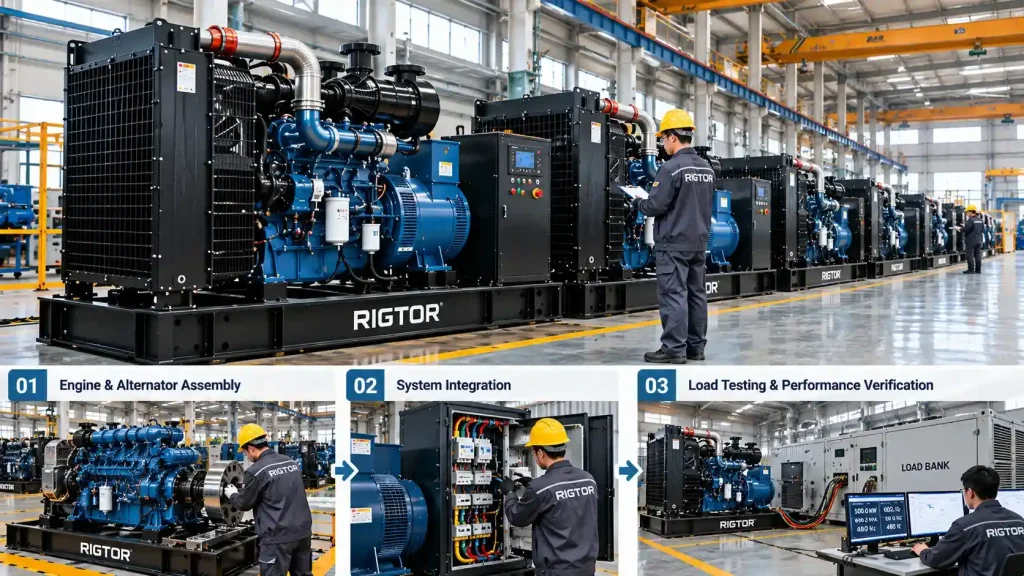
From a manufacturer's perspective, choosing a generator involves matching several systems.
The manufacturer first needs to understand:
Engine selection must consider the required mechanical power, operating speed, duty rating, and environmental conditions.
The selected engine must be suitable for the intended application.
The alternator must provide the required electrical output at the selected rotational speed.
For a conventional 60 Hz synchronous generator, this may involve selecting a four-pole alternator for 1800 RPM or a two-pole alternator for 3600 RPM.
The generator package must integrate:
Appropriate testing helps confirm whether the completed generator set meets its specified requirements.
Depending on the configuration and agreed test scope, this may include load testing, voltage and frequency checks, and protection verification.
The goal is not simply to achieve a particular RPM, but to deliver dependable electrical performance under the required operating conditions.
RIGTOR is a China-based manufacturer of diesel generator sets and temporary infrastructure equipment.
Its equipment portfolio serves construction, mining, infrastructure maintenance, and remote industrial operations.
For industrial generator procurement, selecting an appropriate engine and alternator combination is essential.
Buyers should consider the required electrical output, operating frequency, duty cycle, site conditions, and applicable standards.
RIGTOR's Diesel Generator Systems provide a starting point for exploring available industrial power configurations.
For projects requiring 60 Hz electricity, buyers can discuss suitable generator models and confirm available engine speeds, power ratings, and technical specifications.
For many substantial industrial power applications, 1800 RPM generator sets are a common choice.
However, the better option depends on equipment capacity, operating hours, engine design, noise requirements, and lifecycle cost.
Not necessarily.
Fuel consumption must be compared using actual generator data at equivalent electrical output and operating conditions.
Some high-speed engines may be designed for extended service, but continuous-operation suitability depends on the manufacturer's published duty rating.
RPM alone does not determine whether a generator can operate continuously.
They use different alternator pole configurations.
A four-pole alternator produces 60 Hz at 1800 RPM, while a two-pole alternator produces 60 Hz at 3600 RPM.
Industrial 1800 RPM generator packages may cost more initially than compact 3600 RPM units.
However, price comparisons should use equipment with equivalent power ratings, specifications, and duty requirements.
Yes. Commercially available industrial 500 kW diesel generator sets use 1800 RPM configurations for 60 Hz operation.
The exact rating and suitability depend on the specific generator model.
The difference between 1800 RPM and 3600 RPM generators is more than rotational speed.
The two configurations commonly represent different alternator designs and equipment classes.
For industrial buyers, 1800 RPM generator sets are frequently associated with substantial electrical loads and demanding commercial or industrial applications.
Compact 3600 RPM generators can be appropriate for smaller or more portable power requirements.
However, fuel efficiency, noise, maintenance, service life, and reliability cannot be determined from engine speed alone.
The correct generator should be selected based on actual electrical requirements, published equipment specifications, operating conditions, and total ownership costs.
RIGTOR provides diesel generator systems for construction, mining, and remote industrial power applications.Explore our Diesel Generator Systems or contact our team to discuss your power requirements, operating frequency, and suitable generator configurations.

Behind Every Critical Project.
@ 2026-2026 Rigtor Industry. All Rights Reserved.
 EN
 ES
 PT
 AR