Time: Nov 3 2026 Views: 5
How RIGTOR Configures Factory-Built Equipment for Planned Industrial Maintenance, Shutdowns and Turnaround Projects
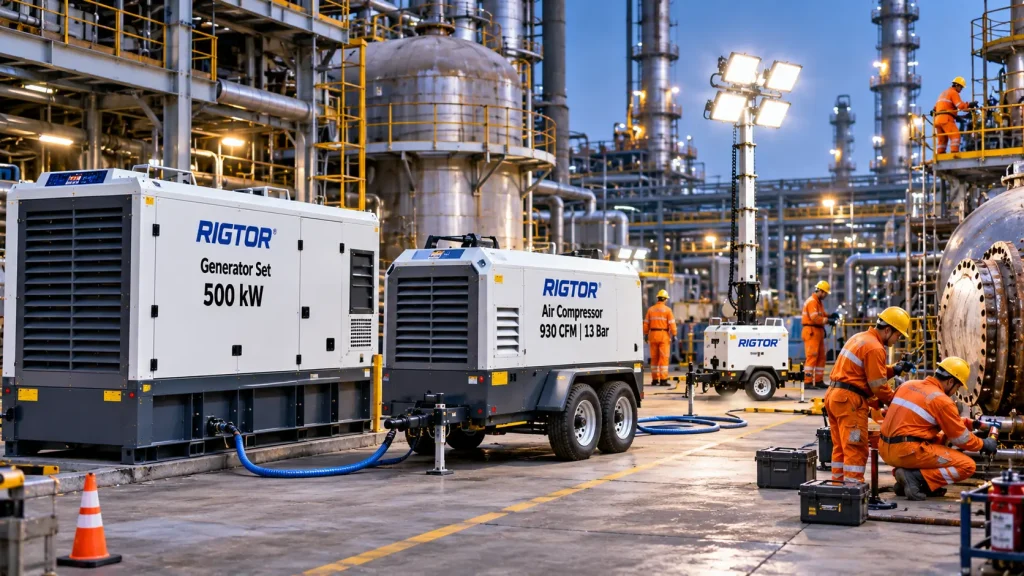
Industrial plant shutdowns and turnarounds are among the most time-sensitive maintenance activities in heavy industry.
Refineries, chemical plants, steel mills, power generation facilities and other industrial operations periodically shut down equipment or production units to conduct inspections, repairs, replacements and major maintenance.
Unlike routine maintenance, a planned shutdown often involves multiple contractors working within a limited time window.
Mechanical maintenance teams, electrical contractors, pipefitters, inspection specialists and cleaning crews may all require temporary infrastructure.
Reliable electrical power, compressed air and mobile lighting are essential to many of these activities.
However, equipment selection must be coordinated before the shutdown begins.
A generator that cannot support the required starting loads, an undersized air compressor or insufficient lighting can disrupt the planned maintenance sequence.
RIGTOR supplies diesel generator sets, portable diesel screw air compressors, mobile lighting towers and mobile surveillance systems for temporary industrial infrastructure applications.
As an equipment manufacturer, RIGTOR approaches shutdown support through application-based equipment selection, configuration review, factory inspection and maintenance preparation.
The objective is to help contractors obtain appropriately specified equipment before the maintenance window begins.
Industrial shutdown projects involve different maintenance activities, each with specific equipment requirements.
| Maintenance Activity | Temporary Equipment Requirements | Main Engineering Considerations |
|---|---|---|
| Mechanical Equipment Overhaul | Power, compressed air, lighting | Tool demand, simultaneous operations |
| Heat Exchanger Maintenance | Power, lighting, selected pneumatic tools | Access restrictions, maintenance conditions |
| Pipework Repair & Replacement | Generator power, compressors, lighting | Welding loads, air requirements, safe positioning |
| Tank & Vessel Maintenance | Power, ventilation, lighting | Confined-space requirements and hazardous areas |
| Surface Preparation & Coating | Compressed air, power | Airflow, pressure, moisture and oil content |
| Valve & Equipment Servicing | Portable power and compressed air | Tool compatibility and maintenance access |
| Night Shift Maintenance | Mobile lighting towers | Illuminance, glare and work-zone coverage |
| Temporary Equipment Storage | Surveillance systems | Access monitoring, communications and autonomy |
Not all applications can be served by standard portable equipment.
Confined-space work, hazardous locations, tank cleaning and certain process operations may require certified equipment, specialist contractors and additional engineered safety systems.
For shutdown projects, equipment planning should begin before the maintenance window.
The contractor provides information about:
RIGTOR reviews the customer's electrical load schedule to identify the required generator capacity and configuration.
The customer identifies pneumatic tools and other compressed-air applications, including required flow, pressure, air quality and simultaneous operation.
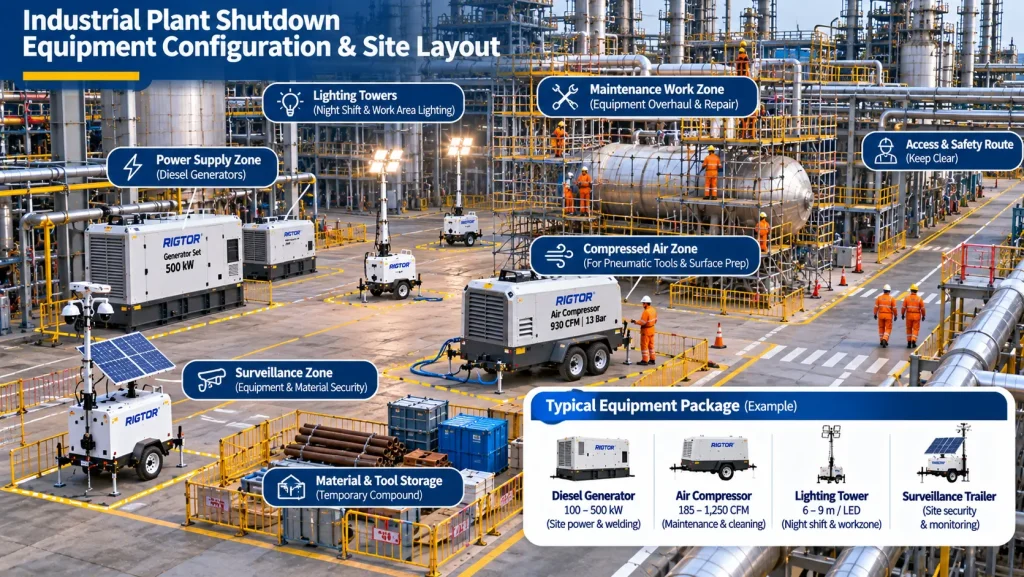
The worksite plan identifies maintenance areas, access routes, night-shift activities and required illumination levels.
Generator, compressor and lighting tower positions are reviewed against approved site restrictions, equipment access and cable or hose routing.
RIGTOR reviews the selected equipment models, available configuration options, manufacturing requirements and factory testing scope.
Operating manuals, maintenance requirements, consumables and agreed spare-parts arrangements should be confirmed before equipment delivery.
During a planned shutdown, permanent electrical systems may be isolated for maintenance.
Temporary diesel generators can support approved electrical loads such as:
However, a temporary generator must not be connected to isolated plant systems without an approved electrical design, isolation procedures and appropriate protection.
Consider an illustrative industrial maintenance area.
| Electrical Load | Running Demand |
|---|---|
| Welding and maintenance equipment | 35 kW |
| Auxiliary pumps | 15 kW |
| Power tools | 10 kW |
| Temporary lighting and facilities | 8 kW |
| Total Connected Running Demand | 68 kW |
These are hypothetical values.
Actual demand depends on simultaneous use, equipment duty cycle, power factor and starting characteristics.
For preliminary evaluation, a 100–125 kW class diesel generator may be considered.
Final sizing must be confirmed through a complete electrical load study.
| Parameter | Why It Matters |
|---|---|
| Prime Power Rating | Supports extended operating schedules where applicable |
| Voltage & Frequency | Must match site equipment |
| Motor Starting Capability | Supports suitable pumps and motors |
| Alternator Performance | Important for load changes and power quality |
| Voltage Regulation | Helps maintain acceptable output conditions |
| Fuel Consumption | Determines fuel logistics and operating costs |
| Cooling Capacity | Must suit ambient and installation conditions |
| Noise Level | Relevant near maintenance crews |
| Control & Protection | Supports safe operation and monitoring |
| Service Access | Allows maintenance without unnecessary disruption |
Depending on the model and engineering scope, RIGTOR can review:
Equipment ratings and options must be verified for the selected generator model.
Compressed air is used in many industrial maintenance activities.
However, the required compressor depends on the application.
Impact wrenches, pneumatic grinders and other approved tools require specific airflow and pressure.
The compressor must support simultaneous tool demand.
Abrasive blasting systems may require significantly higher airflow than general pneumatic tools.
Nozzle diameter, blasting pressure and the number of operators influence compressor selection.
Some cleaning operations use compressed air, but the method must be appropriate for the equipment and site safety requirements.
Instrument air, breathing air, process purging and certain cleaning applications require specialized air-quality or safety requirements.
Standard oil-injected portable compressors must not be assumed suitable for these services.
| Compressor Class | Potential Shutdown Application | Selection Requirement |
|---|---|---|
| 70 CFM / 8 Bar | Selected light pneumatic tools | Verify tool demand |
| 185 CFM Class | General maintenance tools | Confirm rated working pressure |
| 285 CFM / 10 Bar | Multiple tools and selected surface preparation | Verify simultaneous delivered airflow |
| 930 CFM / 13 Bar | High-air-demand maintenance applications | Confirm rated FAD at required pressure |
| 1,250 CFM / 35 Bar | Specialized high-pressure applications | Verify process suitability and full performance data |
These values identify compressor classes for technical evaluation.
The actual simultaneous airflow and pressure must be verified from the selected model's technical documentation.
Suppose three maintenance crews require compressed air.
| Air Consumer | Illustrative Demand |
|---|---|
| Pneumatic tools — Crew A | 65 CFM |
| Pneumatic tools — Crew B | 75 CFM |
| Pneumatic tools — Crew C | 60 CFM |
| Total Simultaneous Demand | 200 CFM |
This calculation assumes all three crews operate simultaneously.
A 285 CFM / 10 Bar class compressor could be evaluated, provided the required pressure, delivered airflow and air-quality conditions are satisfied.
The final selection must also account for hose losses, tool pressure requirements and the actual operating duty.
Industrial shutdowns often involve extended work schedules.
Night-shift maintenance requires appropriate illumination around equipment, access routes and designated work zones.
RIGTOR supplies diesel, solar and hybrid mobile lighting tower configurations.
A representative diesel lighting tower may include:
The number of towers depends on:
A lighting design should be based on verified photometric information rather than nominal wattage alone.
Lighting equipment must not interfere with lifting operations, overhead structures or emergency access.
In hazardous areas, lighting equipment must have the appropriate certification for the location.
Ordinary mobile lighting towers should not be assumed suitable for classified hazardous areas.
Shutdown projects may bring temporary equipment, tools and spare parts into industrial facilities.
Mobile surveillance systems can assist with monitoring designated equipment storage areas and access points.
Potential applications include:
System configuration depends on camera coverage, power autonomy, communications availability and site security requirements.
Surveillance systems supplement rather than replace site security and access-control procedures.
The following project is hypothetical and does not represent an actual RIGTOR customer installation.
An industrial processing plant schedules a 14-day shutdown to complete equipment inspection, mechanical repairs and selected pipework maintenance.
Multiple maintenance contractors will work simultaneously.
The site requires temporary power, compressed air, nighttime lighting and equipment-area monitoring.
| Parameter | Illustrative Value |
|---|---|
| Facility | Industrial processing plant |
| Shutdown Duration | 14 days |
| Maintenance Crews | 3 |
| Daily Working Schedule | 20 hours |
| Connected Running Electrical Load | 68 kW |
| Simultaneous Compressed-Air Demand | 200 CFM |
| Nighttime Work | Required |
| Temporary Equipment Storage | Required |
These figures are illustrative.
| Equipment | Proposed Class | Application |
|---|---|---|
| Diesel Generator | 100–125 kW | Temporary maintenance power |
| Diesel Air Compressor | 285 CFM / 10 Bar | Pneumatic maintenance tools |
| Mobile Lighting Towers | 2 × 7m diesel LED | Selected nighttime work zones |
| Mobile Surveillance Trailer | 1 unit | Temporary equipment compound |
This package is intended for a suitable non-hazardous support area.
It is not a complete industrial shutdown engineering design.
All equipment selections require verification against actual loads, site conditions and safety requirements.
Equipment placement is especially important in an operating industrial facility.
Even during a shutdown, parts of the plant may remain energized or contain hazardous materials.
             INDUSTRIAL PROCESSING PLANT
                    NOT TO SCALE

   ┌─────────────────────────────────────────┐
   │        PROCESS EQUIPMENT AREA           │
   │                                         │
   │   [MAINTENANCE ZONE A]                  │
   │                                         │
   │   [MAINTENANCE ZONE B]                  │
   │                                         │
   │   [MAINTENANCE ZONE C]                  │
   │                                         │
   └─────────────────────────────────────────┘
                       │
          Approved Power / Air Routes
                       │
   =================================================
      ASSESSED NON-HAZARDOUS SUPPORT EQUIPMENT AREA
   =================================================

    [GENERATOR]            [AIR COMPRESSOR]
         │                       │
    Power Cables               Air Hoses
         │                       │

    [LIGHT TOWER A]         [LIGHT TOWER B]

    [SPARE PARTS / MAINTENANCE STORAGE]

    [SURVEILLANCE]          [ACCESS CONTROL]

   -------------------------------------------------
             VEHICLE / EMERGENCY ACCESS
   -------------------------------------------------
This is a conceptual layout only.
Hazardous-area boundaries, separation distances and final equipment positions must be established by qualified site personnel.
Diesel equipment, electrical connections and lighting systems must be suitable for the designated installation area.
Generators, compressors, trailers and temporary cables must not obstruct emergency routes, firefighting equipment or evacuation paths.
Equipment should be positioned to avoid lifting zones, hot-work hazards, confined-space access points and other restricted areas.
Diesel exhaust must be managed to prevent exposure of workers and contamination of occupied or enclosed areas.
Cable and hose routes should be coordinated with the shutdown work plan and protected against mechanical damage.
Technicians should have appropriate access to service panels, filters and approved maintenance points.
The deployment plan should allow equipment to be safely disconnected and removed before plant restart.
The maintenance window is not the ideal time to discover equipment incompatibility.
Contractors should complete key preparation activities before the shutdown begins.
Confirm:
Complete:
Monitor:
Ensure temporary systems are safely isolated, disconnected and removed as required by the approved restart plan.
Industrial maintenance contractors may operate at facilities with different electrical systems, access restrictions and equipment requirements.
As a manufacturer, RIGTOR can review equipment configurations against these requirements.
Potential options include:
Potential options include:
Potential options include:
Potential options include camera arrangement, power autonomy and communications interfaces.
All options depend on model availability and engineering feasibility.
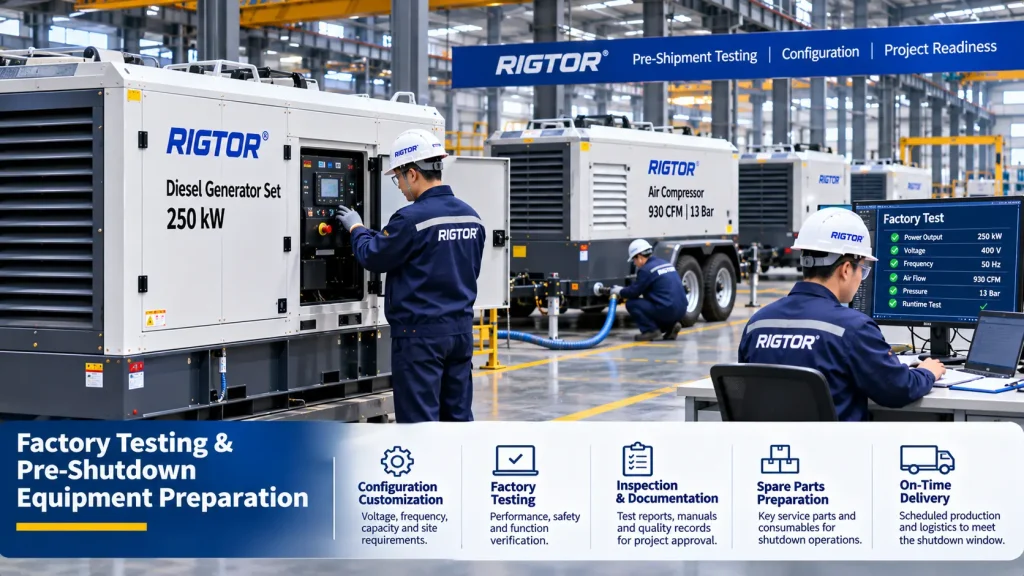
For shutdown contractors, equipment should arrive with its agreed specifications and required documentation.
RIGTOR's manufacturing process can incorporate inspection and testing requirements defined in the purchase agreement.
Verify relevant components against approved specifications.
Review mechanical, electrical and structural assembly requirements.
Diesel Generators: Electrical output, control functions and applicable protection checks.
Diesel Air Compressors: Pressure, airflow and operating checks according to the agreed test scope.
Lighting Towers: Mast, stabilizer, lighting and control checks.
Surveillance Systems: Power, camera and communications checks.
Customers should confirm the required:
Specific test procedures, acceptance criteria and documents must be agreed before delivery.
Industrial shutdowns often involve extended operating hours over a relatively short period.
Maintenance planning should therefore account for the expected equipment duty.
Monitor operating hours, engine service requirements, fuel systems and cooling performance.
Inspect air filters, lubricant systems, separators, cooling systems and pressure controls.
Inspect mast mechanisms, electrical connections, fixtures and stabilizers.
Depending on the selected equipment, contractors may prepare:
RIGTOR can discuss spare-parts requirements and technical documentation as part of the equipment supply process.
Availability and delivery commitments should be confirmed for each model.
A delayed shutdown can create substantial costs.
However, the financial value of equipment preparation depends on the actual project schedule and whether temporary equipment affects critical-path activities.
Consider a maintenance contractor preparing temporary infrastructure for a planned shutdown.
Two approaches are compared.
| Metric | Separately Coordinated Equipment | Pre-Configured Equipment Package |
|---|---|---|
| Equipment setup and checks | 12 hours | 8 hours |
| Crew size | 4 technicians | 4 technicians |
| Labor rate | $65/hour | $65/hour |
| Total setup labor | $3,120 | $2,080 |
Illustrative setup labor savings: $1,040.
The example assumes equivalent safety checks and commissioning requirements.
Suppose a critical maintenance activity is delayed by three hours and the project assigns an internal cost exposure of $4,000 per hour.
Potential schedule-related exposure:
3 × $4,000 = $12,000.
This does not establish that any particular RIGTOR product would prevent the delay.
The value of advance equipment planning is reducing avoidable uncertainty, not guaranteeing a shorter shutdown.
If the setup labor savings and the avoided delay are independent and both actually occur, the modeled benefit would be:
$1,040 + $12,000 = $13,040.
These figures are hypothetical and are not verified customer results or guaranteed savings.
For shutdown and turnaround projects, equipment suppliers must understand the importance of preparation, technical compatibility and delivery requirements.
RIGTOR's manufacturing and supply approach emphasizes five capabilities.
| Capability | Value for Shutdown Contractors |
|---|---|
| Complementary Equipment Portfolio | Coordinate temporary power, compressed air, lighting and surveillance |
| Application-Based Selection | Match equipment to maintenance activities and operating conditions |
| Factory Customization | Review model-specific technical and installation requirements |
| Quality-Control Planning | Define inspection and functional testing before delivery |
| Maintenance Preparation | Plan technical documents, consumables and spare-parts requirements |
Our objective is to support contractors with equipment configured for their maintenance activities and agreed project requirements.
Industrial shutdowns and turnarounds require careful coordination of people, equipment and maintenance activities.
Temporary power, compressed air and lighting are important parts of that preparation.
However, selecting the correct machines requires a clear understanding of electrical loads, pneumatic demand, worksite conditions and safety restrictions.
RIGTOR supplies diesel generators, portable diesel screw air compressors, mobile lighting towers and surveillance systems for suitable industrial maintenance applications.
As an equipment manufacturer and supplier, we focus on application-based configuration, manufacturing requirements, factory testing and maintenance preparation.
For shutdown contractors, the most valuable equipment is equipment that has been properly specified and prepared before the maintenance window begins.
Shutdown contractors may require diesel generators, portable air compressors, mobile lighting towers and temporary surveillance systems. The exact equipment depends on the maintenance scope and site conditions.
Generator selection requires a complete electrical load schedule, including running loads, starting requirements, voltage, frequency and expected operating duty.
The required compressor depends on the pneumatic tools, simultaneous air demand, working pressure and air-quality requirements.
Only where the equipment is suitable for the installation area and complies with the site's safety requirements. Hazardous-area classifications must be reviewed before deployment.
Yes, when appropriately selected and positioned. Lighting design must consider required illuminance, work-area geometry, glare and any hazardous-location requirements.
Advance equipment specification, coordinated delivery, documented setup procedures and pre-delivery testing may reduce avoidable preparation work without omitting required safety checks.
RIGTOR can review model-specific requirements involving voltage, frequency, compressor capacity, mounting arrangements, controls and other available options.
Testing may include generator electrical checks, compressor pressure and airflow verification, lighting tower functional checks and relevant inspection documentation.
The list depends on the equipment model and expected operating hours. Common categories include filters, approved lubricants, selected compressor components and electrical service items.
Customers should provide the facility type, shutdown schedule, electrical loads, compressed-air requirements, lighting needs, site restrictions and applicable technical standards.
Temporary Power. Compressed Air. Mobile Lighting. Equipment Monitoring.
Share your shutdown schedule, maintenance scope and technical requirements with RIGTOR.
Our team can review suitable equipment configurations, factory customization options and pre-delivery requirements.
Contact RIGTOR for an Industrial Shutdown Equipment Proposal.

Behind Every Critical Project.
@ 2026-2026 Rigtor Industry. All Rights Reserved.
 EN
 ES
 PT
 AR