
Time: Nov 3 2026 Views: 4
A Practical Selection Guide for Outdoor Sports Fields from 200 m² to Full-Size Football Pitches
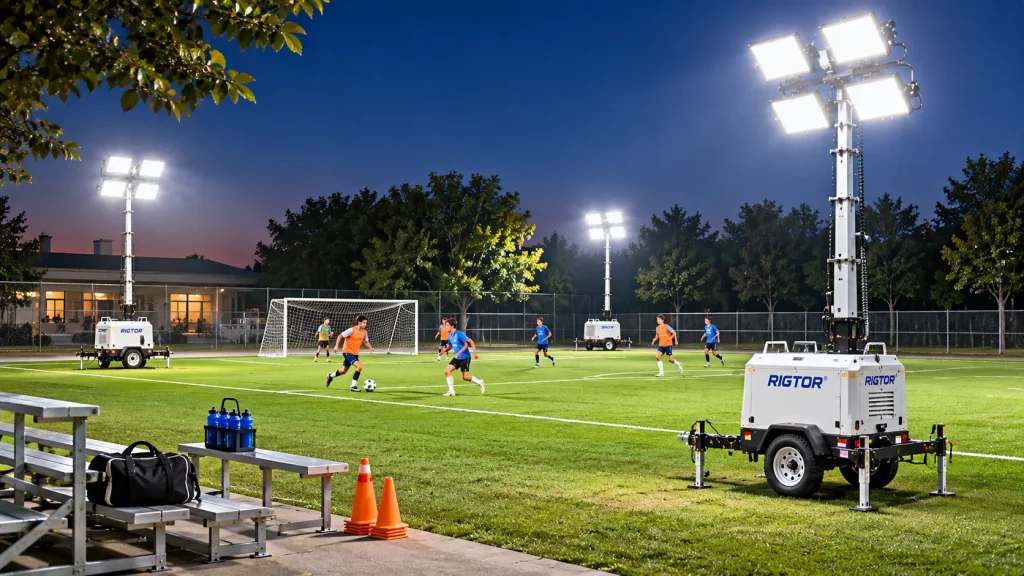
Outdoor sports fields often need temporary lighting for evening training, recreational games, seasonal events and maintenance activities.
Installing permanent floodlights is not always practical, especially for rented facilities, temporary venues and community sports grounds with limited budgets.
Mobile LED lighting towers provide a flexible alternative for selected applications. They can be relocated between playing areas, deployed for seasonal use and removed when no longer needed.
But how many mobile lighting towers does a sports field actually need?
The answer depends on more than field size. Sport type, target illuminance, light distribution, mast height and the intended level of play all affect the selection.
This guide explains how to evaluate RIGTOR mobile lighting towers for different outdoor sports field sizes, from small practice areas to large football grounds.
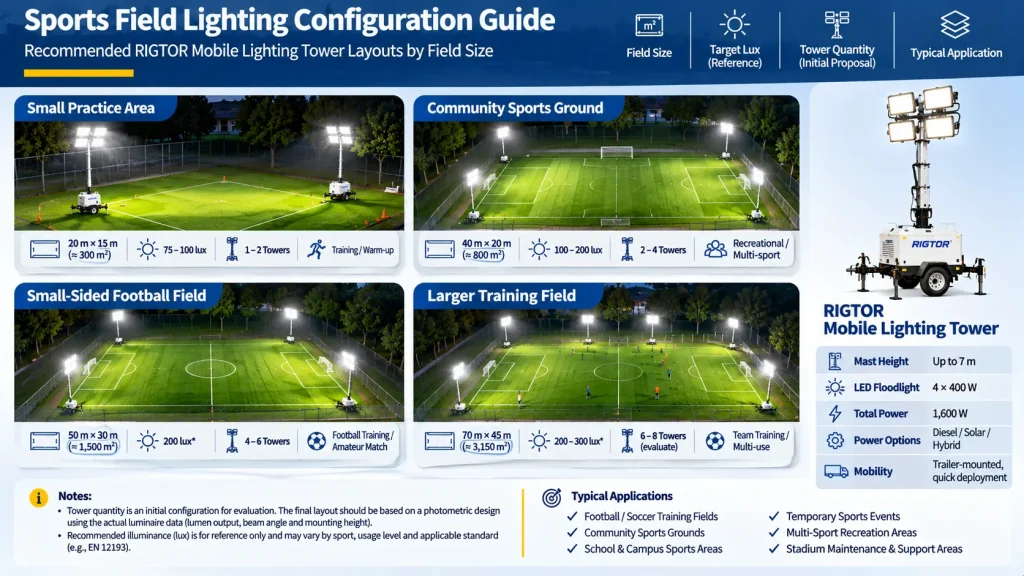
The following table helps buyers identify a starting configuration for their project.
| Outdoor Area | Typical Application | Initial RIGTOR Configuration to Evaluate |
|---|---|---|
| 200–500 m² | Small practice zones, sports activity areas | 1–2 mobile LED light towers |
| 500–1,000 m² | Small training grounds, recreational activity areas | 2–4 mobile LED light towers |
| 1,000–2,000 m² | Small-sided football and multi-sport grounds | 4–6 mobile LED light towers |
| 2,000–4,000 m² | Larger training fields and temporary sports grounds | Multiple towers; engineering review required |
| 4,000–7,000 m² | Large football training areas | Site-specific photometric design required |
| 7,000 m² and above | Full-size football pitches and stadiums | Dedicated sports floodlighting generally preferred |
Important: The quantities above are preliminary layout concepts, not verified coverage ratings or guarantees of sports-lighting compliance. They are intended to help customers begin an equipment discussion. A smaller or larger number of towers may be required following photometric calculations.
RIGTOR's representative mobile LED tower has a 7m mast and four 400W LED floodlights, giving 1,600W of nominal installed lighting power.
The actual number of towers required must be calculated using the selected fixtures' verified lumen output, beam distribution, aiming angles and the field's lighting requirements.
Recommended starting point: 1–2 RIGTOR mobile LED lighting towers for evaluation.
Small outdoor activity areas are among the more practical applications for portable lighting.
Examples include:
Field dimensions: 20m × 15m
Total area: 300 m²
For general supervised recreational activity, the venue operator might initially investigate a 75–100 lux average horizontal illuminance target.
The appropriate requirement must be confirmed for the actual sport and level of play.
A possible starting layout places two RIGTOR 7m mobile towers on opposite sides of the activity area, outside the required player safety clearance.
Each tower can direct its floodlights toward the assigned area.
| Item | Initial Selection |
|---|---|
| Lighting Tower | RIGTOR 7m LED Mobile Lighting Tower |
| LED Configuration | 4 × 400W per tower |
| Number of Towers | 1–2 for preliminary assessment |
| Power System | Diesel, solar or hybrid depending on operating requirements |
| Application | Small practice and activity areas |
One tower may be suitable for localized activity lighting, but two or more positions are often worth evaluating when shadows and uniformity matter.
A photometric study must confirm whether the configuration meets the required lighting level.
Recommended starting point: 2–4 RIGTOR mobile LED lighting towers for evaluation.
This category includes community sports areas that need temporary evening lighting but do not necessarily require permanent stadium infrastructure.
Field dimensions: 40m × 20m
Total area: 800 m²
Possible activities include recreational football, fitness training and community sports programs.
A preliminary layout may evaluate four mobile lighting towers positioned around the perimeter.
All towers must remain outside the playing area and required safety run-offs.
Several lighting positions can help reduce severe shadows and allow more balanced illumination.
However, adding towers does not automatically improve uniformity. Incorrect aiming can create glare or bright spots.
Four towers with four 400W LED fixtures each would provide:
This is a connected fixture-power calculation, not a measured lighting-performance result.
Diesel towers may be suitable for frequent nighttime operation. Solar or hybrid configurations can also be evaluated where operating schedules, solar availability and battery capacity support the required lighting duration.
Recommended starting point: 4–6 RIGTOR mobile LED lighting towers for preliminary design comparison.
Small-sided football is a potential market for portable lighting, particularly at temporary training facilities.
Field dimensions: 50m × 30m
Total area: 1,500 m²
A training facility may want to operate several evenings per week without investing immediately in permanent lighting poles.
An engineering study could begin by comparing four-tower and six-tower arrangements.
A six-tower concept might use three lighting positions along each long side of the field.
This provides several aiming locations rather than relying on two distant light sources.
| Configuration | Installed LED Power | Initial Assessment |
|---|---|---|
| 4 RIGTOR towers | 6.4 kW | Evaluate for lower-demand use |
| 6 RIGTOR towers | 9.6 kW | Evaluate for improved coverage options |
Neither configuration is guaranteed to achieve the required illuminance or uniformity.
Before selecting equipment, confirm:
A mobile lighting tower originally designed for industrial area lighting may need different optical arrangements to perform well in sports applications.
Recommended approach: request a lighting design before determining tower quantity.
Medium-sized playing areas create a more demanding lighting challenge.
Total area: 3,150 m²
At this size, simply increasing the number of 7m towers may not produce acceptable lighting.
The distance between the light source and the center of the field becomes important.
Potential problems include:
Customers can compare:
Option A — Standard Mobile Lighting Towers
Evaluate multiple 7m towers for lower-demand temporary activities, subject to photometric verification.
Option B — Modified Lighting Configuration
Discuss alternative floodlight optics, fixture arrangements or other feasible customization.
Option C — Dedicated Sports Lighting
Where higher illuminance or uniformity is required, a purpose-designed sports floodlighting system may be more appropriate.
RIGTOR should not recommend a fixed tower quantity until the lighting requirements and optical data have been reviewed.
Large football training areas require a different selection approach.
Total area: 5,400 m²
The main issue is no longer simply providing enough total light output.
The lighting system must distribute that light effectively over a large playing surface.
A 7m mobile tower positioned outside the field may have difficulty reaching distant playing areas without excessive aiming angles or glare.
RIGTOR can review temporary lighting requirements for peripheral areas, maintenance zones, training support spaces and selected activities.
For full-field nighttime football training, the customer should first commission a sports-lighting calculation.
Depending on the results, higher-mounted floodlights or dedicated sports lighting equipment may be necessary.
Standard mobile construction lighting towers should not be assumed suitable for full-field illumination.
A typical full-size football pitch measures approximately 105m × 68m.
Total playing area: 7,140 m²
At this scale, professional lighting design becomes essential.
FIFA's stadium guidance emphasizes horizontal illuminance, uniformity, glare control and, for televised events, vertical illuminance and additional broadcast requirements.
RIGTOR's standard 7m mobile lighting towers should not be presented as a direct substitute for dedicated professional stadium floodlighting.
The required mounting heights, beam geometry, light output and uniformity may be beyond what a standard temporary area-lighting tower can economically provide.
Even at a large stadium, mobile lighting towers can support:
These applications may offer a better fit for RIGTOR's existing equipment portfolio than professional match lighting.
Lighting requirements depend on the sport, competition level and applicable standard.
The following figures are examples from published EN 12193-related sports-lighting guidance, not universal requirements for every venue.
| Sport / Use | Illustrative Average Horizontal Illuminance |
|---|---|
| Recreational football training | 75 lux |
| Football competition, intermediate class | 200 lux |
| Recreational tennis, Class III | 200 lux |
| Tennis, Class II | 300 lux |
Actual projects must also satisfy applicable uniformity, glare, colour-rendering and other requirements.
For professional football stadiums, the requirements can be substantially higher.
For example, UEFA's Level B stadium lighting guide specifies average horizontal illuminance greater than 1,400 lux, alongside separate uniformity, vertical illuminance and glare requirements.
This illustrates why recreational sports lighting and professional stadium lighting should be treated as different applications.
A useful preliminary calculation starts with field area and target illuminance.
Required light incident on the playing surface:
Field Area × Target Average Illuminance
Assume:
Then:
800 × 100 = 80,000 lumens incident on the playing surface, expressed as the required average illuminance multiplied by area.
This does not mean that an 80,000-lumen lighting tower would be sufficient.
The installed fixtures must produce additional light to account for optical distribution, light falling outside the target area, maintenance losses and other design factors.
A preliminary lumen-method relationship is:
Required Installed Lumens ≈ (Area × Target Lux) ÷ (Utilization Factor × Maintenance Factor)
The utilization factor represents the portion of fixture output effectively delivered to the target surface.
The maintenance factor accounts for expected light-output reduction over time.
Both depend on the actual equipment and installation.
For illustration only, assume:
Estimated installed lumens:
80,000 ÷ (0.40 × 0.80) = 250,000 lumens
This is an illustrative estimate, not a verified RIGTOR lighting-tower output requirement.
A final design must use actual fixture photometric files and evaluate illuminance at points across the playing surface.
RIGTOR offers different mobile lighting power configurations for temporary applications.
| Power Type | Potentially Suitable Use | Key Selection Consideration |
|---|---|---|
| Diesel Lighting Tower | Regular nighttime activities and longer operating periods | Fuel supply, noise, maintenance |
| Solar Lighting Tower | Suitable lower-demand or shorter-duration applications | Solar resource, battery capacity, actual lighting load |
| Hybrid Lighting Tower | Sites seeking reduced engine operating time | Battery storage, generator operation and load profile |
Diesel-powered units are a practical option where nighttime operation is frequent and dependable on-site fuel supply is available.
Solar configurations may be attractive for selected outdoor activity areas, but battery autonomy must be calculated from the actual lighting power and operating hours.
A solar-powered system cannot be selected solely from the size of the sports field.
Hybrid systems combine energy sources and may reduce generator operating hours under suitable conditions.
The economic benefit depends on fuel costs, usage schedules, battery capacity and the system configuration.
To prepare an application-specific proposal, customers should provide:
| Information | Example |
|---|---|
| Sport Type | Football, tennis, basketball, multi-sport |
| Field Dimensions | 40m × 20m |
| Intended Use | Training, recreation, competition |
| Required Illuminance | 100 lux, or applicable standard |
| Operating Hours | 6:00 PM–10:00 PM |
| Operating Days | 4 evenings per week |
| Power Preference | Diesel, solar or hybrid |
| Tower Placement Restrictions | Perimeter access and player safety zones |
| Site Location | Country, climate and wind conditions |
| Additional Requirements | Noise limits, glare control, lighting calculations |
With this information, RIGTOR can review the suitability of its mobile lighting tower models and available configuration options.
A verified lighting design may require additional fixture data and specialist photometric analysis.
RIGTOR manufactures and supplies mobile lighting systems for temporary infrastructure applications.
For outdoor sports projects, our engineering and manufacturing discussions can cover:
Customization availability depends on the selected model and engineering feasibility.
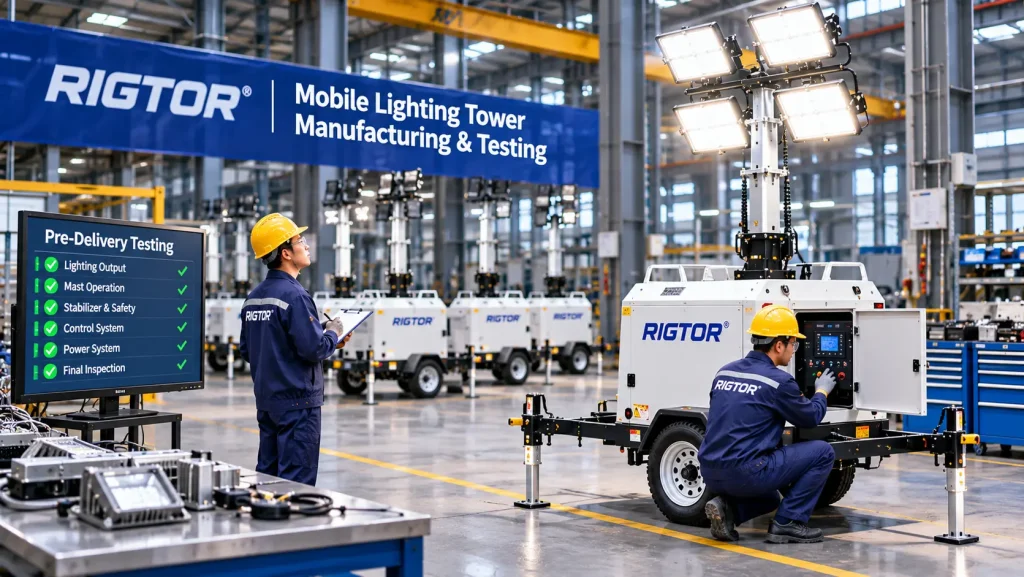
Before shipment, the agreed inspection scope may include:
Where sports-lighting performance is required, customers should request verified luminaire photometric data and a project-specific lighting calculation.
For small recreational areas below 1,000 m², RIGTOR's 7m LED mobile lighting tower is a reasonable product to evaluate first.
For small-sided sports grounds between 1,000 and 2,000 m², a multiple-tower layout can be considered, with lighting simulation used to confirm the required performance.
For larger training fields, equipment selection should begin with a photometric design rather than a fixed tower-count recommendation.
For full-size football stadiums and professional competition fields, dedicated sports floodlighting is generally the more appropriate starting point.
RIGTOR mobile lighting towers may still provide valuable support for stadium parking, access, maintenance and temporary event areas.
The correct selection depends on the required lighting performance—not simply the field's area.
One or two towers may be evaluated as a preliminary arrangement for selected recreational activities. The final quantity depends on the sport, illuminance target and fixture photometric performance.
A preliminary study may compare several tower arrangements, such as two- and four-position layouts. No specific quantity should be purchased without confirming the required lighting performance.
A single tower may provide localized illumination, but full-court sports lighting requires verification of illuminance, uniformity and glare. Multiple lighting positions or dedicated sports fixtures may be needed.
They may be considered for certain temporary uses, but tennis requires careful control of glare and illumination for players tracking balls in the air. Standard construction lighting towers may not meet the required performance.
The best configuration depends on field size, required illuminance, operating hours and power availability. Diesel, solar and hybrid models should be compared against the actual operating schedule.
Only if the battery capacity, usable stored energy, solar charging conditions and actual fixture load support the required operating duration.
A 7m mast may be insufficient for suitable full-field lighting, particularly where glare control and uniformity are important. A professional lighting design is required.
Start with field dimensions and target illuminance, then use verified luminaire photometric data to calculate the required number and positioning of towers.
RIGTOR can review available mast, fixture, power-system and control options for the selected models. Feasibility must be conf

Behind Every Critical Project.
@ 2026-2026 Rigtor Industry. All Rights Reserved.
 EN
 ES
 PT
 AR