

Time: Oct 26 2026 Views: 14
Understanding diesel engines, alternators, voltage regulation, and generator manufacturing from an industrial equipment manufacturer's perspective.
Diesel generators are widely used to supply electricity to construction sites, mining operations, industrial facilities, emergency response locations, and remote projects where reliable grid power is unavailable.
But how does a diesel generator work, and how can a machine powered by diesel fuel produce electricity for industrial equipment?
The basic principle is straightforward: a diesel engine converts fuel energy into mechanical rotation, while an alternator converts that rotation into electrical energy.
However, producing reliable electricity involves more than connecting an engine to an alternator. The generator must maintain acceptable voltage and frequency, respond to changing electrical loads, manage engine temperature, and protect connected equipment.
This article explains how diesel generators work step by step, examines their main components, and explores the engineering considerations involved in manufacturing dependable diesel generator sets.
A diesel generator is an electrical power generation system that combines a diesel engine with an alternator to produce electricity.
It is also commonly called a diesel generator set or diesel genset.
Unlike a battery, which stores electrical energy, a diesel generator produces electricity continuously while sufficient fuel is available and the equipment operates within its rated conditions.
The two principal components are:
Diesel Engine: Converts chemical energy from diesel fuel into mechanical power.
Alternator: Converts mechanical rotation into alternating-current electrical power.
A complete generator set also includes a fuel system, cooling system, lubrication system, voltage regulation, control equipment, and protective devices.
Diesel generators are commonly used for:
Depending on the application, generator sets may be supplied in open-type, sound-attenuated, trailer-mounted, or containerized configurations.
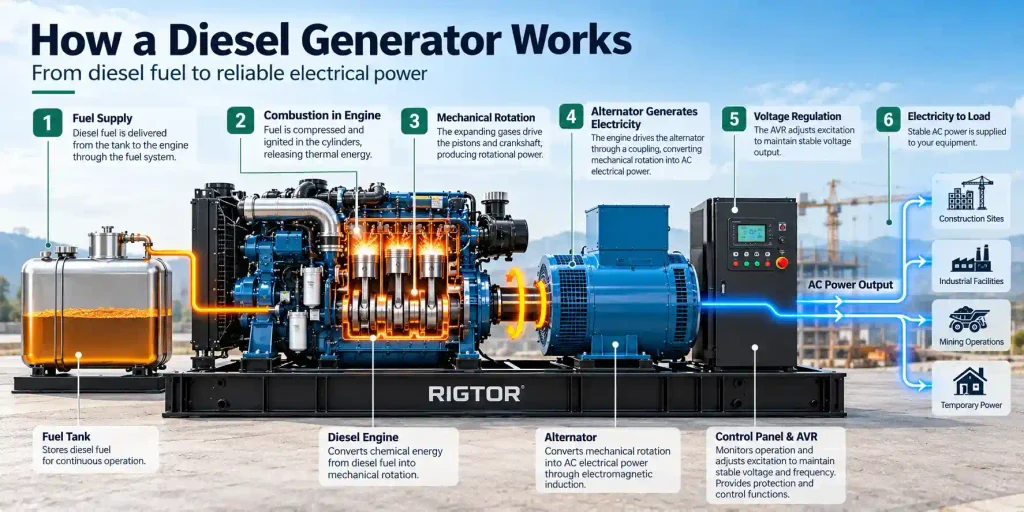
The electricity generation process can be divided into five main stages.
Diesel fuel is delivered from the fuel tank through the fuel supply system to the engine's injection equipment.
Inside the engine cylinders, air is compressed to a high pressure and temperature.
Fuel is then injected into the hot compressed air, causing combustion.
Unlike conventional spark-ignition gasoline engines, diesel engines normally use compression ignition rather than spark plugs.
The combustion process releases thermal energy that drives the engine's pistons.
The expanding combustion gases push the pistons downward.
Connecting rods transfer the pistons' reciprocating motion to the crankshaft, producing rotational mechanical power.
In a conventional four-stroke diesel engine, the operating cycle consists of:
The crankshaft continues rotating as the engine repeats these cycles.
This mechanical rotation provides the energy required to drive the alternator.
The diesel engine and alternator are mechanically coupled.
As the engine crankshaft rotates, it drives the alternator rotor.
The rotor produces a rotating magnetic field, which interacts with the alternator's stator windings.
Through electromagnetic induction, this changing magnetic field generates an alternating electrical voltage in the stator.
The alternator therefore converts mechanical power into electrical power.
Importantly, the diesel engine does not directly produce electricity. Its function is to provide the mechanical energy required by the alternator.
Electrical equipment requires a supply voltage within an acceptable operating range.
An Automatic Voltage Regulator, commonly called an AVR, helps maintain generator output voltage.
In a typical brushless synchronous alternator, the AVR adjusts the excitation system to regulate the magnetic field and maintain the desired voltage.
When the electrical load changes, the AVR responds by adjusting excitation.
However, an AVR cannot independently correct every voltage disturbance. Its performance depends on the alternator, excitation system, load characteristics, and operating conditions.
Once the generator reaches its required operating conditions, electrical power can be supplied through the output circuit breaker and distribution equipment.
The electricity may power:
The generator's control system monitors important operating parameters and can initiate warnings or shutdowns when specified protection limits are exceeded.
The result is a complete mechanical-to-electrical energy conversion system.
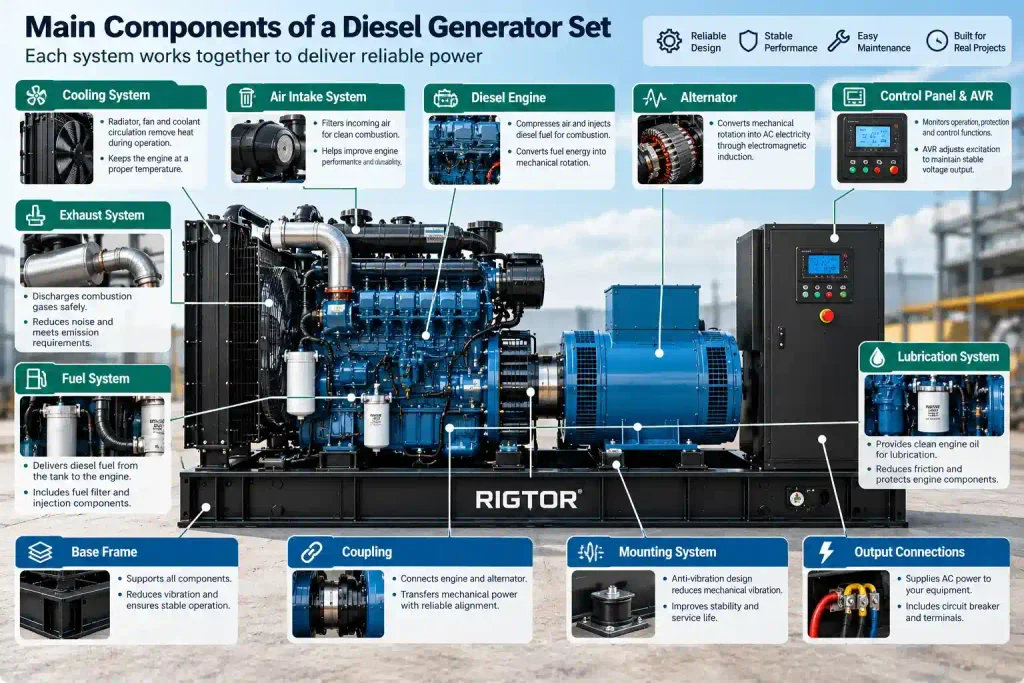
Understanding the principal components helps explain why generator performance depends on the complete equipment configuration.
The diesel engine is the prime mover.
Its rated power, operating speed, fuel consumption, cooling capability, and load response influence generator performance.
Engine selection must consider the intended operating conditions, including ambient temperature, altitude, duty cycle, and required electrical output.
The alternator produces electrical power from mechanical rotation.
Important characteristics include:
The alternator must be matched to the engine and the electrical load.
The AVR controls excitation to help regulate output voltage.
Correct AVR selection and adjustment are particularly important when the generator supplies equipment with changing electrical demands.
The engine governor regulates engine speed by controlling fuel delivery or related engine-management functions.
In an alternating-current generator, engine speed is closely related to electrical frequency.
The governor responds to load changes by adjusting engine output to maintain the required speed.
Diesel engines generate significant heat during operation.
The cooling system removes excess heat through coolant circulation, heat exchangers, radiators, and fans, depending on the engine design.
Adequate cooling is especially important for continuous operation in demanding industrial environments.
Engine oil reduces friction, removes heat from moving components, and helps protect the engine against excessive wear.
Oil pressure and temperature monitoring are important parts of generator protection.
The control panel provides monitoring, starting and stopping functions, alarms, and protective controls.
Depending on the configuration, it may display voltage, frequency, current, engine speed, operating hours, coolant temperature, and other parameters.
Some generator sets can also support remote monitoring and automatic operation.
One of the most important aspects of generator operation is maintaining acceptable electrical output while the connected load changes.
Voltage and frequency are controlled through related but different mechanisms.
Voltage regulation is primarily associated with the alternator excitation system.
The AVR senses generator output voltage and adjusts excitation to maintain the configured voltage setpoint.
For example, when a large electrical load is connected, the generator may experience a temporary voltage reduction.
The AVR responds by changing excitation, while the engine and alternator respond to the additional electrical demand.
The final voltage response depends on the generator design and load characteristics.
Generator frequency depends on the rotational speed of the alternator and its number of magnetic poles.
For a synchronous alternator:
Frequency (Hz) = Rotor Speed (RPM) × Number of Poles / 120
For a four-pole alternator:
1,500 RPM produces 50 Hz.
1,800 RPM produces 60 Hz.
This is why many industrial diesel generator sets operate at 1,500 or 1,800 RPM.
Other speed and pole combinations are possible.
When electrical demand increases, the engine governor must supply additional mechanical power to help maintain the required rotational speed.
Industrial electrical equipment is designed to operate within specified voltage and frequency limits.
Excessive deviations can cause problems for motors, electronic controls, and other connected devices.
Generator engineering must therefore consider not only rated output power but also dynamic response under changing loads.
A diesel generator does not always operate under a constant load.
For example, a construction site may use lighting, pumps, compressors, and electric motors at different times.
When a motor starts, it may draw significantly more current than during normal operation.
This sudden electrical demand can cause a temporary reduction in generator voltage and frequency.
The generator responds through two main systems:
Engine Governor Response
The governor increases engine fuel delivery as necessary to provide additional mechanical torque.
Alternator Excitation Response
The AVR adjusts excitation to help maintain the required electrical voltage.
The effectiveness of this response depends on several factors:
A generator that can supply a motor's normal running power may not necessarily be capable of starting that motor without excessive voltage or frequency deviation.
This is one reason why industrial generator selection should consider motor starting requirements rather than relying exclusively on total running kW.
For buyers comparing equipment, RIGTOR provides a range of Diesel Generator Systems for temporary and industrial power applications.
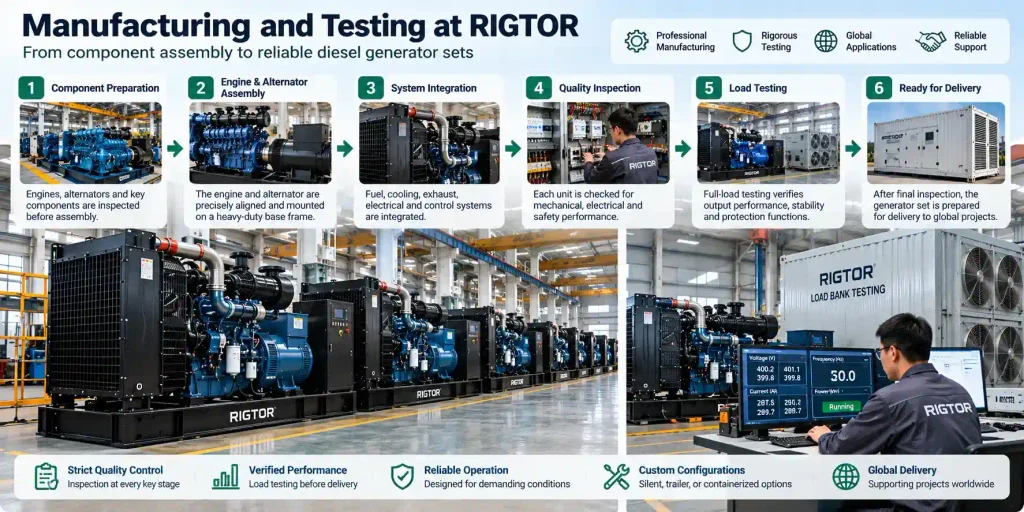
Understanding how a generator works also helps explain why manufacturing quality is important.
A generator set combines several mechanical, electrical, and control systems into one operating machine.
The final performance depends on appropriate component selection, assembly, integration, and verification.
The first engineering consideration is matching the diesel engine to the alternator and the required electrical output.
The engine must provide sufficient mechanical power for the intended duty.
The alternator must support the required voltage, frequency, load characteristics, and operating conditions.
An unsuitable combination may create performance limitations even when the individual components are of acceptable quality.
The engine and alternator are mounted on a common base frame or suitable structural arrangement.
Depending on the design, assembly considerations include:
For sound-attenuated generator sets, enclosure design also affects ventilation, service access, and noise performance.
The electrical system connects the alternator, control panel, protection devices, and output terminals.
Proper electrical integration requires attention to wiring, grounding, circuit protection, sensor connections, and control compatibility.
The selected controller should support the monitoring and protection functions required by the project.
Testing is essential for determining whether an assembled generator performs according to its specified requirements.
Typical factory verification activities may include:
The exact testing procedure should be defined according to the generator model, applicable standards, and agreed customer requirements.
Test records can provide useful evidence of equipment performance before delivery.
RIGTOR is a China-based industrial equipment manufacturer focused on temporary infrastructure systems for construction, mining, emergency response, and remote industrial operations.
Its product portfolio includes diesel generator systems, mobile lighting towers, portable diesel air compressors, and surveillance trailers.
Within its power generation business, RIGTOR focuses on generator set configurations for different operating environments and project requirements.
Industrial customers may require different generator configurations depending on their electrical loads, operating frequency, installation environment, and mobility requirements.
Relevant options may include:
Configuration availability and technical specifications should be confirmed for each project.
For a generator set manufacturer, the objective is not simply to provide a diesel engine with a specified power rating.
The engine, alternator, controls, cooling arrangement, and structural configuration must be considered as a complete system.
RIGTOR works with industrial buyers to review equipment requirements and identify suitable generator configurations from its available product range.
Overseas buyers should confirm the required voltage, frequency, environmental conditions, applicable standards, and project-specific documentation before ordering.
Depending on the application, additional considerations may include transportation dimensions, acoustic requirements, fuel storage arrangements, and maintenance access.
These factors can influence both the generator configuration and the final quotation.
Understanding how a diesel generator works is the foundation of proper equipment selection.
However, the correct generator size depends on the actual electrical requirements.
Before requesting a quotation, buyers should identify:
Required Power Output
Determine the total operating load in kW and the apparent power requirement in kVA.
Starting Loads
Identify motors, pumps, compressors, and other equipment that may create significant starting current.
Operating Frequency and Voltage
Confirm whether the project requires 50 Hz or 60 Hz and the appropriate voltage configuration.
Operating Duty
Determine whether the generator will provide standby, prime, or other defined duty service.
Environmental Conditions
Consider ambient temperature, altitude, ventilation, dust, humidity, and installation conditions.
Mobility and Noise Requirements
Select an open-type, silent, trailer-mounted, or other appropriate generator arrangement.
For projects requiring temporary or remote electricity, explore RIGTOR's industrial diesel generator models to review available equipment configurations.
Most industrial diesel generator sets use alternators to produce alternating-current (AC) electricity.
Direct-current systems are also possible through suitable generation or power-conversion arrangements.
Some diesel generator sets are designed for extended operation under defined duty ratings.
Actual operating duration depends on fuel supply, equipment rating, cooling, maintenance requirements, and manufacturer specifications.
A standby-rated generator should not automatically be treated as suitable for unrestricted continuous operation.
The alternator converts mechanical rotation from the diesel engine into electrical energy through electromagnetic induction.
Without a generator or suitable electrical conversion device, the engine's mechanical rotation does not directly supply usable electrical power.
kW represents real electrical power.
kVA represents apparent electrical power.
For a balanced AC system, the relationship is:
kW = kVA × Power Factor
For example, a generator rated at 100 kVA with a rated power factor of 0.8 corresponds to 80 kW of real power at that rating.
Actual operating limits must also consider the generator's specifications and load characteristics.
A diesel engine converts fuel energy into mechanical power.
A diesel generator set combines a diesel engine, alternator, controls, and supporting systems to produce electrical power.
So, how does a diesel generator work?
Diesel fuel releases energy through combustion inside the engine. The engine converts that energy into mechanical rotation, and the alternator converts the rotation into electrical power.
The AVR helps regulate voltage, while the engine governor controls speed to maintain the required electrical frequency.
However, reliable generator operation depends on more than these basic principles.
Engine and alternator matching, electrical integration, cooling design, load response, protective systems, and manufacturing quality all contribute to the performance of a complete generator set.
For industrial buyers, understanding these relationships helps support more informed equipment selection.
RIGTOR supplies diesel generator systems for construction, mining, temporary infrastructure, and remote industrial power applications.
Explore our Diesel Generator Systems or contact our team to discuss your required power rating, operating conditions, and equipment configuration.

Behind Every Critical Project.
@ 2026-2026 Rigtor Industry. All Rights Reserved.
 EN
 ES
 PT
 AR