
Time: Nov 3 2026 Views: 3
Remote industrial projects often operate far from established electrical grids, maintenance facilities, equipment suppliers and transportation networks.
Oil and gas infrastructure, pipeline construction, remote processing facilities, industrial installation projects and temporary utility operations may all require independent power, compressed air, outdoor lighting and site monitoring.
For project owners, EPC contractors and industrial equipment operators, these conditions create a significant operational challenge.
Equipment must be transported to remote locations, installed efficiently, operated for extended periods and maintained with limited access to replacement parts and specialist technicians.
A machine that is inexpensive to purchase may become costly if it requires frequent service visits or causes extended downtime.
At RIGTOR, we supply temporary infrastructure equipment for demanding field operations, including diesel generator sets, portable diesel rotary screw air compressors, mobile lighting towers and mobile surveillance systems.
Our approach is to help customers select equipment based on actual operating conditions and plan the infrastructure required for reliable remote operations.
This guide explains the challenges of remote industrial projects, the equipment needed to support them, and how coordinated deployment and maintenance planning can help reduce total operating costs.
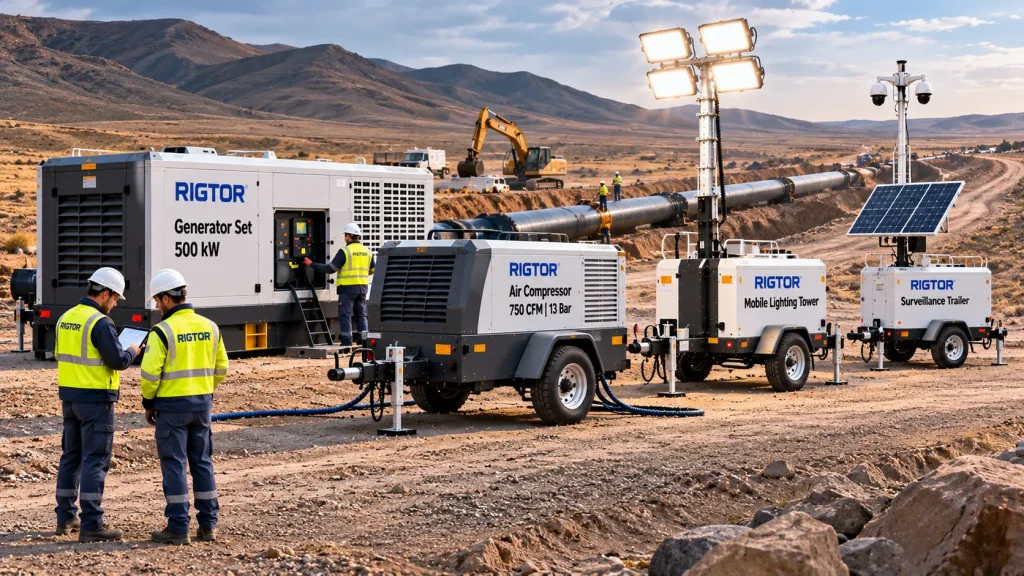
Unlike urban construction sites, remote industrial projects may have limited access to permanent utilities and technical support.
Several factors make equipment selection especially important.
Remote project locations may not have reliable grid electricity.
Temporary generators are therefore needed to support selected equipment, maintenance facilities, control systems and temporary buildings.
Industrial equipment may need to travel long distances over unpaved roads or through areas with limited lifting and unloading facilities.
Equipment dimensions, transport weight, lifting arrangements and delivery sequencing affect mobilization costs.
Some remote industrial projects operate continuously or across multiple shifts.
Generators, compressors and lighting systems must be selected for the expected duty cycle and operating environment.
Remote facilities may not have specialist technicians or readily available replacement parts.
A relatively minor equipment failure can become a lengthy interruption when the required component must be transported from another region.
Pipeline construction, remote utility installation and infrastructure maintenance often involve moving equipment between work areas.
Portable equipment can reduce the need for permanent installations at every location.
Diesel generator sets provide electrical power for remote industrial applications where grid connections are unavailable or unreliable.
Typical applications include:
Generator sizing should account for continuous electrical demand, motor starting requirements, voltage, frequency, load variation and environmental conditions.
For long-duration operations, fuel supply and preventive maintenance are particularly important.
Compressed air is used in industrial maintenance, pneumatic tools, selected drilling applications and equipment servicing.
Portable diesel rotary screw compressors allow these operations to continue without a permanent electrical connection.
RIGTOR's discussed compressor configurations include:
| Compressor Configuration | Potential Application |
|---|---|
| 70 CFM / 8 Bar | Selected small pneumatic maintenance tools |
| 185 CFM class | General field maintenance and construction tools |
| 930 CFM / 13 Bar | Higher-volume industrial compressed-air demand |
| 1250 CFM / 35 Bar | Selected high-pressure drilling applications |
These configurations serve different operating requirements.
The correct compressor must be selected using verified free-air delivery, working pressure, engine rating and tool specifications.
Higher airflow does not automatically mean a compressor is suitable for higher-pressure applications.
Remote industrial projects may require nighttime maintenance, installation work and equipment inspections.
Mobile lighting towers can provide elevated illumination without permanent lighting infrastructure.
RIGTOR's lighting solutions include diesel, solar and hybrid configurations.
For example, a 7m diesel LED lighting tower with four 400W floodlights has a combined nominal lighting load of 1,600W.
Actual illumination coverage depends on fixture luminous flux, optical distribution, mast height and the required worksite lux levels.
Remote sites may contain generators, compressors, fuel storage areas, tools and other valuable equipment.
Mobile surveillance trailers can support temporary monitoring of equipment yards, access points and selected infrastructure locations.
Their effectiveness depends on camera coverage, available power, communications connectivity and environmental conditions.
In areas without reliable cellular coverage, communications arrangements must be evaluated before deployment.
The total cost of remote industrial equipment is often much higher than the initial purchase price.
Long-distance equipment delivery, specialized transport and repeated relocation can increase project expenses.
Diesel fuel may need to be delivered over significant distances.
Fuel storage, delivery frequency and consumption can become major operational considerations.
A repair that takes two hours in a city may require substantially more time at a remote location because of travel and site-access requirements.
Unavailable components can extend downtime even when the mechanical repair itself is straightforward.
When a critical generator or compressor fails, connected work may stop until the equipment is repaired or replaced.
The financial impact depends on whether the affected activity is critical to the project.
For remote industrial projects, these costs should be evaluated before equipment procurement.
A coordinated deployment plan can help reduce avoidable installation and logistics work.
The project team provides information about location, access roads, altitude, ambient temperature, dust conditions, electrical loads, compressed-air demand and operating hours.
Generator capacity, compressor output, lighting requirements and monitoring needs are reviewed together.
This helps identify potential mismatches between equipment capacity and actual operating demand.
Where included in the agreed scope, equipment inspections, configuration checks and documentation preparation can be completed before delivery.
Equipment dimensions, unloading requirements, lifting arrangements and delivery sequence are confirmed.
Qualified personnel position the equipment, establish appropriate connections and complete the required safety and commissioning checks.
The contractor establishes maintenance schedules, critical spare-parts inventories and technical support procedures.
The objective is not to eliminate field installation, but to reduce unnecessary work and avoid preventable delays.
The following is a hypothetical industrial project scenario. It is provided to demonstrate equipment planning and cost calculations and does not represent a documented RIGTOR customer installation.
An EPC contractor is developing a remote pipeline support facility and associated industrial infrastructure.
The project is located approximately 180 kilometers from the nearest major service center.
The expected project duration is 12 months.
Permanent electrical infrastructure is unavailable during the initial project stages.
The contractor requires temporary power, compressed air, nighttime lighting and equipment monitoring.
The contractor identifies four major concerns:
| Equipment | Illustrative Configuration | Application |
|---|---|---|
| Diesel Generator | 1 × 100 kW class | Temporary electrical supply |
| Diesel Air Compressor | 1 × 185 CFM class | Compatible pneumatic tools |
| Mobile Lighting Towers | 2 × 7m diesel LED towers | Nighttime work areas |
| Mobile Surveillance Trailer | 1 unit | Equipment-yard monitoring |
The 100 kW generator and 185 CFM compressor are illustrative selections, not verified project requirements.
Actual capacities must be determined through an electrical load study, pneumatic tool assessment and site-specific engineering review.
Engineering Assessment
The contractor provides the expected electrical loads, pneumatic equipment specifications, worksite layout and operating schedule.
Equipment Configuration
RIGTOR reviews the requested equipment and identifies suitable configurations.
Pre-Shipment Preparation
Equipment inspections and technical documentation are completed according to the agreed supply scope.
Delivery Coordination
The contractor and supplier confirm transport dimensions, unloading requirements and site installation responsibilities.
Commissioning
Qualified personnel complete the required electrical, mechanical and operational checks.
Maintenance Planning
The project team establishes routine servicing procedures and identifies critical replacement parts.
The contractor compares two procurement approaches.
Option A: Equipment sourced independently from multiple established European or American suppliers.
Option B: A coordinated RIGTOR equipment package with planned interfaces, delivery requirements and documentation.
Both options are assumed to meet equivalent technical and safety requirements.
| Deployment Activity | Option A | Option B |
|---|---|---|
| Equipment coordination and inspection | 6 hours | 4 hours |
| Positioning and connections | 10 hours | 7 hours |
| Testing and commissioning | 8 hours | 6 hours |
| Total Deployment Work | 24 hours | 17 hours |
Modeled deployment work reduction: 7 hours, or approximately 29.2%.
These are illustrative assumptions rather than measured supplier performance.
The difference reflects coordination and preparation, not an inherent speed advantage of one manufacturer's equipment.
Suppose the contractor completes four comparable deployments or major relocations during the project.
| Calculation | Illustrative Result |
|---|---|
| Work time saved per deployment | 7 hours |
| Number of deployments | 4 |
| Total crew time saved | 28 hours |
| Crew size | 3 technicians |
| Assumed labor rate | $65 per technician-hour |
| Estimated Labor Savings | $5,460 |
The 28 hours represent reduced deployment duration across four events.
With three technicians working during each event, the modeled reduction is 84 labor-hours.
These savings do not automatically represent 28 hours of earlier project completion.
Maintenance is particularly expensive when equipment operates far from service facilities.
A remote repair may involve transportation, technician travel, replacement-part delivery and equipment downtime.
| Maintenance Category | Conventional Package | RIGTOR Package |
|---|---|---|
| Filters, lubricants and consumables | $8,000 | $7,000 |
| Planned replacement parts | $7,000 | $6,000 |
| Maintenance labor | $10,000 | $9,000 |
| External service and travel | $9,000 | $6,500 |
| Total Annual Maintenance Cost | $34,000 | $28,500 |
Modeled maintenance cost reduction: $5,500, or approximately 16.2%.
These figures are hypothetical planning assumptions, not verified RIGTOR maintenance results or actual competitor costs.
The lower-cost scenario assumes that appropriate spare parts are available and more routine servicing can be performed by the local project team.
It does not assume longer service intervals, fewer mechanical failures or superior equipment reliability.
Preventive Maintenance
Routine servicing can help identify developing problems before they result in major equipment failures.
Critical Spare-Parts Inventory
Keeping selected replacement components on site can reduce dependence on urgent deliveries.
Service Documentation
Equipment-specific manuals and parts references can help technicians diagnose problems and identify the correct components.
Local Maintenance Capability
Training qualified personnel to perform approved routine maintenance can reduce reliance on external service visits.
Equipment downtime may create significant costs when the affected system supports critical work.
For example, a compressor failure may interrupt pneumatic installation work.
A generator failure may affect temporary electrical loads.
The impact depends on whether the affected activity can continue using alternative equipment.
Assume a remote industrial project incurs $1,800 per hour in measurable interruption costs when a critical activity stops.
If maintenance preparation and spare-parts availability avoid or shorten six hours of such interruption during the year:
6 hours × $1,800/hour = $10,800
This is a hypothetical avoided-cost calculation.
It is not evidence that RIGTOR equipment experiences fewer failures than competing equipment.
For critical applications, preventive maintenance alone may not provide sufficient protection.
Project operators should evaluate standby generators, spare compressors or other redundancy where the cost of interruption justifies the additional investment.
Fuel can represent a substantial expense over a 12-month remote industrial project.
The cost is influenced by engine efficiency, operating load, daily runtime, fuel delivery costs and maintenance condition.
Consider a hypothetical diesel generator operating under the following assumptions:
| Parameter | Illustrative Value |
|---|---|
| Average fuel consumption | 12 L/hour |
| Daily operating time | 12 hours |
| Operating days | 300 |
| Total operating hours | 3,600 hours |
| Annual diesel consumption | 43,200 liters |
| Delivered diesel price | $1.30/liter |
| Estimated Annual Fuel Cost | $56,160 |
These figures are illustrative and do not represent verified consumption for a RIGTOR generator.
An oversized generator operating at low load may use fuel inefficiently.
An undersized generator may not support peak loads or motor starting requirements.
Similarly, compressor airflow and pressure should be matched to the connected equipment.
Correct sizing can help avoid unnecessary energy consumption and operating problems.
Combining the modeled deployment, maintenance and downtime-related benefits:
| Savings Category | Illustrative Annual Benefit |
|---|---|
| Deployment and relocation labor | $5,460 |
| Maintenance and service expenses | $5,500 |
| Avoided critical equipment downtime | $10,800 |
| Total Potential Project Benefit | $21,760 |
The total assumes that each benefit occurs and can be independently measured without double-counting.
It excludes equipment acquisition costs, fuel differences, freight, import duties, financing, insurance, taxes and residual value.
These additional costs must be included in a complete procurement comparison.
A fair comparison should use equivalent equipment specifications and operating conditions.
The analysis should include:
RIGTOR's commercial competitiveness should be demonstrated through actual quotations and operating data rather than unsupported claims of superiority.
Remote industrial equipment may operate in dusty, hot, cold or high-altitude conditions.
These environments can affect engine output, cooling requirements and maintenance intervals.
Cooling systems must be suitable for the expected temperature range.
Air filtration and cooling-system cleanliness become particularly important.
Diesel engines may require power derating at elevated locations.
Generator and compressor performance should be verified for the actual altitude.
Equipment should be selected for the expected duty cycle and supported by an appropriate maintenance schedule.
Remote monitoring and surveillance systems require an appropriate communications solution.
Cellular connectivity should not be assumed at isolated industrial sites.
Before purchasing temporary infrastructure for remote industrial projects, contractors should review:
A complete technical review helps identify equipment that is suitable for both initial deployment and long-term operation.
Remote industrial projects require reliable temporary infrastructure in locations where transportation, electrical supply and maintenance support may be limited.
Diesel generators, portable air compressors, mobile lighting towers and surveillance systems can support construction, maintenance and temporary industrial operations.
From RIGTOR's manufacturing and supply perspective, the objective is to help customers select appropriate equipment, prepare for efficient deployment and establish practical maintenance support.
The illustrative 12-month project demonstrates how coordinated planning could reduce deployment labor, maintenance expenses and selected downtime costs.
Actual savings depend on equipment specifications, operating conditions and verified project data.
For remote industrial contractors, equipment value should be measured not only by purchase price, but also by its ability to support reliable operations at a manageable total cost.
Remote industrial projects may require diesel generators, portable air compressors, mobile lighting towers and surveillance systems. The correct equipment package depends on electrical loads, pneumatic requirements, site conditions and project duration.
Contractors can reduce avoidable setup work through coordinated equipment selection, advance documentation, delivery planning and appropriate pre-shipment inspections. Actual savings depend on site conditions and commissioning requirements.
Remote locations may require longer technician travel, additional spare-parts transportation and greater logistical coordination. Equipment downtime can also become more expensive when replacement components are not readily available.
RIGTOR equipment may offer competitive ownership costs depending on purchase price, fuel consumption, maintenance requirements and service arrangements. A reliable comparison requires equivalent equipment specifications and verified operating data.
Savings depend on project conditions. In the illustrative 12-month scenario presented above, the modeled potential benefit is $21,760. This is a hypothetical calculation, not a documented RIGTOR customer result or guaranteed saving.
Generator capacity depends on the site's continuous electrical demand, peak loads, motor starting requirements and operating conditions. A load assessment should be completed before selecting the generator.
A compact 70 CFM compressor may support selected small pneumatic tools, while 185 CFM or larger compressors may be needed for higher airflow requirements. The correct selection depends on actual tool consumption and working pressure.
Preventive maintenance, critical spare-parts inventories, qualified technicians, equipment inspections and appropriate backup systems can help reduce downtime risk. The effectiveness of each measure depends on the operating environment and equipment configuration.
Yes. Mobile lighting towers can provide temporary illumination for installation work, maintenance areas and selected industrial activities. Lighting performance, fuel or energy autonomy, ground stability and weather conditions must be evaluated.
Buyers should provide electrical loads, compressed-air requirements, lighting needs, site location, environmental conditions, expected operating hours, project duration and maintenance arrangements. These details support more accurate equipment selection.
Remote projects require equipment that matches real operating conditions.
RIGTOR supplies diesel generators, portable diesel air compressors, mobile lighting towers and mobile surveillance systems for temporary industrial applications.
Contact our team with your project specifications, site conditions and operating requirements to discuss a suitable equipment configuration.

Behind Every Critical Project.
@ 2026-2026 Rigtor Industry. All Rights Reserved.
 EN
 ES
 PT
 AR