

Time: Nov 5 2026 Views: 2
Learn how to convert kilowatts to kVA, understand power factor, and select the right diesel generator for industrial and temporary power applications.
When choosing a diesel generator, you may notice that electrical equipment is often rated in kilowatts (kW), while generator sets are commonly specified in kilovolt-amperes (kVA).
For example, a construction site may require 80 kW of electrical power, but a generator supplier may offer equipment rated at 100 kVA, 125 kVA or 150 kVA.
How do you determine which capacity is appropriate?
The answer begins with understanding the relationship between kW, kVA and power factor.
In this guide, RIGTOR explains the kW to kVA conversion formula, provides practical conversion tables and demonstrates how these calculations apply to diesel generator sizing.
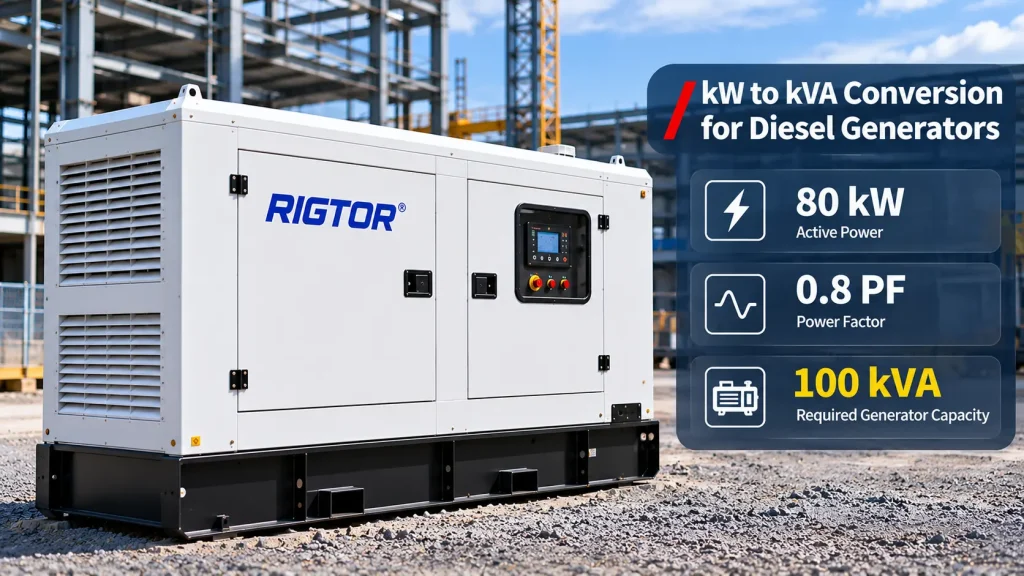
The basic formula is:
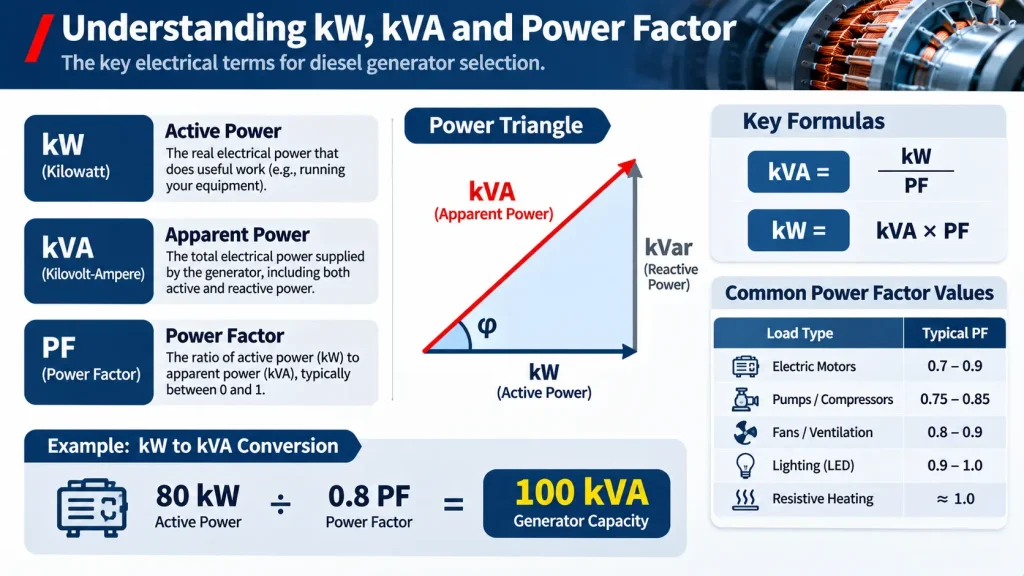
kVA = kW ÷ Power Factor (PF)
Where:
For example, if your electrical equipment requires 80 kW at a power factor of 0.8:
kVA = 80 ÷ 0.8
Result: 100 kVA
This means the equipment requires 100 kVA of apparent electrical power under the stated conditions.
The reverse calculation is:
kW = kVA × Power Factor
At a power factor of 0.8, a generator rated at 100 kVA typically has a corresponding rated active power of 80 kW.
Important: The load's actual power factor and the generator's rated power factor are not necessarily the same. Use the load power factor to calculate demand, and check the generator's kW and kVA ratings separately.
Diesel generator sets combine a diesel engine with an electrical alternator.
These components are subject to different operating limitations.
The engine supplies mechanical power, which is converted into electrical active power.
The alternator must carry the electrical current associated with both active and reactive power.
Consequently, generator specifications normally identify both kW and kVA ratings.
For many three-phase industrial generator sets, the rated power factor is 0.8.
For example:
| Generator Rating | Active Power at 0.8 PF |
|---|---|
| 50 kVA | 40 kW |
| 100 kVA | 80 kW |
| 150 kVA | 120 kW |
| 250 kVA | 200 kW |
| 500 kVA | 400 kW |
| 1000 kVA | 800 kW |
These figures describe the relationship between the generator's rated kVA and kW at 0.8 power factor.
They do not guarantee that every connected load can be supported without additional engineering checks.
The following table helps engineers and equipment buyers estimate apparent power requirements at different load power factors.
| kW | PF 0.7 | PF 0.8 | PF 0.9 | PF 1.0 |
|---|---|---|---|---|
| 10 | 14.3 kVA | 12.5 kVA | 11.1 kVA | 10 kVA |
| 20 | 28.6 kVA | 25 kVA | 22.2 kVA | 20 kVA |
| 40 | 57.1 kVA | 50 kVA | 44.4 kVA | 40 kVA |
| 50 | 71.4 kVA | 62.5 kVA | 55.6 kVA | 50 kVA |
| 80 | 114.3 kVA | 100 kVA | 88.9 kVA | 80 kVA |
| 100 | 142.9 kVA | 125 kVA | 111.1 kVA | 100 kVA |
| 150 | 214.3 kVA | 187.5 kVA | 166.7 kVA | 150 kVA |
| 200 | 285.7 kVA | 250 kVA | 222.2 kVA | 200 kVA |
| 300 | 428.6 kVA | 375 kVA | 333.3 kVA | 300 kVA |
| 400 | 571.4 kVA | 500 kVA | 444.4 kVA | 400 kVA |
| 500 | 714.3 kVA | 625 kVA | 555.6 kVA | 500 kVA |
Values are rounded to one decimal place where appropriate. The table is for electrical power conversion, not final generator selection.
For the same active power demand, a lower power factor results in a higher apparent power requirement.
Consider a 100 kW load:
However, a generator's ability to supply reactive power depends on its alternator capability and operating limits.
A larger kVA rating may be required for low-power-factor loads, but generator selection must consider the complete operating conditions.
Power factor describes the relationship between active power and apparent power.
For conventional sinusoidal AC systems, reactive power is associated with inductive and capacitive loads.
In practical industrial installations, equipment such as electric motors, transformers and power electronic devices can affect overall power factor.
Different loads may have different power factors.
For example:
Resistive Heating Equipment
Resistive heating loads can operate close to unity power factor.
Electric Motors
Induction motors generally require reactive power. Their power factor varies with design and operating load.
Variable-Frequency Drives
VFD systems may have a relatively high displacement power factor, but input harmonics can affect true power factor and generator compatibility.
UPS Systems
UPS equipment can introduce nonlinear loading and, under some conditions, leading power factor.
The correct generator must accommodate these electrical characteristics, not simply the total running kW.
Consider a temporary construction project requiring diesel-generated electrical power.
The project includes lighting, water pumps, ventilation and workshop equipment.
| Equipment | Electrical Running Power |
|---|---|
| Construction lighting | 12 kW |
| Water pumping equipment | 20 kW |
| Ventilation systems | 15 kW |
| Workshop machinery | 18 kW |
| Site offices | 10 kW |
| Total | 75 kW |
These are illustrative electrical input values, assuming all listed equipment operates simultaneously.
Suppose the combined load has a true power factor of 0.8.
kVA = 75 ÷ 0.8
Required running apparent power = 93.75 kVA
A 100 kVA generator might initially appear suitable based on the steady-state kVA requirement.
However, the 75 kW load would use most of the generator's typical 80 kW rated active-power capacity.
The site includes electric pumps and ventilation motors.
Their starting current may be significantly higher than their running current.
If a large motor starts while other equipment is operating, the generator may experience a temporary voltage or frequency drop.
The actual generator size depends on the motor starting method, starting kVA, permissible voltage dip and other connected loads.
The final selection should consider:
A manufacturer may recommend a different generator size or alternator configuration after reviewing these factors.
Engineering takeaway: Converting 75 kW to 93.75 kVA identifies the running apparent-power demand, but it does not establish the final generator rating.
For industrial projects, generator selection should follow a structured process.
Determine the actual electrical input requirements of all connected equipment.
Where motors are specified by mechanical shaft-output power, account for motor efficiency before calculating electrical input demand.
Common project specifications include:
The required output depends on the destination market and connected equipment.
Large motors, compressors, pumps and other industrial equipment may create substantial starting or transient demand.
Starting methods such as soft starters and VFDs can influence the required generator capacity.
Diesel generators may be specified for standby, prime or other defined operating duties.
The selected rating should match the expected operating schedule and applicable manufacturer definitions.
High altitude, high ambient temperature, ventilation restrictions and other site conditions may reduce available power.
Generator controllers, protection systems, circuit breakers, transfer arrangements and distribution interfaces must be compatible with the project.
These considerations are especially important when a generator is part of a temporary infrastructure system.
At RIGTOR, diesel generator selection begins with understanding the customer's electrical requirements and operating environment.
As a supplier of temporary infrastructure equipment, RIGTOR provides diesel generator solutions for construction, mining, remote industrial operations and emergency power applications.
Our generator configurations can be evaluated around several project requirements.
Depending on the power range and project specification, RIGTOR can discuss generator configurations using engine platforms such as Cummins, Volvo, Perkins and Kubota.
The selected engine and alternator must be compatible with the required electrical output, duty rating and operating conditions.
Silent Diesel Generator Sets
Sound-attenuated generator enclosures are suitable for sites where noise reduction, outdoor equipment protection and packaged installation are important.
Acoustic enclosure design must also account for cooling airflow, exhaust routing and maintenance access.
Open-Type Diesel Generator Sets
Open-type generators may be suitable for dedicated generator rooms and protected industrial installations.
They provide direct access to the engine, alternator and associated components.
Depending on the selected generator model, project requirements may include:
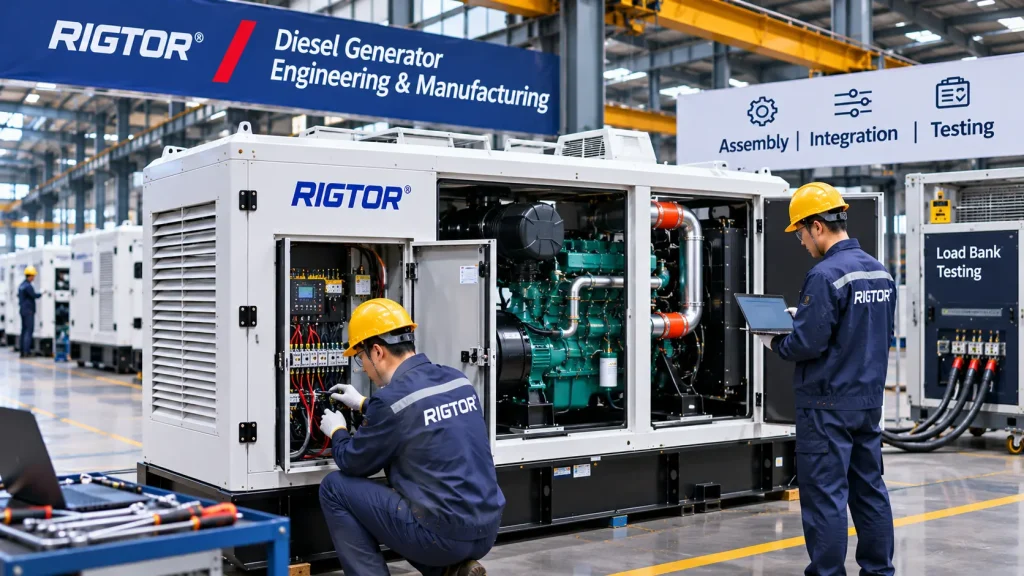
Generator manufacturing involves coordinating mechanical assembly, electrical integration, enclosure fabrication and equipment inspection.
Factory acceptance requirements should be confirmed during procurement.
Depending on the agreed inspection scope, these may include functional checks, electrical output verification and load-bank testing.
The objective is to supply a generator configuration appropriate for the customer's actual operating requirements.
Some projects require more than an individual diesel generator.
A remote construction site may need electrical power for mobile lighting, surveillance equipment, pumping systems and auxiliary facilities.
RIGTOR's product portfolio includes:
| Equipment Category | Role in Temporary Infrastructure |
|---|---|
| Diesel Generator Sets | Primary or backup electrical power |
| Mobile Lighting Towers | Temporary site illumination |
| Mobile Surveillance Systems | Remote monitoring and site security |
| Portable Diesel Air Compressors | Compressed air for pneumatic equipment |
These systems can be specified individually or coordinated as part of a wider site equipment package.
An important distinction is that diesel-driven air compressors do not necessarily require generator power for their main compression function. Their auxiliary electrical loads, if any, should be evaluated separately.
Similarly, solar-powered or self-contained lighting and surveillance equipment may have different external power requirements from grid-dependent equipment.
Understanding these differences helps avoid unnecessary generator oversizing.
At a power factor below 1.0, apparent power is greater than active power.
A 100 kW load at PF 0.8 requires 125 kVA, not 100 kVA.
A generator's rated power factor of 0.8 does not mean every connected load operates at 0.8.
Use the actual load power factor whenever available.
A motor rated at 30 kW mechanical output may require more than 30 kW of electrical input.
Electrical input must account for motor efficiency.
A generator that supports the running kW may still be unable to start a large motor satisfactorily.
Both active power capacity and apparent power/current capacity must be checked.
Prime and standby ratings are not interchangeable, and environmental conditions may require derating.
To receive a technically appropriate generator recommendation, provide:
| Required Information | Example |
|---|---|
| Total running load | 120 kW |
| Load power factor | 0.85 |
| Voltage | 400V |
| Frequency | 50Hz |
| Phase | Three-phase |
| Largest motor | 30 kW |
| Starting method | Soft starter |
| Operating duty | Prime |
| Daily operating hours | 12 hours |
| Installation environment | Outdoor construction site |
| Generator type | Silent diesel generator |
| Additional requirements | Remote monitoring |
The example represents a sample enquiry rather than a completed generator selection.
For this example, the running apparent-power demand is:
120 ÷ 0.85 = 141.2 kVA
The final generator rating must still be established through engineering review.
Divide electrical active power in kW by the load's true power factor.
For example, 80 kW ÷ 0.8 = 100 kVA.
At a power factor of 0.8, 100 kW equals 125 kVA. At PF 1.0, it equals 100 kVA.
At PF 0.8, 50 kW equals 62.5 kVA.
At PF 0.8, 200 kW equals 250 kVA.
Many three-phase industrial generators are rated at 0.8 lagging power factor to define their combined active-power and apparent-power capabilities. The exact rating must be confirmed from the manufacturer's datasheet.
No. Actual load power factor varies with equipment type and operating conditions.
No. The conversion determines apparent-power demand, but motor starting, transient loads, operating duty, site conditions and generator capabilities must also be evaluated.
A three-phase generator rated at 100 kVA and 0.8 power factor typically has an 80 kW rated active-power output, not 100 kW.
kW to kVA conversion uses power factor to calculate apparent power.
kVA to amps conversion uses apparent power, voltage and phase configuration to calculate electrical current.
Both calculations are useful when planning diesel generator installations.
RIGTOR can review project electrical requirements and discuss generator configurations based on the supplied load schedule, voltage, frequency, operating duty and installation conditions.
Understanding kW to kVA conversion is an important first step in diesel generator selection.
The formula is straightforward: divide electrical kW by the load power factor to calculate apparent power in kVA.
However, selecting a reliable generator requires a more complete assessment of electrical loads, starting conditions and operating requirements.
RIGTOR supplies diesel generator systems for construction, mining, industrial and temporary infrastructure applications.
By combining electrical load assessment with appropriate generator configuration, customers can identify power solutions suited to their projects.
Diesel Generator Solutions Built Around Your Power Requirements
Share your running kW, power factor, voltage, frequency and application details with RIGTOR.
Our team can help review your requirements and discuss suitable silent or open-type diesel generator configurations.
Contact RIGTOR for Generator Selection & Quotation.

Behind Every Critical Project.
@ 2026-2026 Rigtor Industry. All Rights Reserved.
 EN
 ES
 PT
 AR