

Time: Nov 5 2026 Views: 2
Learn how to reduce diesel generator noise through better placement, vibration isolation, exhaust silencers, acoustic enclosures and professional generator design.
Diesel generators provide reliable power for construction sites, industrial facilities, mining operations and remote projects. However, excessive generator noise can create problems for workers, nearby communities and site operations.
If your diesel generator is too loud, you may be wondering: How can I make my generator quieter without compromising its performance?
The answer depends on where the noise originates and how the generator is installed.
Some improvements are relatively simple, such as increasing the distance between the generator and occupied areas. Others require engineered solutions, including acoustic enclosures, exhaust silencers, vibration isolation and redesigned cooling airflow.
This guide explains ten practical ways to make a diesel generator quieter, how each method works and when a purpose-built silent diesel generator may be the better solution.
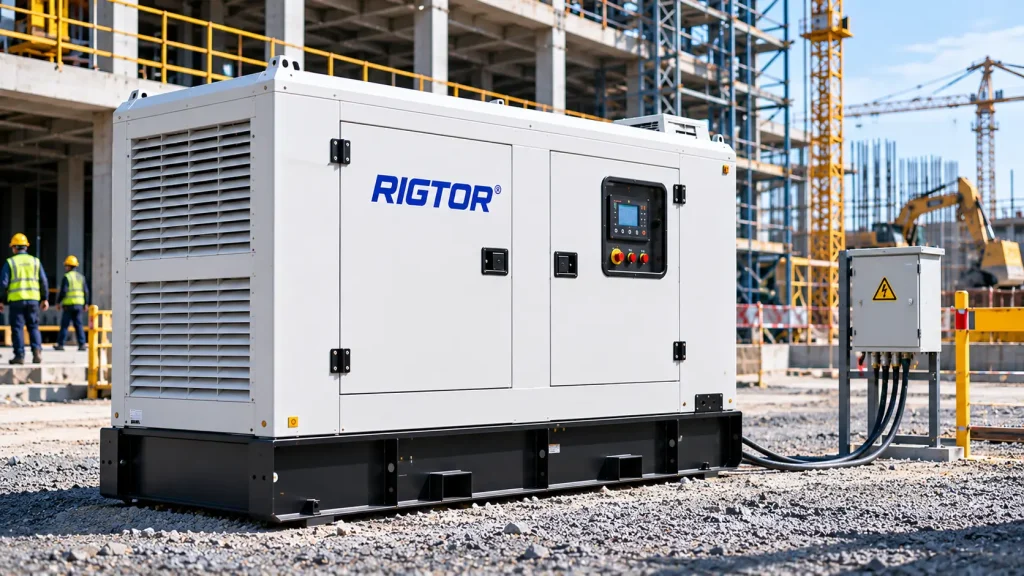
Before reducing generator noise, it is important to identify its sources.
A diesel generator produces several types of noise simultaneously.
| Noise Source | How It Is Generated | Typical Characteristics |
|---|---|---|
| Engine combustion | Rapid pressure changes during combustion | Mechanical and low-frequency noise |
| Exhaust system | High-pressure exhaust gas pulses | Strong exhaust noise |
| Cooling fan | Air movement through the radiator | Broadband airflow noise |
| Alternator | Electromagnetic and mechanical operation | Tonal and mechanical noise |
| Engine vibration | Engine movement transmitted to the frame | Structure-borne noise |
| Air intake | Air entering the engine and cooling system | Airflow and intake noise |
| Enclosure panels | Vibration and sound transmission through panels | Rattling and radiated noise |
The relative contribution of each source depends on engine speed, load, generator design and installation conditions.
For example, reducing exhaust noise may produce only a limited improvement if the cooling fan is the dominant noise source.
The most effective noise-reduction strategy addresses the major sources rather than treating the generator as a single noise-producing component.
<text>Best for: Outdoor construction sites, temporary power installations and remote industrial projects.</text>
Increasing the distance between a generator and the people affected by its noise is often one of the simplest improvements.
In an unobstructed outdoor environment, sound pressure generally decreases as distance increases.
For an ideal point source in a free field, doubling the distance produces approximately a 6 dB reduction in sound pressure level.
However, actual site conditions can change the result.
Buildings, reflective surfaces, terrain, barriers and multiple noise sources all influence sound propagation.
Practical recommendations:
Moving a generator may reduce the noise experienced at a particular location, even though the generator itself produces the same amount of sound.
<text>Best for: Projects requiring substantial overall noise reduction.</text>
A sound-attenuated enclosure is one of the most important components of a silent diesel generator.
Unlike a simple metal housing, a properly engineered acoustic enclosure is designed to reduce sound transmission while allowing the generator to operate safely.
A typical design may incorporate:
The enclosure must balance acoustic performance with heat rejection, airflow resistance and serviceability.
Important: Never surround an operating generator with an improvised sealed box or block its ventilation openings. Restricted airflow can cause overheating, and inadequate exhaust management can create a serious carbon monoxide hazard.
For industrial applications, an enclosure should be engineered around the specific generator set rather than treated as a generic cover.
<text>Best for: Generators where exhaust noise is a major contributor.</text>
Diesel engine exhaust creates pressure pulses that can produce significant noise.
An exhaust silencer reduces these pressure fluctuations before the exhaust gases are discharged.
Different silencer designs provide different levels of attenuation and impose different exhaust-flow restrictions.
Industrial generator systems may use residential-grade, critical-grade or other application-specific silencers, depending on the manufacturer's classification.
A more aggressive silencer is not automatically the best choice.
The silencer must be selected according to:
Excessive exhaust backpressure can adversely affect engine performance.
For this reason, silencer upgrades should be reviewed against the engine manufacturer's requirements.
<text>Best for: Generators transmitting vibration into floors, structures or connected equipment.</text>
Not all generator noise travels directly through the air.
Engine vibration can pass through the generator frame into the floor, platform or supporting structure.
These vibrations may cause surrounding surfaces to radiate additional sound.
Anti-vibration mounts help isolate the engine-generator assembly from its supporting structure.
Depending on the equipment design, vibration-control measures may include:
Isolation components must be matched to equipment weight, vibration frequency and operating conditions.
Improperly selected mounts can increase movement or create mechanical reliability problems.
<text>Best for: Enclosed diesel generators and high-capacity industrial installations.</text>
Cooling systems can be a major source of generator noise.
A diesel generator must reject heat from the engine, radiator and alternator.
The cooling fan moves large volumes of air through the equipment, producing aerodynamic noise.
Reducing fan noise may involve:
However, airflow modifications must not compromise cooling performance.
Simply reducing fan speed or restricting an air opening can cause overheating, especially at high ambient temperatures.
For industrial generator installations, acoustic and thermal engineering should be evaluated together.
<text>Best for: Outdoor sites where noise travels directly toward nearby work areas or property boundaries.</text>
Acoustic barriers can reduce the direct transmission of sound between a generator and a receiver.
A barrier works best when it interrupts the line of sight between the main noise source and the area requiring protection.
Examples include:
Barrier effectiveness depends on height, length, placement, frequency and surrounding conditions.
A barrier may be less effective against low-frequency noise, which can diffract around obstacles.
The barrier must also be positioned so that it does not interfere with generator ventilation, exhaust discharge or maintenance.
<text>Best for: Generators that have become louder over time.</text>
A generator that was previously quiet but has developed unusual noise may have a maintenance problem.
Potential causes include:
Regular inspection and maintenance can prevent unnecessary noise and help identify developing equipment faults.
If a generator suddenly produces knocking, grinding, excessive rattling or unusual exhaust noise, it should be inspected by qualified personnel.
Maintenance can restore normal operating noise levels, but it should not be expected to transform an inherently loud open-type generator into a silent generator.
<text>Best for: Sites with highly variable electrical demand.</text>
Generator noise can change with electrical load.
Higher loads may increase engine combustion noise, exhaust energy and cooling requirements.
However, the relationship is not always linear.
A generator running at a fixed synchronous speed may maintain approximately the same rotational speed while its acoustic characteristics change with load.
Proper load management can help avoid unnecessary operation and improve overall site planning.
Useful practices include:
Do not assume that operating a diesel generator at extremely low load is a suitable long-term noise-control strategy.
Prolonged light-load operation may create engine operating and maintenance concerns, depending on the model.
<text>Best for: New generator procurement and major equipment replacement.</text>
Generator speed and engine configuration influence acoustic performance.
Many conventional four-pole diesel generator sets operate at:
Two-pole designs commonly operate at higher speeds, such as 3000 rpm at 50Hz or 3600 rpm at 60Hz.
Engine speed can affect combustion frequency, mechanical noise and vibration.
However, a lower-speed generator is not automatically quieter in every application.
Engine displacement, cylinder arrangement, loading, cooling fan design, exhaust treatment and enclosure construction also influence noise.
For industrial projects, generator selection should be based on verified acoustic data under comparable operating conditions.
<text>Best for: Projects where noise reduction is a permanent operating requirement.</text>
If an existing open-type diesel generator remains too loud after practical site improvements, a purpose-built silent generator may offer a more effective solution.
Silent diesel generators combine multiple noise-control measures within one engineered package.
These may include:
For construction, mining, industrial and temporary power projects, a properly configured silent generator can reduce the need for separate on-site acoustic modifications.
The final noise level depends on the complete generator configuration and installation.
Different methods address different noise problems.
| Method | Main Noise Problem Addressed | Typical Application |
|---|---|---|
| Increase distance | Noise at the receiver location | Outdoor sites |
| Acoustic enclosure | Overall airborne noise | Industrial generator sets |
| Exhaust silencer | Exhaust noise | Diesel engines |
| Vibration isolation | Structure-borne noise | Buildings and equipment platforms |
| Cooling system optimization | Fan and airflow noise | Enclosed generator sets |
| Acoustic barrier | Direct sound transmission | Site boundaries |
| Preventive maintenance | Abnormal mechanical noise | Existing equipment |
| Load management | Operating noise and runtime | Variable-demand sites |
| Engine configuration | Source noise characteristics | New equipment selection |
| Silent generator replacement | Multiple noise sources | Long-term noise-sensitive applications |
No single method guarantees a particular reduction in dB(A).
The best solution depends on the dominant noise source, required reduction and installation environment.
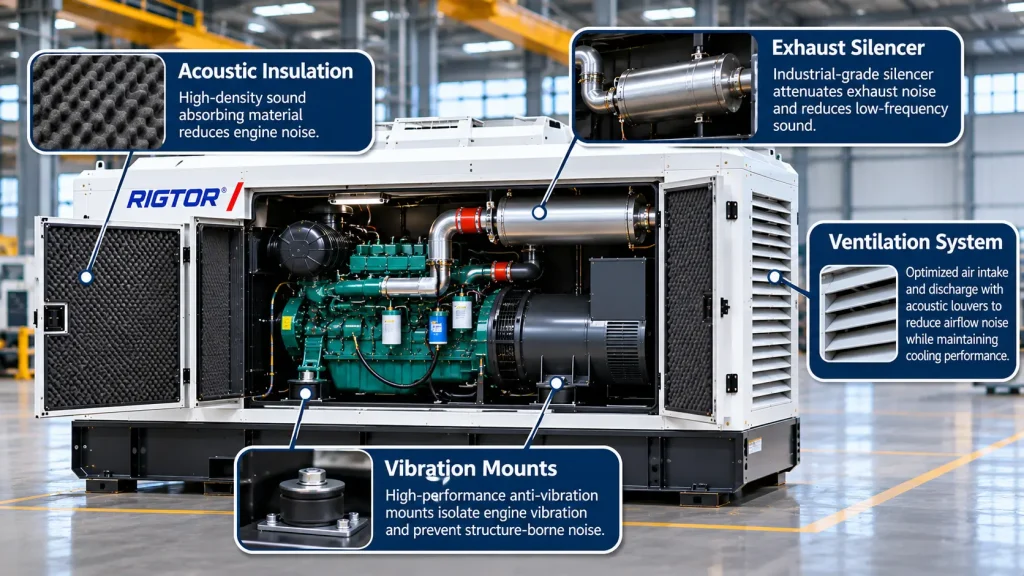
Generator noise is commonly expressed in dB(A), a sound pressure level measurement adjusted to reflect human hearing sensitivity.
When comparing generator specifications, buyers should confirm:
For example, a noise figure measured at 7 meters cannot be directly compared with a figure measured at 1 meter without accounting for the measurement conditions.
Similarly, a reading at 25% load may not represent performance at 100% load.
There is no universal dB(A) threshold that defines every diesel generator as “silent.”
Acceptable noise depends on the application, local requirements, measurement method and distance from affected areas.
For procurement purposes, buyers should request a clearly defined acoustic performance specification rather than relying on the word “silent” alone.
Example of a procurement requirement:
The diesel generator shall meet the project-specified sound pressure limit at 7 meters, under the agreed load and measurement conditions.
The exact limit should be established from the project's acoustic requirements.
Both configurations can be appropriate for industrial applications.
| Consideration | Silent Diesel Generator | Open-Type Diesel Generator |
|---|---|---|
| Noise reduction | Integrated acoustic treatment | Usually requires external acoustic measures |
| Outdoor installation | Packaged enclosure may provide weather protection | Usually requires suitable protection |
| Cooling design | Engineered within enclosure | Depends on installation environment |
| Maintenance access | Through enclosure doors or removable panels | More direct component access |
| Installation planning | Packaged acoustic solution | May require a dedicated generator room |
| Typical use | Noise-sensitive outdoor and temporary sites | Industrial rooms and protected facilities |
A silent generator is generally preferable when noise control must be incorporated into the equipment package.
An open-type generator may be appropriate when the site already provides a properly engineered generator room with adequate ventilation and acoustic treatment.
For industrial buyers, selecting a quiet generator involves more than choosing an enclosure with acoustic insulation.
The generator must operate reliably while meeting electrical, thermal and mechanical requirements.
RIGTOR supplies diesel generator solutions for temporary construction, mining, industrial projects and remote power applications.
Depending on project requirements, generator configurations can be reviewed across several areas.
Engine and alternator selection influences electrical output, operating speed, cooling requirements and equipment dimensions.
RIGTOR can discuss generator configurations using engine platforms such as Cummins, Volvo, Perkins and Kubota, subject to the selected power range and project specification.
The enclosure provides a structural platform for integrating acoustic insulation, access doors, ventilation paths and exhaust components.
Important design considerations include panel construction, sealing, corrosion protection, maintenance access and cooling airflow.
Exhaust silencers and vibration isolation components can be incorporated according to the generator's operating requirements.
These components must be compatible with the engine and overall mechanical arrangement.
A quieter generator must still maintain appropriate engine and alternator temperatures.
Airflow, radiator performance, ambient temperature and acoustic restrictions should therefore be evaluated together.
Depending on the project, generator configurations may include digital controllers, electrical protection, automatic transfer interfaces and remote monitoring provisions.
Generator assembly and electrical integration require inspection before delivery.
The agreed factory acceptance scope may include operational checks, electrical output verification and load-bank testing.
Where acoustic performance is contractually specified, the required noise measurement procedure and acceptance criteria should also be agreed in advance.
Buyers should request test records relevant to the exact generator configuration they intend to purchase.
Construction projects may operate near offices, accommodation or surrounding properties.
A sound-attenuated diesel generator can help reduce the noise experienced by workers and nearby occupants.
Generator placement, temporary acoustic barriers and operating schedules may provide additional benefits.
Mining sites often require reliable electrical power in demanding environments.
Although remote locations may have fewer nearby residents, noise exposure can still affect operators and maintenance personnel.
Generator noise control must be balanced with durability, cooling and service access.
Backup generators may operate near commercial buildings, hospitals, data facilities and other occupied premises.
Noise-control requirements should be considered during equipment selection and installation planning.
Temporary infrastructure projects may require generators close to roads, public areas or operating facilities.
Packaged silent generator sets can simplify acoustic planning, provided that the site installation also meets applicable requirements.
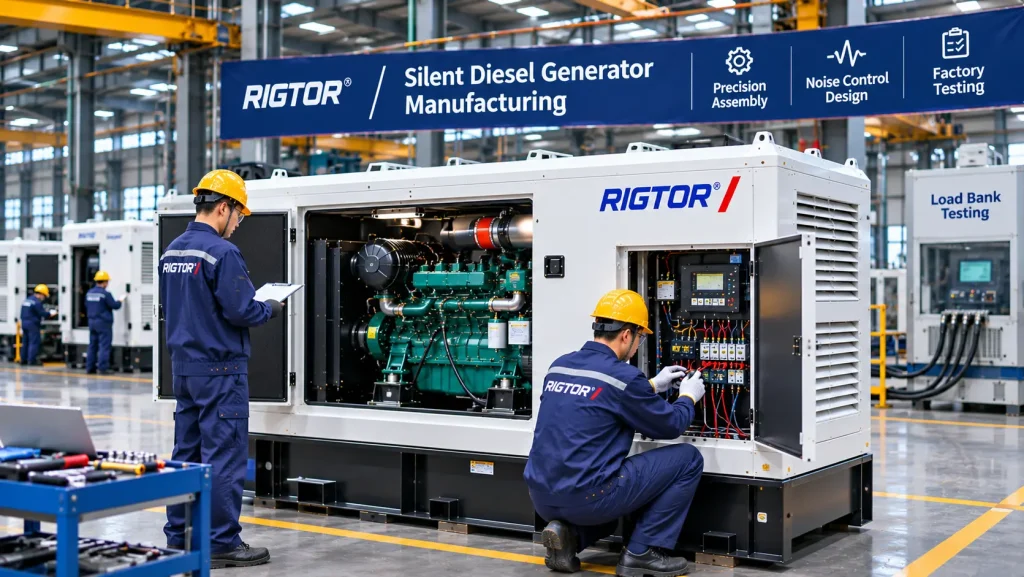
Before purchasing a quiet diesel generator, request clear answers to the following questions.
A supplier that can explain these engineering details is better positioned to help buyers evaluate acoustic performance and operational suitability.
Common methods include increasing installation distance, adding an engineered acoustic enclosure, using a suitable exhaust silencer, installing vibration isolation and maintaining the generator properly.
Yes, some generators can be retrofitted with acoustic treatments. However, enclosure design must preserve ventilation, exhaust safety and maintenance access.
An appropriately selected exhaust silencer can reduce exhaust noise. Its effect on total generator noise depends on the contribution of other noise sources.
No. The term “silent generator” generally refers to a sound-attenuated generator rather than equipment that produces no sound.
Not necessarily in every comparison. Noise depends on engine design, speed, load, cooling system and acoustic treatment, not only generator capacity.
A professionally engineered acoustic enclosure can reduce noise. An improvised sealed box is unsafe because it can restrict cooling airflow and create exhaust hazards.
Under ideal free-field conditions, doubling the distance from a point source reduces sound pressure level by approximately 6 dB. Actual site conditions can produce different results.
Often, yes. Placement changes, maintenance, vibration isolation, exhaust treatment and engineered barriers may help. The achievable improvement depends on the existing equipment and installation.
A silent generator incorporates an acoustic enclosure and related noise-control features. An open-type generator generally has no integrated sound-attenuating enclosure.
RIGTOR provides silent diesel generator solutions for construction, mining, industrial and temporary infrastructure applications. Generator configurations can be discussed according to the required power rating, operating conditions and project-specific acoustic requirements.
Making a diesel generator quieter requires understanding the source of its noise.
Simple measures such as improving generator placement and performing regular maintenance can help. More substantial improvements may require exhaust silencers, vibration isolation, acoustic barriers or purpose-built enclosures.
For projects where low noise is an important long-term requirement, a properly engineered silent diesel generator can offer a more integrated solution.
RIGTOR works with industrial customers to review generator requirements, including electrical output, operating conditions, enclosure configuration and system integration.
The objective is not simply to make a generator quieter, but to provide reliable power with appropriate noise-control performance.
Silent Diesel Generator Solutions for Demanding Applications
RIGTOR supplies diesel generator systems for construction sites, mining operations, remote industrial projects and temporary infrastructure.
Share your required power rating, voltage, frequency, installation conditions and acoustic requirements.
Our team can help review suitable generator configurations for your project.
Contact RIGTOR for Technical Consultation & Quotation.

Behind Every Critical Project.
@ 2026-2026 Rigtor Industry. All Rights Reserved.
 EN
 ES
 PT
 AR