

Time: Nov 5 2026 Views: 3
A Practical Guide to Single-Phase and Three-Phase Generator Sizing
When selecting a diesel generator for a construction site, industrial facility, equipment rental fleet or temporary power installation, one of the most common questions is:
How many amps can a diesel generator supply at a given kVA rating?
For example, how many amps can a 100 kVA diesel generator deliver at 400V? Is the current different at 415V? And how does the calculation change for a single-phase generator?
Understanding kVA to amps conversion is important for matching a generator to electrical loads, distribution equipment and project requirements.
However, converting kVA into amperes is only the first step in generator selection. Engineers must also consider motor starting current, power factor, operating duty and load characteristics.
In this guide, RIGTOR explains how to convert kVA to amps, provides practical generator capacity tables and shows how manufacturers use these calculations when configuring diesel generator sets.
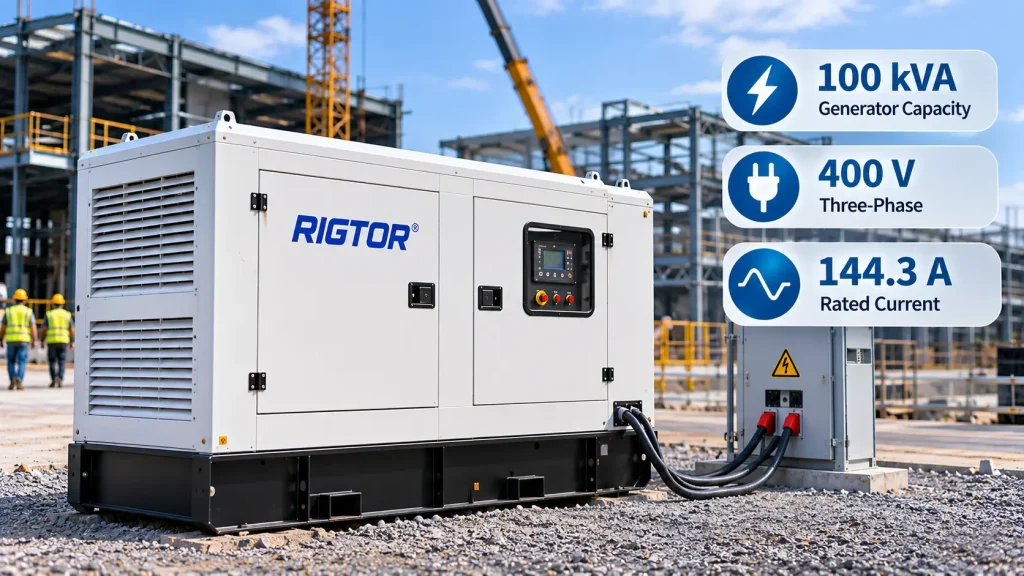
kVA stands for kilovolt-amperes. It represents apparent electrical power.
Diesel generator sets are commonly rated in kVA because their electrical capacity depends on both voltage and current.
A generator may also have a corresponding kW rating, which represents active power.
The relationship is:
kW = kVA × Power Factor
For example, at a power factor of 0.8:
These examples assume a rated power factor of 0.8. Always verify the actual generator specification.
The distinction matters because a generator must satisfy both the required active power and the electrical current demand.
The calculation depends on whether the electrical system is single-phase or three-phase.
For a balanced three-phase system:
Amps (A) = kVA × 1000 ÷ (√3 × Voltage)
Where:
This formula is commonly used for industrial diesel generators operating at 400V, 415V or 480V.
Amps = 100 × 1000 ÷ (1.732 × 400)
Result: Approximately 144.3 A
A 100 kVA, 400V three-phase generator therefore has a theoretical rated line current of approximately 144 A when delivering 100 kVA.
For a single-phase system:
Amps (A) = kVA × 1000 ÷ Voltage
Amps = 10 × 1000 ÷ 230
Result: Approximately 43.5 A
Notice that the single-phase formula does not include √3.
Important: A three-phase generator's total kVA rating should not be treated as available on any single phase. Individual phase loading and allowable imbalance must remain within the manufacturer's limits.
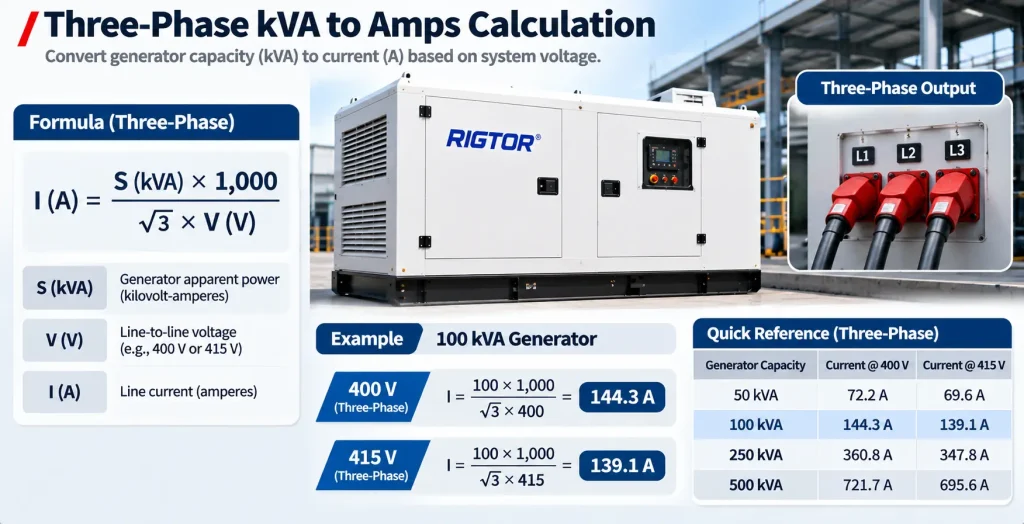
The following table provides theoretical line-current values for balanced three-phase generators at common industrial voltages.
| Generator Capacity | 400V Three-Phase | 415V Three-Phase | 480V Three-Phase |
|---|---|---|---|
| 20 kVA | 28.9 A | 27.8 A | 24.1 A |
| 30 kVA | 43.3 A | 41.7 A | 36.1 A |
| 50 kVA | 72.2 A | 69.6 A | 60.1 A |
| 75 kVA | 108.3 A | 104.3 A | 90.2 A |
| 100 kVA | 144.3 A | 139.1 A | 120.3 A |
| 150 kVA | 216.5 A | 208.7 A | 180.4 A |
| 200 kVA | 288.7 A | 278.2 A | 240.6 A |
| 250 kVA | 360.8 A | 347.8 A | 300.7 A |
| 400 kVA | 577.4 A | 556.5 A | 481.1 A |
| 500 kVA | 721.7 A | 695.6 A | 601.4 A |
| 750 kVA | 1082.5 A | 1043.4 A | 902.1 A |
| 1000 kVA | 1443.4 A | 1391.2 A | 1202.8 A |
Calculated values are rounded and assume the stated kVA is available at the specified voltage. They do not account for derating, phase imbalance, transient loading or installation-specific limitations.
At the same apparent power, increasing voltage reduces current.
For example, a 100 kVA generator supplies approximately:
This is why the voltage specification must be confirmed before choosing distribution equipment.
A generator rated for one voltage cannot automatically be assumed to support another voltage without a suitable alternator and configuration.
For UK projects, 400/230V is the nominal low-voltage three-phase supply convention.
However, 415V is still encountered in legacy installations and equipment specifications.
When selecting a diesel generator for the UK market, buyers should confirm:
For example, a buyer requesting a 100 kVA generator for a 415V installation should not simply assume that the required voltage and current are identical to a 400V system.
The generator's alternator, voltage regulation and site requirements should be reviewed.
A 100 kVA generator is a useful example because it is a common capacity category for temporary and industrial power applications.
At 400V three-phase:
100 kVA ≈ 144.3 A
At a rated power factor of 0.8:
100 kVA × 0.8 = 80 kW
This means the generator may be rated for 100 kVA apparent power and 80 kW active power under its specified operating conditions.
These are two different constraints.
A load combination must remain within both limits.
Suppose a construction project has the following estimated running loads:
| Equipment | Running Active Power |
|---|---|
| Water pumps | 18 kW |
| Site lighting | 8 kW |
| Ventilation equipment | 12 kW |
| Workshop equipment | 15 kW |
| Site offices and auxiliary loads | 7 kW |
| Total | 60 kW |
If the combined load operates at a power factor of 0.8:
Required apparent power = 60 ÷ 0.8
Result: 75 kVA
At 400V three-phase, this corresponds to approximately 108.3 A.
On running load alone, a 100 kVA generator might appear sufficient.
However, this conclusion is incomplete.
If the site includes large electric motors, the generator must also handle starting transients.
The example assumes all loads operate simultaneously and is illustrative rather than a verified generator selection.
A common purchasing mistake is to select a diesel generator based only on calculated running current.
Generator selection requires additional engineering checks.
Electric motors may draw substantially more current during starting than during normal operation.
For example, a direct-on-line induction motor may draw several times its rated running current during startup.
The exact starting current depends on motor design, starting method and operating conditions.
A generator that supports the motor's running load may still experience excessive voltage or frequency deviation during startup.
A low power factor increases apparent power demand for a given active power.
For example:
At 60 kW and 0.8 power factor:
60 ÷ 0.8 = 75 kVA
At 60 kW and 0.9 power factor:
60 ÷ 0.9 ≈ 66.7 kVA
The generator's active and apparent power ratings must both be respected.
Variable-frequency drives, UPS equipment and other power electronic loads may introduce harmonics.
Harmonic distortion can affect alternator heating, voltage waveform quality and system performance.
A diesel generator's standby rating and prime rating are not interchangeable.
A generator intended for extended temporary power operation should be selected using the appropriate manufacturer-defined duty rating.
High ambient temperatures and high-altitude installations can reduce available generator performance.
Engine and alternator derating requirements must be considered.
Three-phase loads should be distributed appropriately.
Excessive imbalance may affect generator performance even when total calculated kVA is below the nameplate rating.
Manufacturer's advice: Use kVA to amps conversion to understand current demand, but complete generator selection using a detailed load schedule and operating profile.
As a manufacturer and supplier of diesel generator systems, RIGTOR supports customers requiring generator configurations for construction, mining, industrial and temporary infrastructure projects.
Our approach begins with understanding the electrical application rather than selecting a generator from kVA alone.
The required generator capacity is evaluated against:
RIGTOR offers diesel generator solutions for 50Hz and 60Hz applications, subject to the selected engine and alternator platform.
Common project requirements may include:
The required electrical output must be confirmed for the specific model.
Depending on the project and power range, RIGTOR can discuss generator configurations using engine platforms such as:
Availability and suitability depend on the engine model, power requirement and market specification.
RIGTOR supplies generator solutions for different installation conditions.
Silent Diesel Generator Sets
Sound-attenuated enclosures are suitable for projects where noise reduction and packaged equipment protection are important.
The enclosure design must coordinate acoustic attenuation, ventilation, cooling and service access.
Open-Type Diesel Generator Sets
Open-type configurations are suitable for protected installations, dedicated generator rooms and projects requiring direct component access.
Depending on the agreed configuration, generator systems may incorporate:
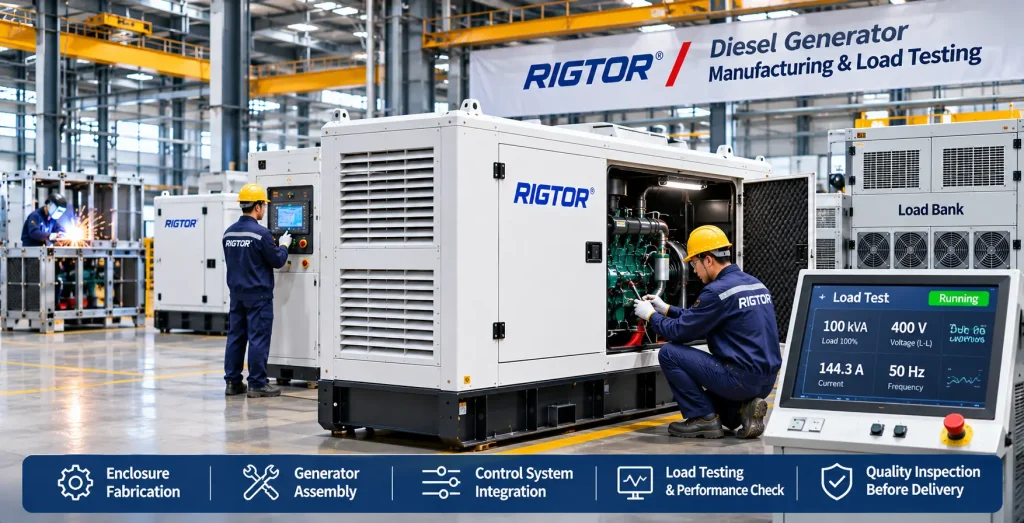
Before delivery, generator inspection and acceptance requirements should be agreed with the buyer.
These may include assembly inspection, control-system checks, operating tests and load testing where specified.
RIGTOR can discuss project-specific inspection and documentation requirements during technical quotation.
Different applications place different demands on a generator.
| Application | Important Selection Factors |
|---|---|
| Construction sites | Motor starting, changing loads, portability |
| Mining operations | Heavy-duty operation, environmental conditions |
| Equipment rental | Standardized voltage, serviceability, transport |
| Industrial maintenance | Temporary distribution, load compatibility |
| Emergency backup | Starting reliability, transfer arrangements |
| Remote infrastructure | Fuel logistics, monitoring, maintenance |
| Mobile lighting systems | Lighting load, runtime, system integration |
| Compressor installations | Motor starting method and transient demand |
RIGTOR's broader temporary infrastructure product portfolio includes diesel generators, mobile lighting systems, compressed air equipment and mobile surveillance systems.
For projects requiring multiple equipment categories, the electrical requirements should be evaluated at system level.
For example, a temporary site using lighting, surveillance equipment and electric auxiliary loads may benefit from coordinated power-system planning.
Sometimes the customer knows the required current but not the generator capacity.
In that case, the calculation can be reversed.
kVA = √3 × Voltage × Amps ÷ 1000
kVA = 1.732 × 400 × 200 ÷ 1000
Result: Approximately 138.6 kVA
A load drawing 200 A at 400V three-phase represents approximately 138.6 kVA of apparent power, assuming balanced sinusoidal conditions.
This does not automatically mean a 150 kVA generator is the correct choice.
The actual selection must account for load power factor, motor starting, duty rating, environmental derating and appropriate operating margin.
Selecting a substantially oversized diesel generator can increase purchase cost and may cause prolonged low-load operation.
Some diesel engines may experience operational problems when run at very low loads for extended periods.
The preferred solution is a generator appropriately matched to the expected load profile, rather than simply choosing the largest available model.
When requesting a diesel generator quotation, provide the following details.
| Parameter | Example |
|---|---|
| Required voltage | 400V |
| Frequency | 50Hz |
| Phase | Three-phase |
| Running current | 200 A |
| Running power factor | 0.85 |
| Largest motor | 30 kW |
| Motor starting method | Star-delta |
| Operating duty | Prime |
| Operating hours | 10 hours/day |
| Installation | Outdoor construction site |
| Noise requirement | Sound-attenuated enclosure |
| Ambient conditions | Site-specific |
| Monitoring requirements | Local controller |
The example is a sample enquiry, not a completed generator sizing recommendation.
Providing this information helps the manufacturer evaluate a suitable engine, alternator, enclosure and control configuration.
kVA to amps conversion is an essential calculation when planning diesel generator installations.
For three-phase systems, current depends on generator kVA and line-to-line voltage.
A 100 kVA generator at 400V three-phase corresponds to approximately 144.3 A, while the same kVA at 415V corresponds to approximately 139.1 A.
However, generator selection requires more than a conversion formula.
Motor starting loads, power factor, operating duty, environmental conditions and electrical configuration all influence the final equipment choice.
RIGTOR provides diesel generator solutions for industrial and temporary power applications, including silent and open-type configurations.
By reviewing the complete electrical requirements, we help customers identify generator configurations suited to their operating conditions.
For three-phase systems, divide kVA multiplied by 1000 by √3 multiplied by line-to-line voltage. For single-phase systems, divide kVA multiplied by 1000 by voltage.
Approximately 144.3 A, assuming balanced three-phase operation.
Approximately 139.1 A for a balanced three-phase system.
Approximately 72.2 A for a balanced three-phase system.
Approximately 360.8 A for a balanced three-phase system.
kVA measures apparent power, while kW measures active power. Their relationship depends on power factor.
If kVA and voltage are already known, power factor is not needed to calculate current under the standard single-phase or balanced three-phase formula. Power factor is required when converting between kW and kVA.
Not if it has an 80 kW active-power rating at 0.8 rated power factor. Always check both the kVA and kW ratings.
At 400V, 200 A corresponds to approximately 138.6 kVA. Although this is below 150 kVA, the generator must also satisfy active power, starting loads, duty and other operating requirements.
RIGTOR can evaluate generator configurations for 400V and 415V applications, subject to the selected engine, alternator and model specifications.
Not inherently. If the electrical ratings and operating conditions are equivalent, the theoretical kVA-to-current relationship is the same. Enclosure-related operating limitations must still be considered.
Provide voltage, frequency, phase, running load, starting loads, power factor, duty rating, operating hours, site conditions and any noise or control requirements.
Diesel Generator Sets Configured Around Your Electrical Requirements
Whether you need a silent diesel generator for a construction site or an open-type generator for an industrial installation, RIGTOR can help evaluate your power requirements.
Share your required kVA, voltage, frequency, load schedule and operating conditions.
Contact RIGTOR for Diesel Generator Selection & Quotation.

Behind Every Critical Project.
@ 2026-2026 Rigtor Industry. All Rights Reserved.
 EN
 ES
 PT
 AR