

Time: Nov 4 2026 Views: 3
Camera Selection, Night Vision, Environmental Protection, Power Supply and Mobile Surveillance System Design
Industrial security cameras operate in environments that are very different from offices, retail stores or residential buildings.
Manufacturing plants, mining operations, construction sites, oil and gas facilities, logistics yards and remote industrial compounds often involve large monitoring areas, limited lighting, heavy machinery, dust, vibration and challenging weather conditions.
Choosing the right security camera is therefore not simply a matter of comparing megapixels or prices.
A professional industrial surveillance system must provide usable images, reliable power, suitable environmental protection, stable communications and practical maintenance access.
At RIGTOR, our approach to mobile surveillance equipment begins with the operating environment and the customer's security objectives.
This guide explains how industrial buyers should evaluate professional security cameras and how those cameras can be integrated into complete surveillance systems.
Before selecting a camera, define exactly what the surveillance system must accomplish.
Industrial sites generally have several different monitoring requirements.
| Monitoring Objective | Typical Industrial Application | Main Camera Requirement |
|---|---|---|
| General observation | Equipment yards and open industrial areas | Wide field of view |
| Intrusion detection | Fences and restricted zones | Reliable detection and alerts |
| Activity assessment | Maintenance areas and loading yards | Sufficient image detail |
| Person identification | Controlled entrances and gates | High pixel density at the target |
| Vehicle monitoring | Truck entrances and logistics routes | Suitable exposure and motion handling |
| Equipment protection | Temporary machinery and stored assets | Continuous or event-based monitoring |
| Remote site monitoring | Unattended industrial compounds | Remote access and dependable power |
A camera that provides an excellent overview of a large yard may not capture enough detail to identify a person at the far end of that yard.
Likewise, a camera optimized for a narrow entrance may not be suitable for general perimeter monitoring.
Manufacturer's recommendation: Define the required monitoring task for each camera position before selecting resolution, lens or camera type.
Different camera designs solve different monitoring problems.
Bullet cameras are commonly used for monitoring specific directions, such as entrances, fences, equipment storage areas and vehicle access routes.
They are suitable when the area of interest remains relatively constant.
Best suited for:
Dome and turret cameras can be useful around buildings, covered loading areas and other locations where compact installation is preferred.
Outdoor installations require appropriate environmental and impact protection.
Best suited for:
Pan-tilt-zoom cameras allow operators to change the viewing direction and zoom level.
They are useful for investigating activity across large industrial areas.
However, a PTZ camera cannot continuously observe every direction at the same time.
For critical perimeter coverage, fixed cameras may still be necessary.
Best suited for:
Thermal cameras detect infrared radiation associated with temperature differences.
They can support detection in darkness and certain challenging visibility conditions.
However, thermal images do not automatically provide the same identification detail as visible-light cameras.
Thermal detection performance also depends on weather, background conditions, optics and the target.
Best suited for:
Multisensor cameras combine multiple imaging modules to monitor different directions or create a broader combined view.
They may reduce the number of individual camera mounting positions required for certain installations.
Their suitability depends on the required resolution, coverage and installation geometry.
Resolution is important, but megapixel count alone does not determine surveillance quality.
A 4MP camera with the correct lens and mounting position may provide more useful detail at a specific entrance than an 8MP camera covering a much wider area.
The key concept is pixel density, commonly expressed in pixels per meter (px/m).
Pixel density describes how much image detail is available across a real-world distance.
Suppose a camera records a horizontal image resolution of 3,840 pixels.
| Horizontal Scene Width | Approximate Pixel Density |
|---|---|
| 10m | 384 px/m |
| 20m | 192 px/m |
| 40m | 96 px/m |
| 80m | 48 px/m |
These values assume the full image width corresponds to the stated scene width at the target plane.
They are mathematical examples, not guaranteed identification performance.
Image quality also depends on the lens, lighting, exposure, compression, viewing angle and target movement.
2MP Cameras: May be adequate for certain general monitoring tasks where the field of view is relatively narrow.
4MP Cameras: Often worth evaluating for a balance between image detail, storage demand and bandwidth.
8MP Cameras: Can provide additional detail where the lens, lighting and recording system can make effective use of the resolution.
Higher-Resolution Cameras: May be useful for large scenes or detailed monitoring, but can increase storage, bandwidth and processing requirements.
Do not specify 8MP cameras for every location.
First calculate the required detail at the target distance, then select the lens and sensor combination that can deliver it.
A camera's lens determines how much of the scene it captures.
A wide-angle lens covers a broad area but distributes the available image pixels across that area.
A narrower field of view can provide greater detail over a smaller region.
Consider a temporary equipment yard measuring 80m × 50m.
The security manager wants to monitor:
A practical concept may combine:
A single PTZ camera should not be assumed to provide continuous identification-quality coverage across the entire yard.
These answers are more useful than simply requesting the highest available resolution.
Industrial sites frequently require surveillance after working hours.
Nighttime camera performance is therefore a critical selection factor.
IR-equipped cameras can illuminate scenes using infrared light that is not normally visible to the human eye.
They are useful where visible illumination is limited.
However, advertised IR range is not equivalent to guaranteed identification distance.
Performance depends on the camera, lens, target reflectivity and environmental conditions.
White-light illumination can support colour video at night.
It may also act as a visible deterrent in selected applications.
However, white-light systems can create glare, light spill or unwanted illumination near occupied areas.
Thermal cameras can assist with detecting people or vehicles in darkness without relying on conventional visible illumination.
They require careful evaluation of detection range, image resolution and environmental conditions.
| Technology | Main Advantage | Important Limitation |
|---|---|---|
| IR Night Vision | Monitoring without strong visible illumination | IR range and image detail vary |
| White-Light Imaging | Colour images when adequately illuminated | Glare and light pollution |
| Thermal Imaging | Detection based on thermal contrast | Limited visual identification detail |
| Hybrid Visible + Thermal | Complementary detection and visual assessment | Higher system complexity and cost |
For many industrial sites, combining different camera technologies may be more effective than using one type everywhere.
Industrial cameras must withstand the conditions in which they operate.
The ingress protection rating indicates resistance to dust and water under specified test conditions.
IP66 indicates dust-tight protection and resistance to powerful water jets.
IP67 indicates dust-tight protection and resistance to temporary immersion under defined test conditions.
IP67 does not automatically mean a product is suitable for continuous high-pressure washing, saltwater exposure or all outdoor environments.
A camera used in a desert mining operation may experience high ambient temperatures and strong solar radiation.
A camera used in a northern industrial facility may require low-temperature starting capability.
The selected model's operating and storage temperature ranges should be verified.
Coastal facilities, chemical processing plants and industrial sites with corrosive atmospheres may require special housing materials or coatings.
A stainless steel housing is not automatically suitable for every corrosive environment.
Industrial cameras may be exposed to vibration from nearby equipment or mechanical impact.
Where required, buyers should evaluate impact ratings, mounting strength and vibration-test information.
Oil refineries, chemical plants and other facilities may contain classified hazardous areas.
Standard outdoor cameras and mobile surveillance trailers must not be assumed suitable for these locations.
Equipment selection must comply with the applicable hazardous-area classification and certification requirements.
One of the most important purchasing decisions is whether to install permanent cameras or use a mobile surveillance system.
Permanent CCTV infrastructure is often appropriate for established industrial facilities.
Advantages include:
However, fixed systems may require cabling, civil works and installation time.
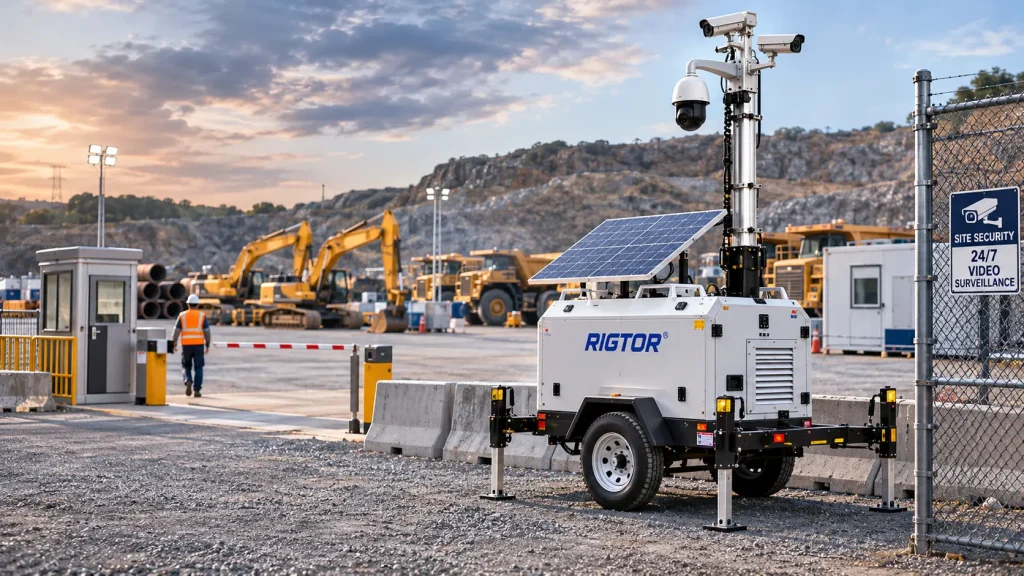
Mobile surveillance trailers are designed for temporary or changing monitoring locations.
A typical system can combine:
Actual features depend on the selected configuration.
| Site Condition | Fixed CCTV | Mobile Surveillance Trailer |
|---|---|---|
| Permanent manufacturing plant | Usually preferred | Supplemental use |
| Temporary construction project | Possible | Strong candidate |
| Remote mining equipment yard | Depends on infrastructure | Strong candidate |
| Industrial shutdown compound | Temporary installation possible | Strong candidate |
| Changing pipeline worksite | Less flexible | Strong candidate |
| Long-term logistics facility | Usually preferred | Temporary expansion |
| Emergency industrial response | Installation may take time | Strong candidate |
RIGTOR focuses on mobile surveillance systems for temporary industrial infrastructure and remote field operations.
This makes complete system configuration particularly important.
A camera is only useful when its supporting power system operates reliably.
Industrial buyers should evaluate the entire surveillance system's electrical load.
That includes:
Consider a hypothetical surveillance trailer with the following average electrical loads.
| Component | Average Power |
|---|---|
| Four cameras | 48W |
| Video recording equipment | 25W |
| Router and communications | 15W |
| Control and auxiliary equipment | 12W |
| Total | 100W |
For continuous operation:
100W × 24 hours = 2.4 kWh/day
This is the daily energy demand before accounting for battery, inverter and other system losses.
Suppose the customer wants 48 hours of operation without charging.
Energy demand:
100W × 48 hours = 4.8 kWh
If an illustrative system allows 80% usable battery capacity and has 90% delivery efficiency:
4.8 ÷ (0.80 × 0.90) = approximately 6.7 kWh nominal battery capacity
This is an illustrative sizing calculation, not a RIGTOR product specification.
Actual system design must consider peak loads, cold-weather capacity, aging, battery chemistry and required reserve.
Solar systems require additional evaluation of:
A solar-powered surveillance trailer should not be selected based solely on its solar-panel wattage.
Hybrid configurations can combine solar, battery storage and a generator or other charging source.
They may be useful for remote industrial applications where reliable continuous operation is required.
Remote surveillance requires dependable communications.
The best network option depends on the site's infrastructure.
Suitable for established industrial facilities with existing network infrastructure.
Can be useful over selected areas, but industrial structures, distance and interference may affect performance.
A practical option for many temporary sites with adequate cellular coverage.
May offer additional network capacity where supported, but actual coverage and performance must be verified.
May be considered for remote locations without adequate terrestrial connectivity.
The required equipment, power and operating costs should be evaluated.
For remote industrial sites, the system design should address:
A camera system should not rely exclusively on uninterrupted cloud connectivity unless that limitation is acceptable to the customer.
Storage demand depends on camera count, bitrate, recording schedule, compression and retention period.
A simple planning formula is:
Storage (GB) ≈ Bitrate (Mbps) × 86,400 × Days ÷ 8,000
This estimates decimal gigabytes for continuous recording at a constant aggregate bitrate.
Assume:
Aggregate bitrate:
4 × 4 Mbps = 16 Mbps
Estimated storage:
16 × 86,400 × 30 ÷ 8,000 = 5,184 GB
Approximately 5.2 TB of recorded video data.
This excludes additional storage overhead and redundancy.
Actual bitrate may vary substantially depending on scene activity, codec, frame rate and camera configuration.
Event-based recording may reduce storage demand, but it also introduces the risk of missing activity if event detection fails.
Many modern cameras advertise artificial intelligence features.
However, buyers should evaluate how those features perform under actual industrial conditions.
Useful for distinguishing selected target types from other scene movement.
Can help generate alerts when a person or vehicle enters a defined area.
Useful for monitoring designated boundaries or access routes.
Can help alert operators to activity around valuable equipment.
Industrial sites contain moving machinery, changing shadows, dust, rain, animals and vehicle headlights.
These conditions may affect detection accuracy.
Ask for test results or demonstrations using conditions similar to the intended site.
Evaluate detection reliability and nuisance alarms, not just whether the product specification lists “AI detection.”
Industrial surveillance systems are connected devices and should be included in the site's cybersecurity planning.
Important requirements include:
ONVIF standards support interoperability between compatible IP-based security products.
For new systems, buyers should evaluate the relevant supported profiles and verify actual device conformance.
A product description stating “ONVIF compatible” is not sufficient evidence that every function will work with the customer's video management system.
Camera streaming, recording, PTZ controls and analytics integration should be tested as required.
Where surveillance equipment connects to industrial networks, the site's IT and operational technology teams should approve the architecture.
Security cameras should not be connected directly to critical industrial control networks without appropriate risk assessment and controls.
Consider a hypothetical temporary equipment compound.
| Parameter | Example |
|---|---|
| Site Type | Remote industrial equipment yard |
| Dimensions | 100m × 60m |
| Area | 6,000 m² |
| Operating Period | 12 months |
| Grid Power | Unavailable |
| Cellular Coverage | Available, subject to verification |
| Main Risks | Unauthorized access and equipment theft |
| Monitoring Requirement | Continuous recording and remote alerts |
| Equipment | Proposed Function |
|---|---|
| 1 PTZ Camera | Operator-directed yard observation |
| 2 Fixed Cameras | Selected perimeter monitoring |
| 1 Fixed Camera | Entrance monitoring |
| Local Recorder | Video retention during network outages |
| Cellular Router | Remote connectivity |
| Solar/Battery or Hybrid Power | Autonomous operation |
| Mobile Trailer & Mast | Elevated temporary deployment |
This is a conceptual system configuration.
It does not guarantee complete coverage, identification performance or a particular detection range.
A final design must account for blind spots, mounting height, target distance, camera optics and site security requirements.
A mobile surveillance trailer can provide a common platform for cameras, power equipment, communications and recording.
It can also be repositioned as the layout of the industrial compound changes.
For temporary projects, this flexibility can reduce dependence on permanent camera mounting infrastructure.
For industrial customers, a complete mobile surveillance system must integrate several technical subsystems.
RIGTOR's manufacturing and configuration approach can be organized around the following requirements.
Review the required viewing height, camera arrangement, mast structure and safe deployment conditions.
Evaluate camera loads, recording equipment, communications hardware, battery capacity and charging requirements.
Confirm the intended network method, equipment compatibility and remote-access requirements.
Review the trailer arrangement, stabilizers, transport requirements and maintenance access.
Define storage requirements, event functions, user access and operating interfaces.
Review the selected equipment's temperature, ingress-protection and corrosion requirements.
Depending on the agreed project scope, inspection may include:
Testing requirements and acceptance criteria should be agreed before production and delivery.
A manufacturer should evaluate the performance of the complete surveillance system, not only the camera specifications.
A professional quotation should clearly identify the equipment and the proposed system's operating limitations.
This information helps customers compare complete surveillance solutions rather than camera prices alone.
Before approving a purchase, confirm the following.
| Selection Question | Why It Matters |
|---|---|
| What must the camera detect or identify? | Defines image-detail requirements |
| How far is the target? | Determines lens and resolution needs |
| Is night monitoring required? | Determines low-light technology |
| Is the site dusty, corrosive or exposed? | Determines environmental protection |
| Is the location hazardous? | Determines certification requirements |
| Is grid power available? | Determines power-system design |
| Is cellular coverage reliable? | Determines communication options |
| How long must footage be stored? | Determines recording capacity |
| Will the site layout change? | Helps determine fixed vs. mobile equipment |
| What testing will the supplier perform? | Supports system acceptance |
Professional industrial security camera selection begins with the monitoring objective.
Resolution, night vision and environmental protection are important, but they are only part of the overall system.
Power supply, communications, recording, installation geometry and maintenance requirements can be equally important, particularly at temporary or remote industrial sites.
For permanent facilities, fixed CCTV infrastructure may be the appropriate solution.
For temporary construction compounds, mining equipment yards, remote industrial projects and other changing environments, mobile surveillance trailers can provide a flexible alternative.
RIGTOR focuses on mobile surveillance systems that integrate camera equipment with temporary power, communications and deployable structures.
Our objective is to help industrial customers evaluate the complete system required for their operating environment.
There is no single best camera. Fixed cameras are useful for continuous monitoring of defined areas, while PTZ cameras support operator-directed observation across larger spaces. Thermal cameras may be suitable for specialized detection requirements.
The correct choice depends on target distance, field of view and required image detail. An 8MP camera is not automatically better if the lens, lighting or installation geometry is unsuitable.
Both ratings include dust-tight protection. IP66 addresses powerful water jets, while IP67 addresses temporary immersion under specified test conditions. Neither rating alone establishes suitability for every industrial environment.
Nighttime performance depends on the camera, lens, illumination, target and environmental conditions. Advertised IR range should not be treated as guaranteed identification distance.
Yes, suitably designed systems may use batteries, solar charging, generators or hybrid power. Autonomy must be calculated from the complete system's energy demand.
They can be useful for temporary equipment yards, remote compounds and changing work areas, subject to environmental, power, communication and site safety requirements.
Area alone cannot determine camera quantity. The design must account for site geometry, monitoring objectives, target distances, blind spots and required image detail.
Not necessarily. A PTZ camera generally observes one selected direction at a time. Fixed cameras may still be required for continuous coverage of critical areas.
Storage depends on camera count, bitrate and recording mode. Four cameras averaging 4 Mbps each would produce approximately 5.2 TB of video data over 30 days of continuous recording, before additional overhead.
Customers should provide the site layout, monitoring objectives, required operating period, available power, network coverage, environmental conditions and any applicable technical or certification requirements.
Mobile Surveillance Trailers for Temporary and Remote Industrial Sites
Protecting an equipment yard, construction compound, mining site or remote industrial facility?
Share your site dimensions, security objectives and operating conditions with RIGTOR.
Our team can review suitable mobile surveillance configurations, power options, communications requirements and manufacturing specifications.
Contact RIGTOR for a Mobile Surveillance System Proposal.

Behind Every Critical Project.
@ 2026-2026 Rigtor Industry. All Rights Reserved.
 EN
 ES
 PT
 AR