
Time: Nov 3 2026 Views: 3
Application-Based Equipment Selection, Field Layout Engineering and Factory-Built Solutions for Oil & Gas Operations
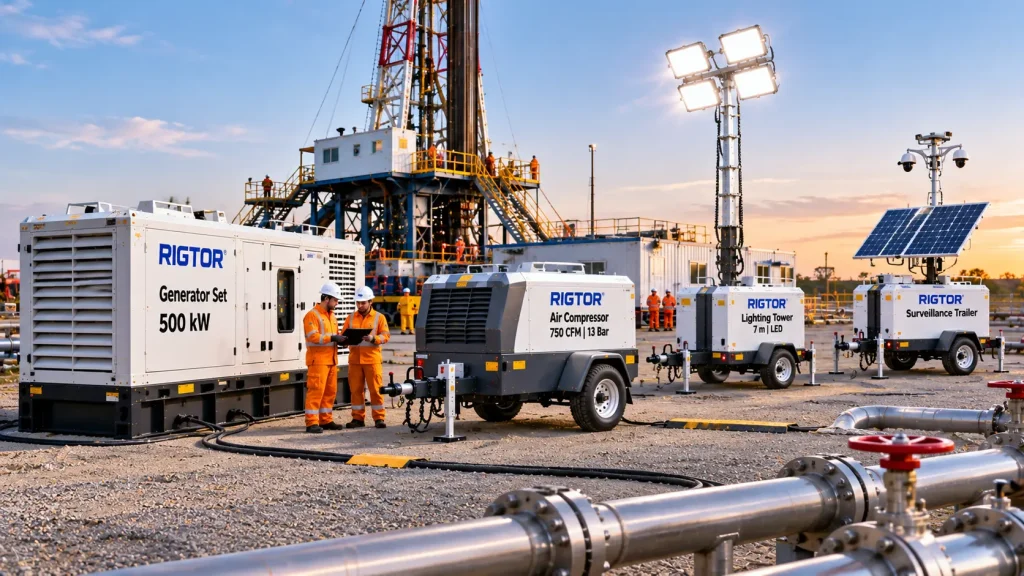
Oil and gas field operations often take place in remote locations where permanent infrastructure is limited, operating conditions are demanding and equipment availability is critical.
Whether supporting an onshore drilling site, well servicing operation, pipeline maintenance project or temporary field facility, contractors need dependable temporary power, compressed air, lighting and site monitoring.
However, selecting equipment for an oil and gas project involves more than choosing a generator by kilowatt rating or an air compressor by CFM.
The equipment must be matched to the actual operating loads, duty cycles, environmental conditions and site restrictions.
Its position within the worksite is equally important.
A diesel generator located too close to a hazardous process area may create an unacceptable ignition risk. An improperly sized compressor may fail to support the required pneumatic tools. Poorly positioned lighting towers can produce glare and shadows that interfere with nighttime operations.
RIGTOR approaches oil and gas field equipment supply from a manufacturer's perspective: understand the operating conditions, define the equipment requirements, develop an appropriate configuration and verify the agreed specifications before delivery.
Our product portfolio includes:
These systems can be supplied individually or considered together for temporary field infrastructure projects.
Oil and gas projects do not share a single equipment configuration.
Different activities create different requirements for electrical power, compressed air, lighting and site monitoring.
| Field Operation | Main Equipment Requirements | Typical Selection Priorities |
|---|---|---|
| Onshore Drilling Support | Temporary power, lighting, selected compressed-air services | Load profile, continuous operation, site safety |
| Well Servicing & Workover | Portable power, task lighting, pneumatic tools | Mobility, fast deployment, equipment compatibility |
| Pipeline Construction | Power, compressed air, lighting, monitoring | Distributed work zones, transport, pressure and airflow |
| Pipeline Maintenance | Temporary power, task-specific air supply, surveillance | Site access, short maintenance windows |
| Remote Field Facilities | Power generation, lighting, monitoring | Runtime, maintenance planning, environmental conditions |
| Oilfield Equipment Maintenance | Power and compressed air for approved tools | Starting loads, air quality, duty cycle |
These requirements must be confirmed for each project.
In particular, compressed-air applications such as pipeline drying, pressure testing, instrument air or process services may require specialized air treatment, pressure ratings, procedures and equipment beyond a standard portable construction compressor.
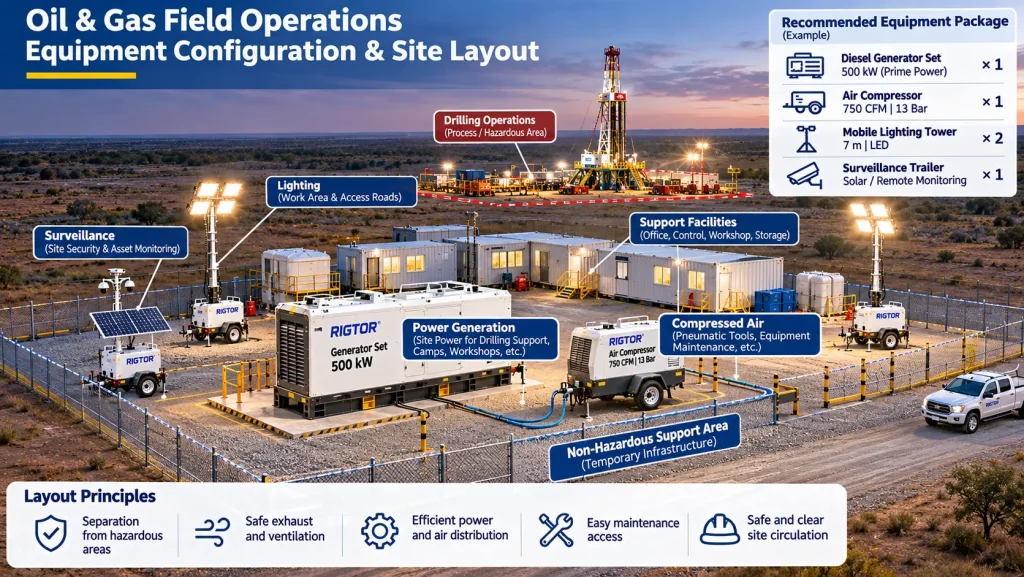
Before recommending equipment, RIGTOR needs to understand how the customer intends to operate it.
The customer identifies:
This information establishes the engineering basis for equipment selection.
The customer provides a list of connected electrical equipment.
For each load, the review should include rated power, voltage, frequency, starting method, power factor and expected simultaneous operation.
For each pneumatic application, the customer should identify:
The site plan should identify the work zones requiring illumination, operating hours, access points and any surveillance requirements.
Equipment positioning is reviewed against site access, hazardous-area boundaries, exhaust direction, ventilation, maintenance clearances and safe cable or hose routing.
RIGTOR reviews the selected equipment models, available configuration options, component compatibility and agreed inspection requirements.
The final equipment schedule is confirmed before manufacturing and delivery.
Temporary electrical power may support lighting systems, maintenance equipment, control facilities, selected pumps and other approved field loads.
The correct generator capacity depends on the complete electrical load profile.
Consider an illustrative non-hazardous support area with the following electrical loads.
| Electrical Load | Running Power |
|---|---|
| Temporary office and communications | 8 kW |
| Maintenance tools and equipment | 12 kW |
| Selected auxiliary pumps | 15 kW |
| Area lighting and auxiliary systems | 5 kW |
| Total Connected Running Load | 40 kW |
These values are hypothetical.
The maximum simultaneous demand may differ from the total connected load.
Motor starting requirements, nonlinear loads and power factor must also be evaluated.
For preliminary discussion, the customer might consider a 60–80 kW class diesel generator, subject to detailed load calculations.
The final rating cannot be established from running kW alone.
| Parameter | Engineering Consideration |
|---|---|
| Rated Output | Prime or standby rating appropriate to the operating duty |
| Frequency | 50 Hz or 60 Hz according to the project |
| Voltage | Match the site electrical distribution system |
| Power Factor | Use the manufacturer's rated value and actual load profile |
| Starting Capability | Verify motor starting and voltage dip |
| Engine | Select according to duty, environment and service requirements |
| Alternator | Match load type, excitation and voltage regulation needs |
| Cooling | Verify performance at maximum site temperature and altitude |
| Fuel System | Calculate runtime using the actual load profile |
| Enclosure | Consider noise, weather protection and service access |
| Controls | Confirm required monitoring, alarms and protective functions |
Oil and gas field equipment may operate for extended periods without utility power.
In such applications, the appropriate prime or continuous rating should be reviewed rather than selecting a generator solely from its standby rating.
The manufacturer's rating definitions, allowable load factor and operating limitations must be followed.
For preliminary fuel planning:
Required Fuel = Average Fuel Consumption × Operating Hours
For example, if a selected generator consumes 12 liters per hour at the assumed load and operates 16 hours per day:
12 L/h × 16 h = 192 liters per day.
This is an illustrative calculation, not a verified RIGTOR fuel-consumption specification.
Actual fuel use must be determined from the selected engine and generator performance data.
RIGTOR can review customer requirements for voltage, frequency, engine selection, enclosure design, control arrangements and service accessibility.
Available configurations depend on the specific generator model and engineering scope.
Compressed air may be required for approved pneumatic tools, selected maintenance operations and certain pipeline-related activities.
However, different applications require significantly different pressure and airflow characteristics.
Two parameters must be evaluated together:
CFM — Airflow Capacity
Indicates the volume of air delivered under the stated reference conditions.
Bar / PSI — Working Pressure
Indicates the pressure required by the application.
A compressor with high airflow but insufficient pressure may be unsuitable.
Likewise, a compressor capable of high pressure may not deliver sufficient airflow at the required operating point.
| Compressor Class | Potential Application | Critical Selection Check |
|---|---|---|
| 70 CFM / 8 Bar | Selected light-duty pneumatic tools | Confirm simultaneous rated delivered airflow |
| 185 CFM Class | General pneumatic maintenance | Confirm rated pressure and tool requirements |
| 285 CFM / 10 Bar | Higher-demand pneumatic applications | Verify required flow at 10 Bar |
| 930 CFM / 13 Bar | Large-air-demand field applications | Confirm engine-airend matching and rated performance |
| 1,250 CFM / 35 Bar | Specialized high-pressure applications | Verify complete performance curve and duty suitability |
These are product classes discussed within RIGTOR's range. Their simultaneous rated airflow and pressure, engine configurations and suitability for specific oilfield processes require confirmation from the applicable technical datasheets.
Suppose a maintenance contractor plans to operate two pneumatic tools.
Each tool requires an illustrative 90 CFM at its specified operating pressure.
Combined tool demand:
90 CFM × 2 = 180 CFM.
The contractor must then consider simultaneous use, hose losses, pressure regulation and the applicable airflow-rating basis.
A nominal 185 CFM compressor should not automatically be assumed adequate simply because 185 exceeds 180.
The actual delivered flow at the required working pressure must be verified.
Oilfield compressed-air applications may require additional engineering for:
Portable diesel compressors should not be treated as universal substitutes for dedicated instrument-air, breathing-air, process-air or high-pressure testing systems.
Oil and gas operations may require lighting for maintenance areas, temporary access roads, equipment servicing and selected work zones.
Lighting selection should be based on the actual work-area geometry and required illumination.
RIGTOR's mobile lighting portfolio includes diesel, solar and hybrid configurations.
A representative diesel lighting tower may use:
Mast operation, fixture photometrics, runtime and environmental ratings must be confirmed for the selected model.
The required number of towers depends on:
For example, two lighting towers may be considered for a temporary support area, but the actual number and positions must be determined through a lighting layout using verified fixture photometric data.
| Lighting Configuration | Potential Advantage | Engineering Limitation |
|---|---|---|
| Diesel | Suitable for extended operation where fuel is available | Fuel, exhaust, noise and maintenance |
| Solar | Reduced engine operation when solar energy is sufficient | Solar availability, battery autonomy and load |
| Hybrid | Combines energy sources for selected duty profiles | Control complexity and battery/fuel planning |
In oil and gas environments, equipment must also be reviewed for hazardous-area suitability.
Oilfield support areas may contain valuable generators, compressors, tools, spare parts and fuel infrastructure.
Temporary surveillance systems can assist with monitoring selected equipment areas and access points.
A mobile surveillance solution may be evaluated according to:
Potential monitoring positions include:
Equipment Storage Area
Observe temporary equipment and approved access routes.
Site Entrance
Monitor vehicle movements and access activity.
Temporary Support Compound
Provide visibility over selected generators, compressors and support equipment.
Surveillance systems do not replace site personnel, access controls or required safety systems.
Equipment selection is only part of the engineering process.
A practical field layout must also account for safety, equipment operation, maintenance and site logistics.
A contractor operates a temporary support compound serving an onshore oil and gas project.
The compound contains:
The following arrangement is conceptual and assumes that the temporary equipment is located in a suitable non-hazardous area established by the site's competent engineering team.
                 PREVAILING WIND / SITE CONDITIONS
                              ↑

       REMOTE FIELD / PROCESS OPERATIONS
       Hazardous-area boundaries established
       by site engineering — not shown to scale

====================================================
       CONTROLLED ACCESS / SAFETY SEPARATION
====================================================

  [LIGHT TOWER A]          [LIGHT TOWER B]
        │                        │
        ▼                        ▼

  ┌────────────────────────────────────────────┐
  │       NON-HAZARDOUS SUPPORT COMPOUND       │
  │                                            │
  │  ┌──────────────┐   ┌─────────────────┐   │
  │  │ MAINTENANCE  │   │ TEMPORARY OFFICE│   │
  │  │ WORK AREA    │   │ & COMMUNICATIONS│   │
  │  └──────────────┘   └─────────────────┘   │
  │          ▲                   ▲             │
  │          │                   │             │
  │     Air Hoses           Power Cables       │
  │          │                   │             │
  │  ┌──────────────┐   ┌─────────────────┐   │
  │  │ DIESEL AIR   │   │ DIESEL GENERATOR│   │
  │  │ COMPRESSOR   │   │ SET             │   │
  │  └──────────────┘   └─────────────────┘   │
  │                                            │
  │       Equipment Storage / Service Area     │
  │                                            │
  │  [SURVEILLANCE]          [ACCESS GATE]     │
  └────────────────────────────────────────────┘

              VEHICLE ACCESS ROUTE
Diesel generators, compressors and other equipment containing potential ignition sources must be positioned according to the approved hazardous-area classification and site safety requirements.
The drawing does not prescribe a minimum safe distance.
Required separation depends on the site-specific hazard assessment, equipment certification and applicable standards.
Diesel equipment requires adequate ventilation and appropriate exhaust management.
Equipment placement must consider prevailing wind, air intakes, occupied facilities and possible accumulation of exhaust gases.
Generator cables and compressed-air hoses should be routed to avoid vehicle paths and personnel access wherever practicable.
Where crossings are unavoidable, appropriate engineered protection is required.
Equipment positioning should allow access to filters, service panels, fluid systems and approved lifting or handling points.
Maintenance clearances should follow the equipment documentation.
Lighting towers should illuminate the required work zones while minimizing glare and shadows.
Tower positions must also account for wind loading, ground conditions and overhead hazards.
Equipment must not obstruct evacuation routes, emergency access, fire protection facilities or designated site circulation.
Fuel storage and refueling arrangements must comply with site requirements and applicable regulations.
Refueling access should be planned without compromising safety or worksite circulation.
Final equipment positioning must be approved by the customer's site engineering and safety personnel.
The following package illustrates how multiple equipment categories could be considered together.
It is not a universal oilfield package.
| Equipment | Preliminary Configuration | Main Function |
|---|---|---|
| Diesel Generator | 60–80 kW class | Temporary electrical supply |
| Diesel Air Compressor | 185 CFM class | Approved pneumatic maintenance tools |
| Mobile Lighting Towers | 2 × 7m diesel LED units | Nighttime support-area illumination |
| Mobile Surveillance Trailer | 1 unit | Equipment-area and access monitoring |
Power Generation
Provides temporary electricity for the selected loads.
Compressed Air
Supplies approved pneumatic tools independently of permanent compressed-air infrastructure.
Lighting
Supports nighttime work and selected access areas.
Surveillance
Provides monitoring of designated equipment and storage locations.
The generator must pass electrical load and starting calculations.
The compressor must meet the actual pressure and airflow requirements.
The lighting design must meet the specified illumination criteria.
The surveillance system must provide suitable coverage and communications.
All equipment must meet the applicable environmental, safety and regulatory requirements.
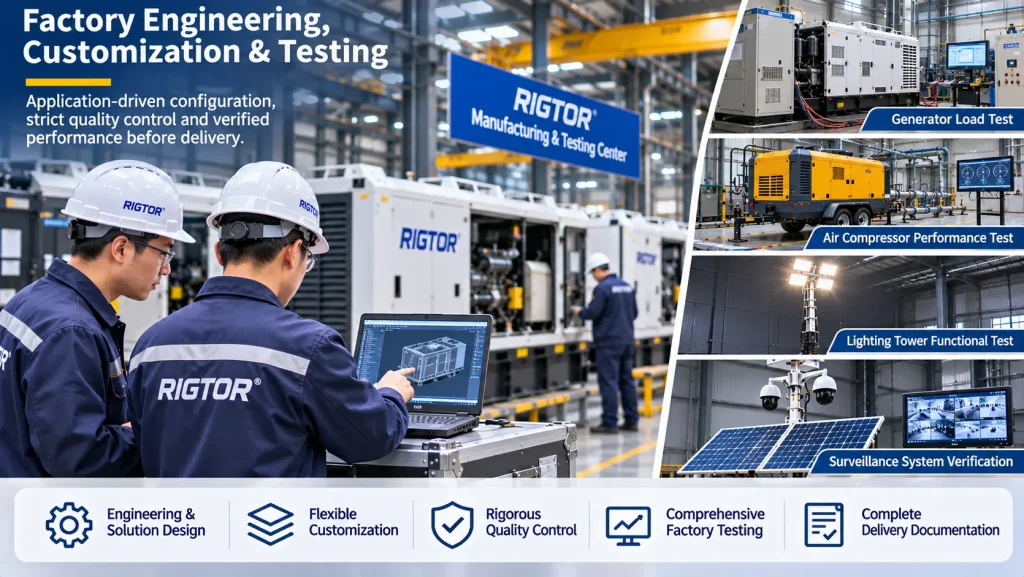
RIGTOR is an equipment manufacturer and supplier, so the proposed configuration must translate into specific manufacturing requirements.
The factory's role is not simply to provide machines from a catalog.
It is to review what can be configured, manufactured, inspected and delivered for the intended application.
RIGTOR reviews customer-supplied requirements such as:
Engine, alternator, compressor airend, electrical components and other critical assemblies are evaluated for compatibility with the selected equipment design.
Depending on the product and agreed scope, customization may include:
The agreed quality-control plan may include component inspection, mechanical assembly checks, electrical inspection and functional testing.
Equipment-specific checks may include:
Generators: Output and protection-function testing under an agreed test procedure.
Air Compressors: Pressure, airflow and operating checks according to the applicable test scope.
Lighting Towers: Mast, stabilization, lighting and control-function checks.
Surveillance Systems: Camera, power and communications checks.
Test conditions, acceptance criteria and reports should be agreed before delivery.
The customer should confirm the required operating manuals, maintenance instructions, spare-parts information, inspection records and warranty terms.
This is especially important for remote oilfield locations where external service access may be limited.
Oil and gas projects may be subject to demanding regulatory and site-specific requirements.
Depending on the project, these may include:
RIGTOR equipment must not be assumed to carry hazardous-area certification or other approvals unless the specific model and documentation confirm them.
For hazardous areas, the customer must identify the required equipment protection method, classification and certification before procurement.
A suitable solution may require locating ordinary diesel equipment outside the hazardous area or using specially approved equipment.
RIGTOR's value lies in coordinating product selection and manufacturing requirements around the actual field application.
Generators, lighting towers, air compressors and surveillance systems can be evaluated through one equipment supply relationship.
Equipment selection starts with operating loads, site requirements and intended duty rather than relying only on nominal model ratings.
Available configurations can be reviewed against customer specifications and manufacturing feasibility.
Inspection and functional testing requirements can be defined as part of the equipment order.
Equipment documentation and spare-parts requirements can be discussed before delivery to support field maintenance planning.
For oil and gas customers, these capabilities are most valuable when supported by complete technical specifications, agreed acceptance criteria and clear responsibilities.
To prepare an equipment recommendation, RIGTOR requests the following information.
| Required Information | Purpose |
|---|---|
| Project type and location | Identify operating conditions |
| Site layout and hazardous-area classification | Review equipment positioning and suitability |
| Electrical load list | Select generator rating and configuration |
| Pneumatic equipment requirements | Select compressor pressure and airflow |
| Work-zone dimensions | Develop lighting requirements |
| Operating hours | Evaluate duty and fuel planning |
| Ambient temperature and altitude | Review equipment derating and cooling |
| Transport restrictions | Determine suitable equipment arrangements |
| Local standards and certification requirements | Review regulatory compatibility |
| Maintenance and spare-parts requirements | Prepare support documentation |
With these inputs, the customer and RIGTOR can develop a more technically appropriate equipment specification.
Oil and gas field operations require more than individual machines.
Temporary infrastructure equipment must be selected according to electrical loads, compressed-air demand, lighting requirements, site conditions and operational safety.
Equipment positioning must also consider hazardous-area boundaries, ventilation, maintenance access, cable routing and emergency access.
RIGTOR supplies diesel generators, portable diesel air compressors, mobile lighting towers and surveillance systems that can be evaluated for suitable oil and gas support applications.
As a manufacturer and supplier, our role is to translate customer operating requirements into practical equipment configurations, define manufacturing and inspection requirements and prepare the agreed technical documentation.
The result is an equipment proposal developed around the field application—not simply a list of available products.
Temporary field operations may require diesel generators, portable air compressors, mobile lighting towers and surveillance systems. The equipment combination depends on the specific operation and site conditions.
Start with a complete electrical load schedule, including running power, motor starting requirements, voltage, frequency and duty cycle. The final generator rating should be verified against the selected model's performance data.
Not automatically. Equipment must be suitable for the site's hazardous-area classification. Ordinary diesel generators may need to be located in an appropriately assessed non-hazardous area.
The required compressor depends on the pneumatic tools or processes involved. Airflow, working pressure, air quality and simultaneous demand must all be confirmed.
Only when the complete system and procedure are suitable for the intended test. Pipeline pressure testing may require specialized equipment, pressure controls, air treatment and safety procedures.
The quantity depends on work-area size, required illuminance, mast height, fixture performance and site obstructions. A photometric lighting plan is preferable to selecting towers solely by area.
RIGTOR can review customer requirements for electrical configurations, compressor specifications, equipment arrangements and selected control or monitoring options. Availability depends on the model and engineering scope.
Yes. RIGTOR supplies these complementary equipment categories. Their combined use should be reviewed through a project-specific equipment schedule and site layout.
Testing should be appropriate to each product and may include generator electrical tests, compressor operating tests, lighting tower functional checks and surveillance system verification. Acceptance criteria should be documented.
Customers should provide the project application, operating conditions, electrical loads, compressed-air requirements, lighting needs, applicable standards and expected operating schedule.
Temporary Power. Compressed Air. Mobile Lighting. Site Monitoring.
Share your field operating requirements, equipment specifications and site conditions with RIGTOR.
Our team can review suitable equipment configurations, available manufacturing options and the technical information needed for your project.
Contact RIGTOR for an Equipment Configuration Proposal.

Behind Every Critical Project.
@ 2026-2026 Rigtor Industry. All Rights Reserved.
 EN
 ES
 PT
 AR