
Time: Nov 3 2026 Views: 5
Infrastructure maintenance is essential to keeping roads, bridges, water systems, utilities and industrial facilities operating safely and efficiently.
Unlike new construction projects, infrastructure maintenance often takes place while the surrounding facilities remain in service.
Road maintenance crews may need to work during limited nighttime lane closures. Utility contractors may need to repair equipment without interrupting nearby operations. Bridge maintenance teams may have only a few hours to complete inspections and repairs before traffic resumes.
For maintenance contractors and infrastructure operators, these conditions create a demanding operational challenge.
Equipment must arrive on time, be deployed quickly, support the required work and be removed before the maintenance window closes.
Temporary electricity, compressed air, outdoor lighting and site monitoring can all play important roles in achieving these objectives.
At RIGTOR, we supply diesel generator sets, portable diesel rotary screw air compressors, mobile lighting towers and mobile surveillance systems for temporary field operations.
Our approach is to help contractors select appropriate equipment configurations, prepare for efficient deployment and establish practical maintenance support.
This article explains how mobile infrastructure equipment can support maintenance projects, reduce avoidable setup time and help control operating costs.
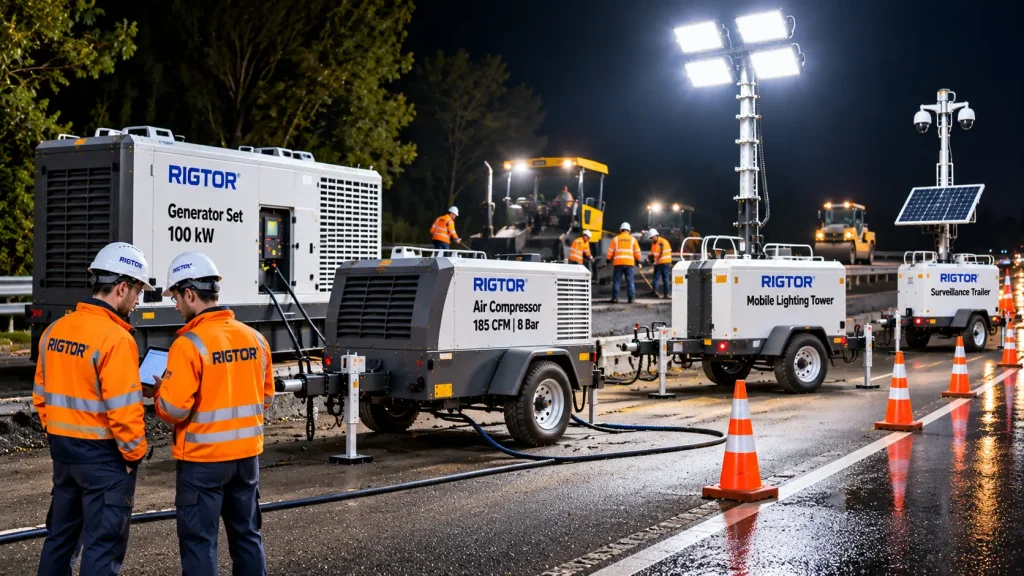
Infrastructure maintenance differs from conventional construction in several important ways.
Road repairs, bridge inspections and utility maintenance may be scheduled during nighttime or off-peak periods.
The available working window may be only a few hours.
Equipment setup and removal must therefore be included in the project schedule.
Maintenance crews may work near moving traffic, operating machinery, electrical systems or public utility networks.
Equipment placement must account for safety, access restrictions and the surrounding operating environment.
Maintenance contractors may work at multiple locations during the same week.
Generators, compressors and lighting towers must be transported, positioned and inspected repeatedly.
Some maintenance work is scheduled in advance, while other activities respond to equipment faults or infrastructure damage.
Contractors need equipment that can be mobilized according to the urgency and technical requirements of each task.
A delayed repair may extend lane closures, increase contractor standby costs or prolong a utility service interruption.
The financial impact depends on the affected infrastructure and the project circumstances.
Diesel generators provide independent electricity where permanent power is unavailable, unsuitable or temporarily isolated.
Typical applications include:
Generator selection should consider connected loads, motor starting currents, voltage, frequency and operating duration.
Electrical protection, grounding arrangements and safe connection procedures must comply with applicable requirements.
Nighttime maintenance is common on highways, bridges and public infrastructure because it may reduce interference with normal daytime operations.
Mobile lighting towers can illuminate work zones, access points and temporary maintenance areas.
RIGTOR offers diesel, solar and hybrid lighting configurations.
A 7m diesel lighting tower equipped with four 400W LED floodlights, for example, has a nominal lighting load of 1,600W.
However, the actual illuminated area depends on fixture performance, mast height, beam distribution and required ground-level illuminance.
Lighting layouts must also control glare for drivers, pedestrians and equipment operators.
Portable diesel screw compressors provide independent compressed air for compatible pneumatic tools.
Applications may include selected pavement repair tools, pneumatic breakers, maintenance tools and industrial servicing equipment.
RIGTOR's discussed compressor configurations include compact 70 CFM models and larger portable compressors.
A 70 CFM unit may be suitable for selected smaller maintenance tools.
A 185 CFM compressor provides greater nominal airflow and may support higher-demand tools.
The correct compressor must be selected according to actual tool consumption and required working pressure.
Infrastructure maintenance sites may contain generators, compressors, tools, materials and temporary storage areas.
Mobile surveillance trailers can support monitoring of selected equipment locations and access points.
Their effectiveness depends on camera placement, communications availability, power autonomy and site conditions.
Monitoring equipment should supplement appropriate physical security and site-control procedures.
For infrastructure maintenance contractors, setup time can directly affect the available working window.
Consider a road maintenance team with an eight-hour nighttime closure.
If equipment delivery, positioning and commissioning require three hours, only five hours remain for maintenance activities before accounting for demobilization.
Reducing avoidable setup work can therefore provide more usable time for the planned repair.
Step 1 — Review Maintenance Requirements
Identify the worksite location, available maintenance window, electrical loads, pneumatic tool requirements and lighting needs.
Step 2 — Select Equipment
Choose generator capacity, compressor output, lighting tower configuration and any required monitoring equipment.
Step 3 — Prepare Before Delivery
Where included in the agreed scope, complete equipment inspections, configuration checks and documentation preparation.
Step 4 — Coordinate Site Access
Confirm transport routes, unloading requirements, work-zone restrictions and equipment positioning.
Step 5 — Install and Commission
Qualified personnel complete the required connections, stabilization, inspections and operational checks.
Step 6 — Plan Demobilization
Establish procedures for disconnecting, securing and relocating equipment when the maintenance window ends.
The goal is to reduce unnecessary coordination work while preserving all required safety and commissioning activities.
The following example is a hypothetical project scenario. It demonstrates how a maintenance contractor could evaluate equipment deployment and operating costs. It does not represent a documented RIGTOR customer installation.
A regional infrastructure maintenance contractor is responsible for selected highway repairs and utility maintenance activities.
The contractor operates across multiple work locations and frequently performs nighttime maintenance.
The evaluation period is 12 months.
The contractor identifies four concerns:
| Equipment | Illustrative Configuration | Intended Function |
|---|---|---|
| Diesel Generator | 1 × 30 kW class | Temporary electrical supply |
| Mobile Lighting Towers | 2 × 7m diesel LED towers | Nighttime work-zone lighting |
| Diesel Air Compressor | 1 × 185 CFM class | Compatible pneumatic maintenance tools |
| Mobile Surveillance Trailer | 1 unit | Temporary equipment-area monitoring |
These capacities are illustrative.
Actual equipment selection must be based on the maintenance tasks, electrical loads, pneumatic requirements, lighting design and site conditions.
Technical Review
The contractor provides maintenance schedules, equipment specifications, site layouts and expected operating hours.
Equipment Configuration
RIGTOR reviews the requested power, compressed-air and lighting requirements.
Pre-Delivery Preparation
Equipment inspections and documentation are completed according to the agreed supply scope.
Deployment Coordination
Transport dimensions, unloading requirements and installation responsibilities are confirmed.
Site Commissioning
Qualified personnel position and inspect equipment before operation.
Maintenance Support Planning
The contractor prepares service schedules, spare-parts lists and equipment inspection procedures.
The contractor compares two approaches.
Option A: Equipment sourced independently from multiple suppliers.
Option B: A coordinated RIGTOR equipment package with pre-planned requirements and documentation.
Both approaches are assumed to meet equivalent technical and safety requirements.
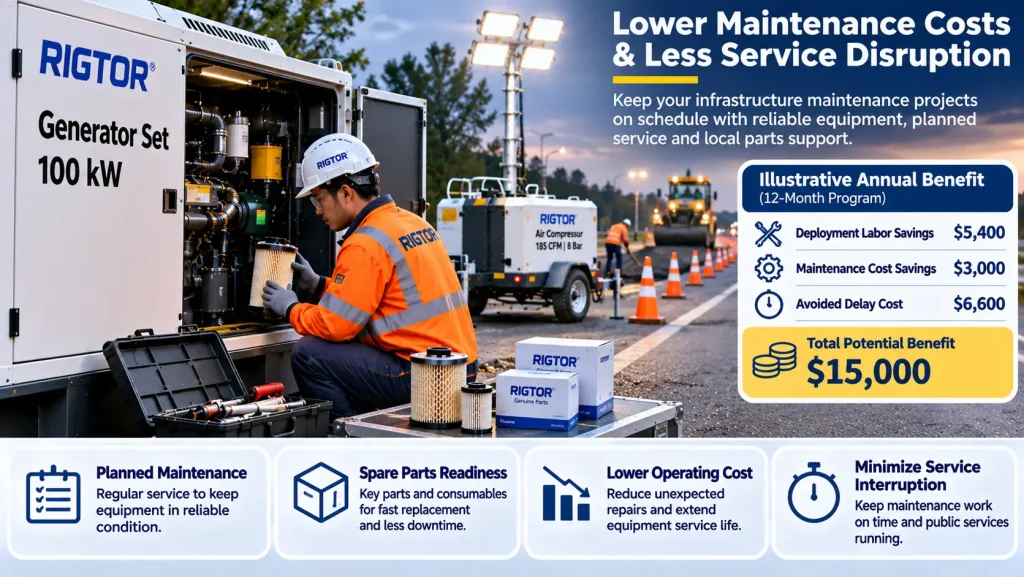
| Deployment Activity | Option A | Option B |
|---|---|---|
| Equipment checks and coordination | 1.5 hours | 1.0 hour |
| Positioning and connections | 2.0 hours | 1.5 hours |
| Testing and commissioning | 1.0 hour | 0.75 hour |
| Total Deployment Work | 4.5 hours | 3.25 hours |
Modeled setup-time reduction: 1.25 hours, or approximately 27.8%.
These figures are hypothetical and do not represent measured RIGTOR performance.
The potential reduction comes from advance planning and coordination, not from bypassing required inspections.
Suppose the contractor completes 24 comparable equipment deployments during the year.
| Calculation | Illustrative Result |
|---|---|
| Time saved per deployment | 1.25 hours |
| Annual deployments | 24 |
| Total crew time saved | 30 hours |
| Crew size | 3 technicians |
| Labor rate | $60 per technician-hour |
| Estimated Annual Labor Savings | $5,400 |
The 30 hours represent reduced deployment duration across the year.
With three technicians working during each deployment, the modeled reduction is 90 labor-hours.
The calculation does not automatically imply 30 hours of reduced road closure time.
Infrastructure maintenance often takes place under strict scheduling requirements.
Equipment readiness can help reduce avoidable interruptions, but the overall schedule also depends on permits, traffic control, weather and worksite conditions.
Mobile lighting and compressed-air equipment can support selected nighttime pavement and road repair activities.
Temporary power and lighting may support inspections, repairs and maintenance work in locations without convenient electrical access.
Portable generators can support appropriately sized pumps, tools and temporary equipment.
Mobile compressors and generators may support servicing activities in industrial facilities or remote utility locations.
Assume an infrastructure maintenance contractor incurs $2,200 per hour in additional labor, equipment standby and traffic-management costs when a critical activity is delayed.
If improved equipment readiness avoids three hours of such delay during the year:
3 hours × $2,200/hour = $6,600
This is a hypothetical avoided-cost calculation.
It does not represent a verified RIGTOR customer saving or the wider economic cost of public service interruptions.
Frequent relocation and repeated operation can increase equipment inspection and maintenance requirements.
A fair comparison between equipment suppliers should consider the complete maintenance cost rather than replacement-part prices alone.
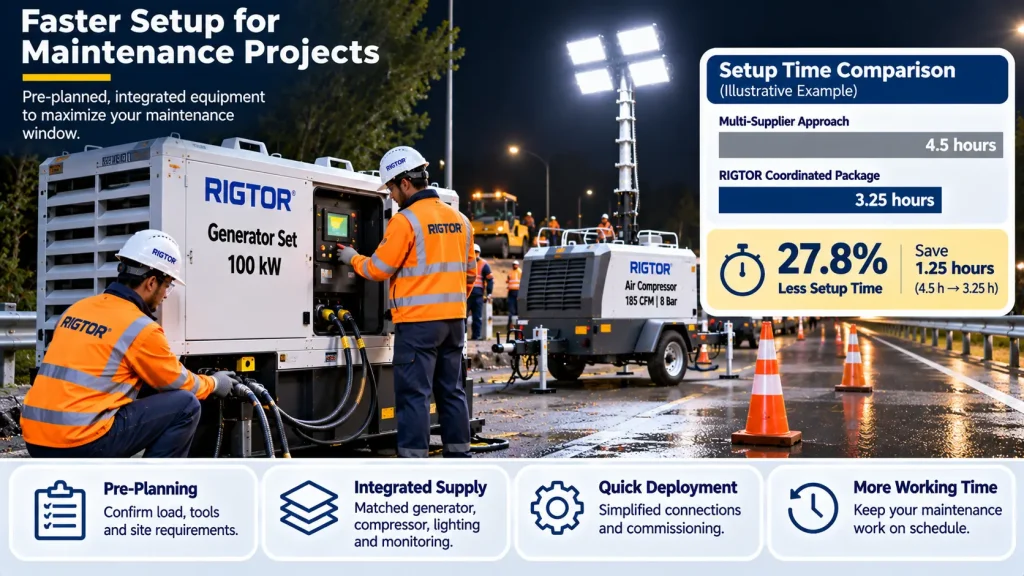
| Maintenance Category | Conventional Package | RIGTOR Package |
|---|---|---|
| Filters, lubricants and consumables | $5,000 | $4,500 |
| Planned replacement parts | $4,000 | $3,500 |
| Maintenance labor | $7,000 | $6,000 |
| External service and travel | $4,000 | $3,000 |
| Total Annual Maintenance Cost | $20,000 | $17,000 |
Modeled maintenance cost reduction: $3,000, or 15%.
These figures are illustrative assumptions, not actual supplier quotations or maintenance records.
The lower-cost scenario assumes appropriate parts availability and the ability to perform more routine maintenance locally.
It does not establish that RIGTOR equipment has longer service intervals or fewer failures than competing products.
Diesel Generators
Inspect engine fluids, filters, cooling systems, electrical connections and operating indicators.
Diesel Air Compressors
Check compressor lubricant, intake filtration, air/oil separation, cooling systems and pressure controls.
Mobile Lighting Towers
Inspect mast mechanisms, stabilizers, LED fixtures, electrical cables and fuel or energy systems.
Surveillance Equipment
Verify camera functionality, power availability, communications and recording systems.
All maintenance must follow the applicable equipment manuals and safety procedures.
Infrastructure maintenance contractors frequently move between work zones.
Equipment mobility therefore affects labor and transport planning.
Smaller equipment may be easier to transport when its capacity is sufficient for the application.
However, compact dimensions alone do not establish transport suitability.
Equipment should be evaluated for towing requirements, lifting points, securing arrangements and applicable road regulations.
Consistent equipment configurations and documented procedures can simplify repeated deployment and maintenance planning.
Grouping compatible maintenance activities may reduce unnecessary equipment movement.
Actual transport savings depend on distance, equipment weight, road access and project scheduling.
Combining the modeled benefits:
| Savings Category | Illustrative Annual Value |
|---|---|
| Equipment deployment labor | $5,400 |
| Maintenance and service | $3,000 |
| Avoided critical-path delay costs | $6,600 |
| Total Potential Annual Benefit | $15,000 |
This total assumes that each benefit occurs and can be independently measured without double-counting.
It excludes equipment purchase or rental costs, fuel, transportation, insurance, taxes and residual value.
The figures should be treated as a scenario-based planning model, not a guaranteed project outcome.
Infrastructure maintenance contractors should evaluate equipment over the expected operating period.
A simplified ownership-cost calculation is:
TCO = Acquisition + Transport + Fuel + Maintenance + Downtime + Other Operating Costs − Residual Value
For rental equipment, rental charges and return conditions should be included instead of the relevant ownership costs.
A lower purchase price does not necessarily mean lower total cost.
Likewise, higher-priced equipment does not automatically provide better reliability or productivity.
The correct comparison requires equivalent equipment specifications, actual operating data and supplier support information.
Before selecting equipment, contractors should review:
These details help determine whether a proposed equipment package is suitable for the maintenance program.
Infrastructure maintenance requires reliable temporary equipment that can be deployed efficiently and operated within limited work windows.
Diesel generators, mobile lighting towers, portable air compressors and surveillance systems can support road, bridge, utility and industrial maintenance activities.
From RIGTOR's manufacturing and supply perspective, the objective is to help contractors select equipment that matches their work requirements, simplify repeated deployment and establish practical maintenance support.
The illustrative 12-month maintenance program demonstrates how coordinated planning could reduce deployment labor, selected maintenance expenses and delay-related costs.
Actual benefits depend on project conditions, equipment specifications and verified operating data.
For infrastructure maintenance contractors, equipment value should be measured by its contribution to safe, reliable and cost-effective maintenance operations.
Infrastructure maintenance may require diesel generators, portable air compressors, mobile lighting towers and temporary surveillance equipment. The correct equipment depends on the maintenance activity, available utilities and site conditions.
Mobile equipment can reduce the need for permanent installations at temporary work zones. Advance equipment planning, coordinated delivery and standardized deployment procedures can also reduce avoidable setup work.
Mobile lighting towers provide elevated illumination for selected nighttime work areas. Proper lighting design must consider illuminance, glare, shadows, road users and worksite safety requirements.
Compressor size depends on the pneumatic tools used. A compact 70 CFM compressor may support selected smaller tools, while a 185 CFM or larger compressor may be required for higher-demand equipment. Working pressure must also be verified.
RIGTOR equipment may offer competitive total ownership costs depending on acquisition price, maintenance requirements, fuel consumption and service arrangements. A valid comparison requires equivalent specifications and verified operating data.
Savings depend on deployment frequency, labor rates, maintenance expenses and avoided delays. In the illustrative 12-month scenario above, the modeled potential benefit is $15,000. This is a hypothetical calculation, not a verified customer result.
Preventive servicing, equipment inspections, spare-parts planning, trained personnel and appropriate backup arrangements can help reduce downtime risk.
Yes. Diesel generators can supply electricity for appropriately sized maintenance equipment, temporary pumps and selected support systems. Electrical loads and applicable safety requirements must be reviewed before deployment.
Mobile surveillance trailers can support monitoring of equipment storage areas, temporary worksites and selected access points. Their effectiveness depends on camera coverage, communications and power availability.
Contractors should provide electrical loads, pneumatic equipment specifications, lighting requirements, maintenance schedules, site conditions, transport restrictions and expected operating hours. This information supports appropriate equipment selection.
Reliable maintenance operations require equipment that can be deployed efficiently and maintained effectively.
RIGTOR supplies diesel generators, portable diesel air compressors, mobile lighting towers and mobile surveillance systems for temporary infrastructure applications.
Contact our team with your project requirements, operating conditions and equipment specifications to discuss a suitable equipment configuration.

Behind Every Critical Project.
@ 2026-2026 Rigtor Industry. All Rights Reserved.
 EN
 ES
 PT
 AR