

Time: Nov 3 2026 Views: 3
When a natural disaster or major infrastructure failure occurs, restoring essential services becomes a race against time.
Storms, floods, earthquakes, wildfires and widespread power outages can disrupt electrical networks, transportation routes, water systems and communications infrastructure.
Emergency response teams must often operate in locations where permanent utilities are unavailable or damaged.
They need dependable temporary electricity, safe worksite illumination, compressed air for compatible repair equipment, and reliable monitoring of temporary facilities.
For emergency contractors, utility companies, disaster recovery organizations and equipment rental providers, the challenge is not simply obtaining machinery.
The real challenge is deploying the right equipment quickly, keeping it operational and controlling the cost of recovery.
At RIGTOR, we supply mobile infrastructure equipment for demanding field operations, including diesel generators, mobile lighting towers, portable diesel rotary screw air compressors and mobile surveillance trailers.
By coordinating these systems around the requirements of a specific emergency operation, response teams can reduce avoidable setup work and prepare more effectively for extended recovery activities.
This guide explains the role of temporary infrastructure in emergency response, how equipment selection affects deployment efficiency, and how contractors can evaluate operating costs using a practical disaster recovery scenario.
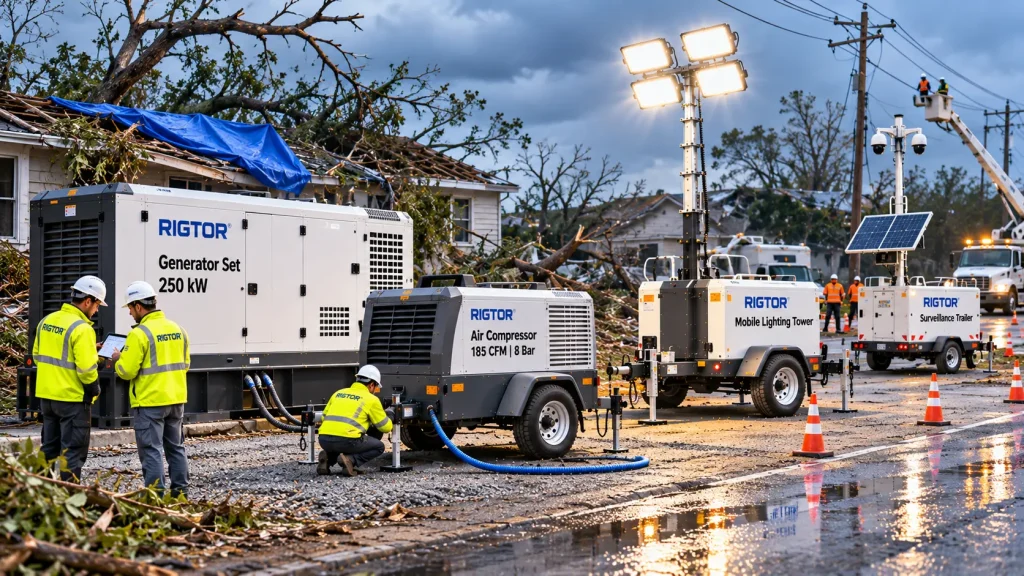
Disaster recovery operations often begin before damaged infrastructure can be repaired.
Electrical service may be unavailable. Roads may be partially blocked. Communications systems may be unreliable, and response teams may need to work through the night.
These conditions create several operational challenges.
Temporary electricity may be needed for repair equipment, temporary offices, pumps, communications equipment and other essential loads.
Without an appropriate power source, recovery work can be delayed.
Emergency crews may work in damaged streets, industrial facilities and utility corridors after dark.
Insufficient lighting can create additional hazards and reduce the ability to perform planned repairs safely.
Certain maintenance and recovery tasks require pneumatic tools.
Portable diesel air compressors can provide independent compressed air where electrical infrastructure is unavailable.
Emergency operations may involve equipment storage areas, temporary supply depots and unattended machinery.
Mobile surveillance systems can support monitoring of these locations when suitable power and communications are available.
An emergency deployment may last several hours, multiple days or several weeks.
Equipment must therefore be selected for both initial deployment and continued operation.
Diesel generators provide independent electrical power for appropriately sized loads.
Emergency applications may include:
Generator sizing must account for running loads, starting currents, voltage, frequency and expected operating duration.
For critical electrical loads, appropriate transfer equipment, protection systems and redundancy may also be required.
Important: Life-safety, medical and other critical applications require additional engineering, compliance and reliability considerations. A standard portable generator should not automatically be treated as an approved emergency power system for those uses.
Mobile lighting towers can illuminate repair zones, temporary work areas and selected access routes.
RIGTOR offers diesel, solar and hybrid mobile lighting configurations.
Diesel lighting towers may be useful when extended nighttime operation is required and fuel logistics are available.
Solar or hybrid systems may be appropriate for selected lower-load applications, depending on energy storage, weather conditions and operating schedules.
Lighting equipment must be deployed according to its wind limits, stabilization requirements and electrical safety instructions.
Diesel rotary screw air compressors provide compressed air independently of the electrical grid.
Applications may include compatible pneumatic tools used for debris removal, pavement repair, utility maintenance and industrial equipment servicing.
RIGTOR's discussed compressor range includes compact 70 CFM units and larger portable configurations.
For emergency maintenance teams, a 70 CFM compressor may support selected small pneumatic tools.
A 185 CFM compressor may be appropriate where higher airflow is required.
Actual equipment compatibility must be confirmed using the tool manufacturer's airflow and pressure specifications.
Mobile surveillance trailers can support monitoring of temporary equipment yards, supply depots and selected access points.
These systems may combine cameras, communications equipment and independent power arrangements.
However, their effectiveness depends on site coverage, communications availability, power autonomy and operating conditions.
Surveillance equipment should be integrated into the response organization's broader security procedures.
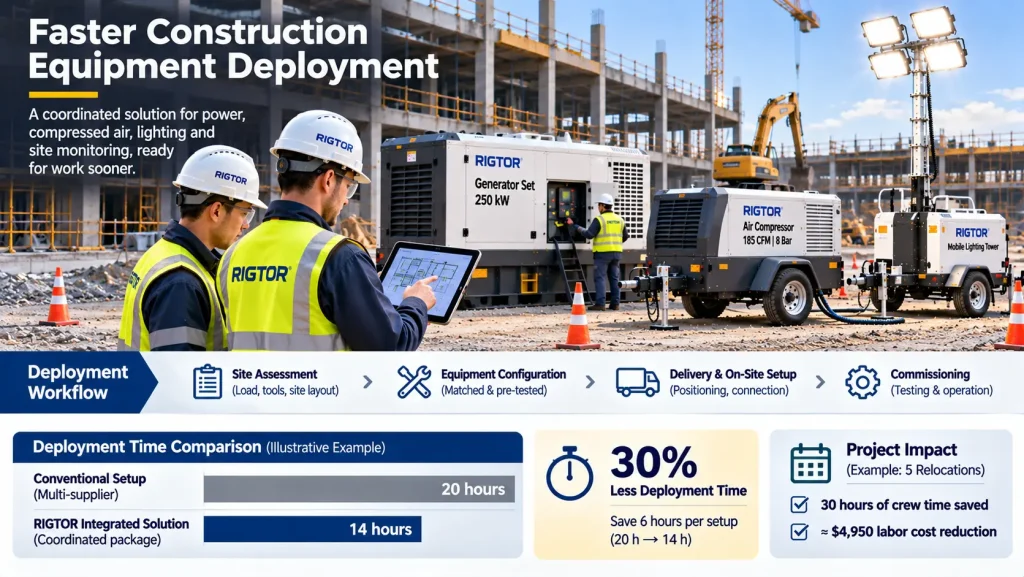
During emergency recovery, equipment availability is only one part of the response.
The equipment must also reach the site, be installed safely and become operational.
Equipment Selection Delays
The response team may not have a clear inventory of required electrical loads, pneumatic tools or lighting needs.
Multiple Supplier Coordination
Different equipment suppliers may use different delivery schedules, connection requirements and documentation.
Installation and Commissioning
Generators, compressors and lighting towers require positioning, inspection and operational checks.
Fuel and Spare-Parts Logistics
A machine may be available but unable to operate for the required duration without sufficient fuel or maintenance support.
For planned emergency equipment procurement, we recommend preparing an equipment package around defined response scenarios.
This includes reviewing expected loads, compressed-air demand, lighting requirements, transportation arrangements and maintenance resources.
Where included in the agreed supply scope, equipment can be inspected and documented before delivery.
The goal is to reduce avoidable setup work without compromising commissioning or safety requirements.
The following scenario is hypothetical. It demonstrates how an emergency contractor could evaluate equipment deployment and recovery costs. It does not represent a verified RIGTOR customer project.
A disaster recovery contractor is supporting utility and infrastructure repairs following a severe storm.
The affected area has experienced localized power outages, damaged access roads and disrupted nighttime working conditions.
The contractor expects the initial response phase to last approximately 72 hours.
The response team needs temporary electrical power for repair support equipment, illumination for nighttime work, compressed air for selected pneumatic tools, and monitoring of a temporary equipment storage area.
| Equipment | Illustrative Configuration | Intended Function |
|---|---|---|
| Diesel Generator | 1 × 50 kW class | Temporary electrical supply |
| Mobile Lighting Towers | 2 × 7m diesel LED towers | Nighttime repair-zone lighting |
| Diesel Air Compressor | 1 × 185 CFM class | Compatible pneumatic repair tools |
| Mobile Surveillance Trailer | 1 unit | Temporary equipment-area monitoring |
The equipment quantities and capacities are planning assumptions.
Actual generator sizing, compressor pressure, lighting performance and surveillance requirements must be verified for the response site.
The contractor identifies electrical loads, work zones, access restrictions, available fuel and the expected duration of the deployment.
RIGTOR reviews the requested equipment specifications and identifies suitable configurations.
Equipment checks, operating information and spare-parts references are prepared according to the agreed supply requirements.
The contractor arranges transportation and unloading.
Qualified personnel position equipment, establish connections and complete the required safety inspections.
The team verifies electrical output, compressor performance, lighting operation and monitoring functionality.
The response team monitors operating hours, fuel availability, equipment condition and maintenance requirements throughout the deployment.
To evaluate potential time savings, the contractor compares two approaches.
Option A: Independently sourced equipment from multiple suppliers.
Option B: A coordinated RIGTOR equipment package with pre-planned configuration and documentation.
Both options are assumed to meet the same technical and safety requirements.
| Deployment Activity | Option A | Option B |
|---|---|---|
| Equipment checks and coordination | 4 hours | 2 hours |
| Positioning and connections | 6 hours | 4 hours |
| Testing and commissioning | 4 hours | 3 hours |
| Total Deployment Work | 14 hours | 9 hours |
Modeled deployment work reduction: 5 hours, or approximately 35.7%.
These figures are hypothetical and should not be interpreted as measured RIGTOR performance.
The reduction assumes that equipment preparation and coordination eliminate some avoidable field work.
It does not assume faster safety testing or reduced regulatory requirements.
In an emergency operation, five hours of earlier equipment readiness may allow crews to begin certain repair activities sooner.
However, the actual schedule benefit depends on personnel availability, site access, permits and whether the affected work is on the critical path.
A reduction in deployment work does not automatically translate into an equivalent reduction in overall recovery time.
Emergency equipment must remain available after the initial deployment.
An unexpected shutdown can interrupt work, particularly when the affected system has no backup.
Generators should be sized for the required loads and operated within their approved limits.
Critical applications may require backup generation or other redundancy.
Lighting towers should be positioned to provide suitable illumination while controlling glare and avoiding unsafe placement.
Fuel or energy-storage capacity must support the expected operating schedule.
Compressors should deliver the required airflow and pressure for the connected pneumatic equipment.
Air filters, lubricant condition, cooling systems and service requirements should be monitored.
Routine inspections and critical spare-parts planning can help reduce the duration of some equipment-related interruptions.
No equipment package can guarantee uninterrupted recovery operations.
Emergency response contractors must manage several cost categories simultaneously.
These may include equipment rental or purchase, transport, fuel, maintenance, personnel and downtime.
A coordinated equipment package may simplify some of these activities, but actual savings depend on the project.
| Cost Category | Multi-Supplier Approach | Coordinated RIGTOR Package |
|---|---|---|
| Equipment deployment labor | $2,100 | $1,350 |
| Delivery and logistics coordination | $1,200 | $900 |
| Routine servicing and consumables | $650 | $550 |
| Emergency spare-parts and service allowance | $1,050 | $750 |
| Total Modeled Cost | $5,000 | $3,550 |
Illustrative cost reduction: $1,450, or 29%.
These amounts are hypothetical assumptions, not actual customer costs or supplier quotations.
The table excludes equipment acquisition or rental charges, fuel, major repairs, and the value of interrupted recovery work.
It should therefore not be interpreted as a complete total-cost comparison.
Emergency response costs are not limited to equipment expenses.
Delays may create additional contractor labor, equipment standby charges and extended temporary-service requirements.
Assume a recovery contractor incurs $2,500 per hour in measurable additional standby and response costs when a critical operation is delayed.
If improved equipment readiness avoids three hours of such delay:
3 hours × $2,500/hour = $7,500
This figure represents a hypothetical avoided cost.
It does not measure the broader social or economic value of restoring electricity, water or other essential services.
| Savings Category | Modeled Value |
|---|---|
| Equipment deployment and operating cost reduction | $1,450 |
| Avoided critical-path delay cost | $7,500 |
| Total Potential Benefit | $8,950 |
This calculation assumes that both savings occur and are independently measurable.
It must not be treated as a guaranteed RIGTOR customer result.
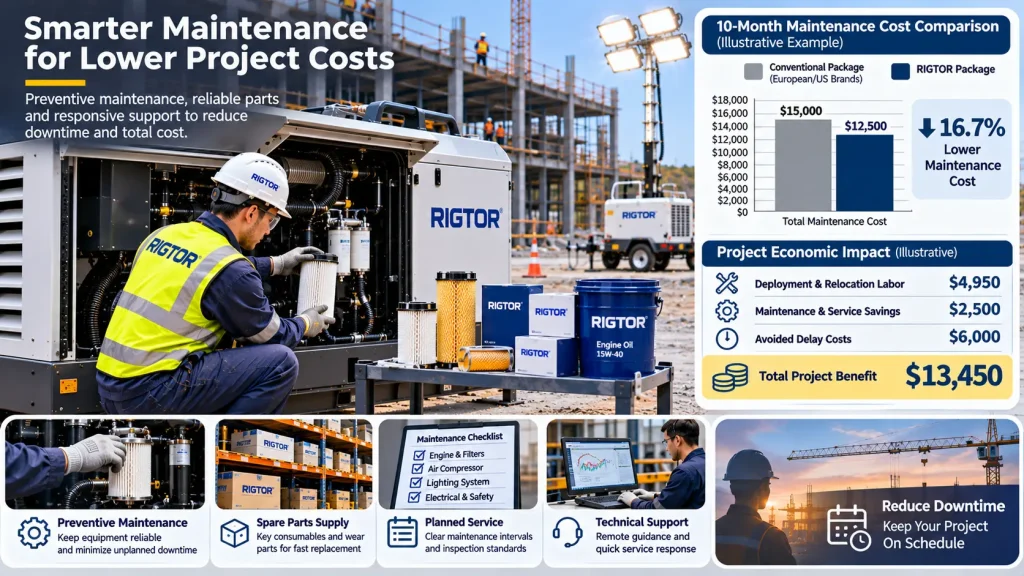
Emergency equipment may operate for extended periods in dusty, wet or otherwise difficult environments.
Maintenance requirements should be established before deployment.
Inspect fuel systems, engine oil, coolant, air filters, electrical connections and operating indicators according to the equipment manual.
Check compressor oil, intake filtration, air/oil separation, cooling performance and pressure controls.
Inspect LED fixtures, electrical cables, mast lifting components, stabilizers and fuel or energy systems.
Verify camera operation, communications connectivity, recording functionality and power availability.
Response teams should identify replacement components that could otherwise cause extended downtime.
Spare-parts inventories should be based on the actual equipment configuration and expected operating conditions.
One of the most effective ways to improve emergency equipment readiness is to prepare before an incident.
Maintain a verified inventory of available generators, compressors, lighting towers and monitoring systems.
Prepare equipment-specific inspection, transportation and commissioning checklists.
Estimate fuel requirements using verified consumption data and the expected operating duration.
Track operating hours, service history, component replacements and known faults.
Ensure personnel understand the equipment's safe operating limits and emergency shutdown procedures.
Confirm documentation, spare-parts availability and technical support arrangements before an urgent deployment is required.
Before selecting equipment for disaster recovery, buyers should review:
Equipment intended for emergency response should be evaluated as part of an operational readiness plan, not simply as an individual product purchase.
Emergency response operations depend on rapid equipment deployment, reliable temporary infrastructure and effective maintenance planning.
Diesel generators, mobile lighting towers, portable air compressors and mobile surveillance trailers can support recovery teams working in locations where permanent infrastructure is damaged or unavailable.
From RIGTOR's manufacturing and supply perspective, the objective is to help customers select equipment that matches their operating requirements and prepare for efficient field deployment.
The illustrative 72-hour recovery scenario demonstrates how coordinated equipment planning could reduce setup work and selected operating expenses.
Actual results depend on the emergency conditions, equipment configuration, deployment resources and verified project data.
For disaster recovery contractors, the most valuable equipment is not necessarily the least expensive machine.
It is the equipment that can be deployed safely, operated reliably and maintained effectively when essential services need to be restored.
Emergency operations may require diesel generators, mobile lighting towers, portable air compressors, temporary communications equipment and surveillance systems. The appropriate equipment depends on the incident, affected infrastructure and recovery requirements.
Contractors can reduce avoidable setup work through advance equipment planning, coordinated delivery, verified technical specifications, standardized procedures and appropriate pre-delivery inspections. Actual time savings depend on site conditions and commissioning requirements.
Deployment time depends on equipment availability, transportation, site access, electrical connections, safety inspections and commissioning. A portable generator does not have a universal guaranteed deployment time.
Diesel generators can provide temporary electrical power for appropriately sized loads. Critical or life-safety applications may require specialized equipment, redundancy, transfer systems and compliance with applicable electrical standards.
Yes. Mobile lighting towers can provide temporary illumination for nighttime repair work, utility restoration and selected emergency support areas. Deployment must account for lighting performance, ground stability, weather conditions and electrical safety.
Compressor selection depends on the pneumatic tools being used. Compact compressors may support small maintenance tools, while larger pneumatic equipment may require 185 CFM or higher airflow. Required pressure must also be verified.
Preventive maintenance, equipment inspections, spare-parts planning, fuel management, trained operators and appropriate backup systems can help reduce downtime risk. No single measure guarantees uninterrupted operation.
RIGTOR equipment may offer competitive acquisition and operating costs depending on configuration, service arrangements and project requirements. A valid comparison requires equivalent specifications and actual cost data. Lower purchase prices do not automatically mean lower recovery costs.
Savings depend on the operation. In the illustrative 72-hour scenario in this article, the modeled potential benefit is $8,950, including selected equipment-related cost reductions and avoided critical-path delay costs. This is not a documented customer result or guaranteed saving.
Buyers should evaluate deployment requirements, operating capacity, fuel runtime, transportation, maintenance access, environmental suitability, spare-parts availability, safety compliance and technical support.
Reliable equipment planning begins before an emergency occurs.
RIGTOR supplies diesel generators, mobile lighting towers, portable diesel air compressors and mobile surveillance equipment for temporary field operations.
Contact our team with your expected operating requirements, equipment specifications and deployment conditions to discuss suitable emergency infrastructure configurations.

Behind Every Critical Project.
@ 2026-2026 Rigtor Industry. All Rights Reserved.
 EN
 ES
 PT
 AR