
Time: Nov 3 2026 Views: 4
Temporary construction sites often require reliable electricity, compressed air, outdoor lighting, and equipment security before permanent infrastructure becomes available.
For general contractors, civil engineering companies, and construction equipment rental providers, these requirements create a practical challenge: essential site equipment must be installed quickly, operated reliably, and relocated as construction progresses.
Delays in temporary power installation, insufficient compressed-air capacity, inadequate lighting, or unexpected equipment failures can interrupt work and increase project costs.
At RIGTOR, we focus on temporary infrastructure systems designed to support changing construction environments.
Our product portfolio includes diesel generator sets, mobile lighting towers, portable diesel rotary screw air compressors, and mobile surveillance trailers.
By selecting equipment around actual project requirements, contractors can simplify site preparation, improve equipment utilization, and develop more predictable maintenance plans.
This article explains how temporary construction infrastructure works, where operating costs arise, and how coordinated equipment deployment can help contractors control project schedules and expenses.
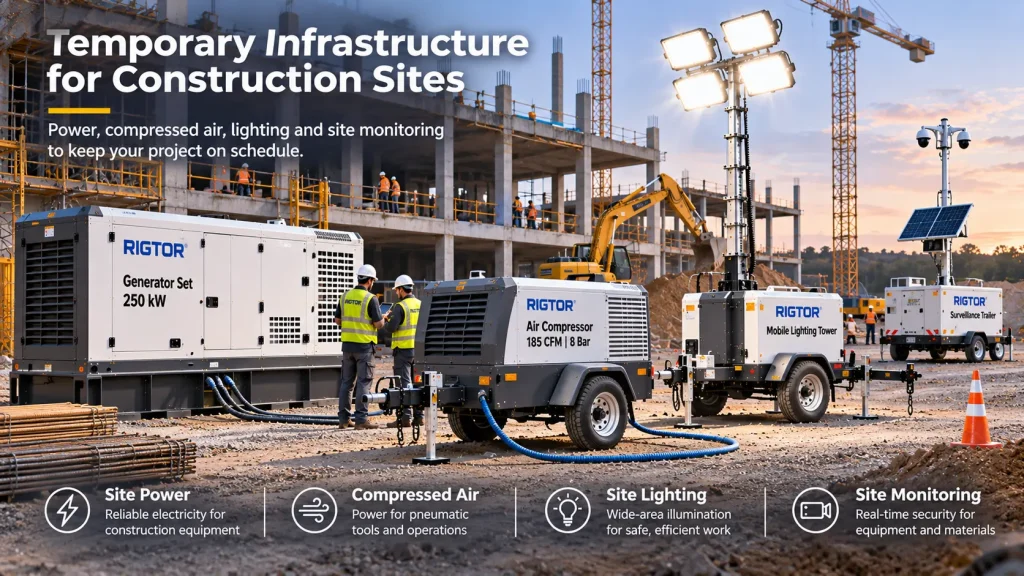
Construction projects depend on temporary infrastructure throughout multiple stages of development.
During initial site preparation, permanent electrical connections may not be available. Earthmoving, concrete work, equipment maintenance, and temporary facilities may all require independent power or compressed air.
As construction progresses, the location of equipment and work areas changes.
This creates several common challenges.
Temporary electrical systems, compressors, and lighting equipment must be delivered, positioned, connected, and tested.
When equipment comes from multiple suppliers, contractors may need additional time to coordinate specifications and installation responsibilities.
An unexpected generator shutdown may interrupt connected equipment.
A compressor problem may prevent pneumatic tools from operating.
Insufficient lighting may delay planned evening work.
The actual impact depends on which activities rely on the affected equipment.
Road construction, utility installation, and large building projects often require temporary equipment to move between work zones.
Equipment dimensions, transport requirements, connection methods, and commissioning procedures influence relocation time.
Fuel consumption, service labor, replacement parts, equipment rental, and emergency repairs all contribute to the total cost of temporary construction infrastructure.
For contractors, reducing these expenses requires more than choosing the lowest purchase price.
Diesel generators provide electricity for temporary construction loads where grid power is unavailable or insufficient.
Typical applications include temporary site offices, selected construction equipment, pumps, maintenance facilities, and electrical tools.
Generator selection should consider continuous power demand, motor starting loads, voltage, frequency, load variation, and environmental conditions.
An incorrectly sized generator may create unnecessary operating costs or fail to support the required electrical loads.
Mobile lighting towers provide elevated illumination for construction zones, access roads, material handling areas, and temporary maintenance locations.
RIGTOR's lighting portfolio includes diesel, solar, and hybrid configurations.
A 7m diesel lighting tower with four 400W LED floodlights, for example, provides a nominal lighting load of 1,600W.
However, effective coverage depends on luminous flux, fixture optics, mast height, aiming, and required ground-level illuminance.
Lighting layouts should also address glare, shadows, pedestrian routes, and safe equipment operation.
Portable diesel compressors provide independent compressed air for compatible pneumatic tools.
RIGTOR's discussed compressor configurations range from compact 70 CFM units to substantially larger industrial models.
A 70 CFM compressor may support selected maintenance tools and small construction tasks.
A 185 CFM compressor offers greater nominal airflow for higher-demand applications.
Larger models may be required for certain drilling, blasting, or industrial operations.
The correct choice depends on the connected equipment's actual airflow and pressure requirements.
Construction sites frequently contain valuable equipment, fuel, materials, and tools.
Mobile surveillance trailers can support temporary monitoring of access points, equipment storage areas, and remote sections of a project.
System performance depends on camera coverage, power autonomy, communications availability, recording requirements, and the operating environment.
Surveillance systems supplement, rather than replace, appropriate physical security procedures.
Temporary construction infrastructure is often purchased or rented from several suppliers.
Although this approach may provide flexibility, it can also increase coordination work.
For example, the electrical contractor may be waiting for generator specifications while the equipment rental provider is arranging lighting towers and compressors.
A coordinated equipment plan can help establish requirements earlier.
Step 1 — Construction Site Assessment
Review electrical loads, pneumatic equipment requirements, operating hours, worksite dimensions, access conditions, and environmental factors.
Step 2 — Equipment Selection
Match generator capacity, compressor airflow, lighting tower configuration, and monitoring equipment to the intended applications.
Step 3 — Equipment Preparation
Where included in the agreed scope, complete equipment inspections, documentation checks, and configuration verification before shipment.
Step 4 — Site Installation
Qualified personnel position the equipment, establish appropriate electrical and pneumatic connections, stabilize lighting towers, and complete required safety checks.
Step 5 — Commissioning and Operation
Verify that the installed systems operate within their specified limits and provide the required site services.
Step 6 — Maintenance and Relocation Planning
Establish inspection schedules, identify spare parts, and prepare procedures for moving equipment as the project develops.
This process is intended to reduce avoidable coordination delays. Actual deployment time depends on project conditions and contractual responsibilities.
The following example is a hypothetical project scenario designed to demonstrate equipment planning and cost calculations. It is not a documented RIGTOR customer installation.
A general contractor is constructing an industrial warehouse and associated access infrastructure.
The project duration is approximately 10 months.
Permanent electricity will not be available during the early construction phase, and the contractor plans to conduct selected evening activities.
The site also requires compressed air for maintenance and compatible pneumatic tools.
The contractor identifies four main concerns:
| Equipment | Illustrative Quantity | Intended Application |
|---|---|---|
| Diesel Generator | 1 × 50 kW class | Temporary electrical supply |
| Mobile Lighting Towers | 2 × 7m, 4 × 400W LED | Nighttime work areas |
| Diesel Screw Compressor | 1 × 185 CFM class | Compatible pneumatic tools |
| Mobile Surveillance Trailer | 1 unit | Equipment storage and site access monitoring |
The generator rating, compressor pressure, lighting coverage, and surveillance configuration must be verified against the actual project requirements.
Initial Technical Review
The contractor provides a temporary electrical load schedule, pneumatic tool specifications, site layout, and expected operating hours.
Equipment Configuration
RIGTOR reviews the equipment requirements and identifies suitable product configurations.
Pre-Delivery Coordination
The supplier and contractor confirm equipment dimensions, documentation, connections, unloading requirements, and commissioning responsibilities.
On-Site Deployment
Qualified personnel position and connect the equipment, inspect safety systems, and complete commissioning checks.
Maintenance Planning
The contractor receives the applicable maintenance information and prepares a service and spare-parts plan.
To evaluate potential benefits, the contractor compares two approaches.
Option A: A conventional multi-supplier equipment package using established European or American equipment brands.
Option B: A coordinated RIGTOR equipment package with pre-planned interfaces and installation documentation.
Both options are assumed to satisfy the same technical and safety requirements.
| Deployment Activity | Option A | Option B |
|---|---|---|
| Equipment delivery checks and coordination | 5 hours | 3 hours |
| Positioning and installation | 9 hours | 6 hours |
| Connections and commissioning | 6 hours | 5 hours |
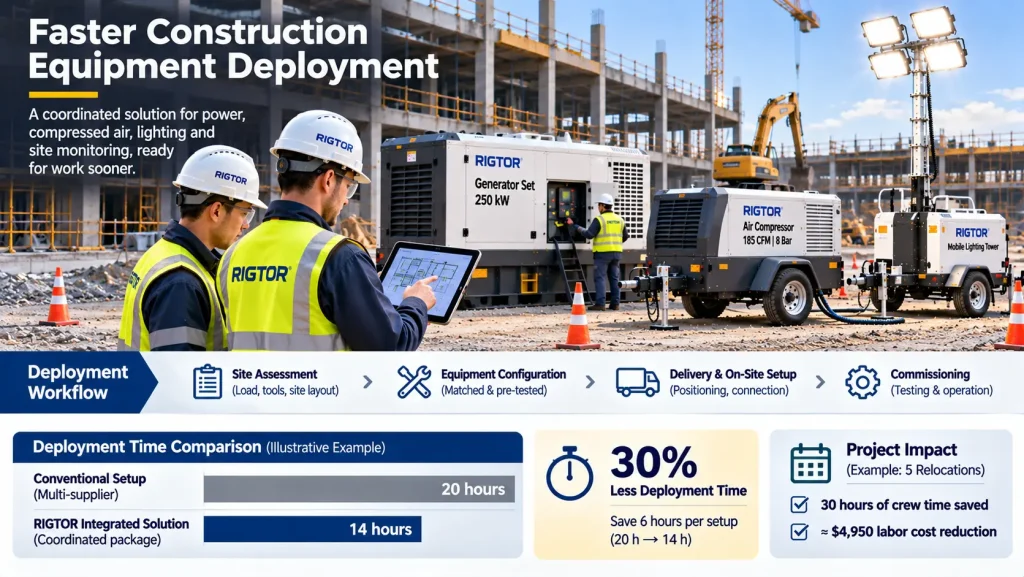
| Total Deployment Work | 20 hours | 14 hours |
Modeled deployment time reduction: 6 hours, or 30%.
These figures are illustrative assumptions, not measured deployment results.
The potential benefit comes from preparation and coordination rather than an inherent installation-speed advantage of one brand.
Suppose the contractor performs five comparable deployments or major equipment relocations during the project.
| Calculation | Illustrative Result |
|---|---|
| Work time saved per deployment | 6 hours |
| Number of deployments | 5 |
| Total crew time saved | 30 hours |
| Installation crew | 3 technicians |
| Assumed labor cost | $55 per technician-hour |
| Estimated labor savings | $4,950 |
The calculation assumes that each deployment requires the same crew size and that the reduction applies to the crew's working time.
A reduction in installation labor does not necessarily translate into an equivalent reduction in the overall construction schedule.
Temporary infrastructure can affect construction schedules when it supports critical-path activities.
For example, a concrete repair crew may be unable to begin work until compressed air is available.
Similarly, an evening maintenance operation may depend on temporary lighting.
Earlier Site Readiness
Preparing equipment specifications and deployment procedures before delivery can reduce unnecessary installation coordination.
Faster Relocation Between Work Zones
Mobile equipment can reduce the need to rebuild temporary infrastructure at every new work location.
Improved Maintenance Readiness
Routine inspections and access to critical spare parts can reduce the duration of certain equipment failures.
Assume a construction activity incurs $1,500 per hour in measurable standby labor and equipment costs.
If better equipment planning prevents four hours of critical-path interruption:
4 hours × $1,500/hour = $6,000 in potentially avoided delay costs.
This is a hypothetical example.
The contractor must verify whether the affected activity was on the critical path and whether the stated costs would actually have been incurred.
Equipment purchase price is only one component of construction operating costs.
A meaningful comparison between RIGTOR and European or American equipment brands should include maintenance materials, spare parts, labor, fuel consumption, service availability, and residual value.
| Maintenance Category | Conventional Package | RIGTOR Package |
|---|---|---|
| Filters, lubricants and consumables | $3,800 | $3,200 |
| Planned replacement parts | $2,600 | $2,100 |
| Maintenance labor | $5,200 | $4,600 |
| External service and travel | $3,400 | $2,600 |
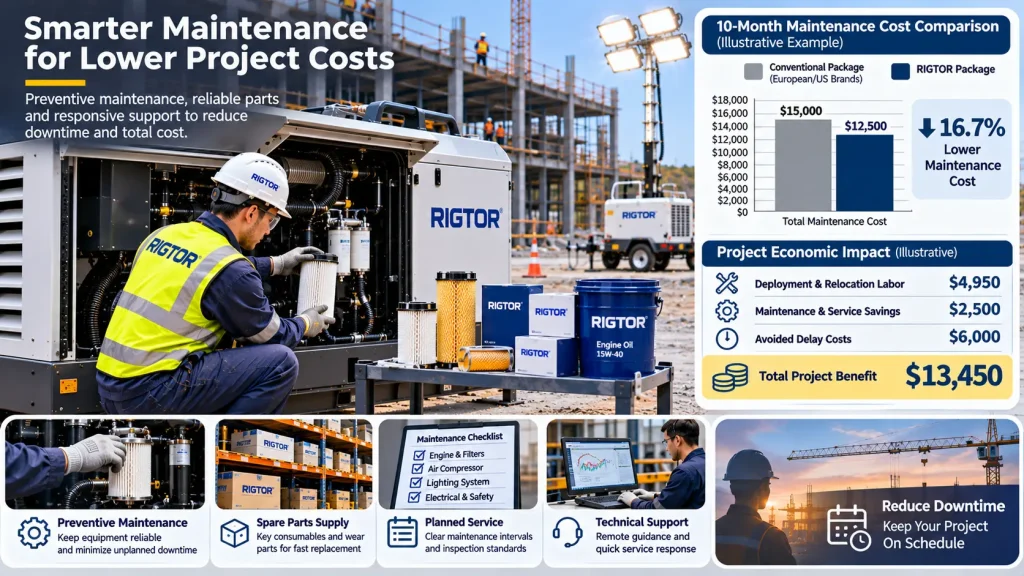
| Total Maintenance Cost | $15,000 | $12,500 |
Modeled maintenance cost reduction: $2,500, or 16.7%.
These are illustrative budget assumptions, not actual RIGTOR service records or verified competitor quotations.
The lower-cost scenario assumes suitable spare-parts sourcing and the ability to perform routine maintenance locally.
It does not assume longer service intervals or superior reliability.
Construction equipment often operates in dusty environments and may be relocated frequently.
Service personnel should be able to inspect engine oil, filters, cooling systems, compressor components, and electrical connections safely.
The exact maintenance procedures depend on the installed equipment.
Fuel is a significant operating expense for diesel-powered temporary infrastructure.
However, choosing the smallest available machine does not always minimize total cost.
An oversized generator may operate inefficiently at low loads.
An undersized generator may be unable to support motor starting requirements or peak demand.
A compressor with insufficient airflow may reduce pneumatic tool performance.
A much larger compressor may create unnecessary capital and operating expenses for low-demand applications.
Diesel, solar, and hybrid lighting systems should be compared using the required illumination, operating hours, site conditions, and energy availability.
The appropriate configuration depends on the project rather than a universal fuel-saving claim.
Contractors should track:
This information helps identify equipment that is oversized, underutilized, or poorly matched to the application.
Combining the modeled savings from the 10-month construction project:
| Savings Category | Illustrative Value |
|---|---|
| Deployment and relocation labor | $4,950 |
| Maintenance and service | $2,500 |
| Avoided critical-path interruption | $6,000 |
| Total Modeled Project Benefit | $13,450 |
The total assumes that all three benefits occur and can be independently verified.
It excludes purchase-price differences, rental charges, fuel consumption, freight, financing, insurance, taxes, and equipment residual value.
These additional factors must be considered before determining whether a particular equipment package offers the lowest total ownership cost.
For construction contractors, the lowest initial equipment price is not necessarily the lowest overall project cost.
A simplified total cost of ownership model is:
TCO = Purchase or Rental Cost + Transport + Installation + Fuel + Maintenance + Downtime − Residual Value
For rental equipment, rental charges and return conditions replace the relevant ownership costs.
The evaluation should also account for productivity, equipment utilization, and the cost of relocating machines between work areas.
A properly sized equipment package with a practical maintenance plan may provide better economic value than equipment selected solely on initial price.
Before selecting temporary construction infrastructure, contractors should review:
These requirements form the basis for selecting equipment that matches the actual construction project.
Temporary construction infrastructure plays an important role in keeping projects operational before permanent utilities become available.
Diesel generators, mobile lighting towers, portable air compressors, and surveillance equipment can support construction activities across different work phases.
From RIGTOR's manufacturing and supply perspective, the objective is to help contractors select appropriate equipment, prepare for efficient deployment, and establish practical maintenance plans.
The illustrative project in this article demonstrates how coordinated planning could reduce deployment labor, maintenance expenses, and certain delay costs.
Actual benefits depend on project conditions, equipment specifications, and verified operating data.
The most effective temporary construction equipment package is one that delivers the required performance safely, reliably, and at a competitive total project cost.
Temporary construction sites may require diesel generators, mobile lighting towers, portable air compressors, and site monitoring equipment. The appropriate combination depends on electrical demand, pneumatic tool requirements, working hours, and site conditions.
Contractors can reduce setup time by confirming technical specifications before delivery, coordinating equipment connections, preparing installation documentation, and using suitable mobile equipment. Actual time savings depend on site conditions and commissioning requirements.
RIGTOR equipment may provide competitive total ownership costs depending on purchase price, fuel consumption, maintenance expenses, spare-parts availability, and service requirements. A valid comparison requires equivalent equipment specifications and verified operating data.
Savings depend on deployment frequency, labor costs, maintenance expenses, and avoided delays. In the illustrative 10-month project presented above, the modeled benefit is $13,450. This is a hypothetical calculation, not a documented customer result or guaranteed saving.
Generator size depends on the connected electrical loads, motor starting requirements, voltage, operating hours, and peak demand. Contractors should prepare a load schedule before selecting generator capacity.
A 70 CFM compressor may be suitable for selected maintenance tools and small construction tasks. A 185 CFM compressor offers greater nominal airflow for higher-demand applications or multiple tools. The correct choice depends on actual tool consumption and required pressure.
Mobile lighting towers provide elevated temporary illumination for selected work areas. Properly designed lighting can support nighttime operations, but fixture output, lighting uniformity, glare, and worksite safety must be evaluated.
Preventive maintenance, correct equipment sizing, spare-parts planning, routine inspections, and trained technicians can help control maintenance expenses. Maintenance requirements should follow the actual engine and equipment manuals.
Mobile surveillance trailers can support temporary monitoring of equipment storage areas, access points, and remote work zones. Their effectiveness depends on camera placement, power supply, communications, and the site's security plan.
Customers should provide electrical loads, pneumatic tool specifications, lighting requirements, site conditions, expected operating hours, project duration, and equipment relocation requirements. These details help determine an appropriate equipment configuration.
Need reliable temporary power, compressed air, outdoor lighting, or site monitoring for your construction project?
RIGTOR supplies mobile infrastructure equipment for construction contractors, equipment rental companies, and industrial project operators.
Contact our team with your project requirements to discuss suitable equipment configurations and deployment planning.

Behind Every Critical Project.
@ 2026-2026 Rigtor Industry. All Rights Reserved.
 EN
 ES
 PT
 AR