

Time: Oct 31 2026 Views: 7
A 930 CFM 13 Bar portable diesel rotary screw air compressor is designed to supply substantial compressed-air volume for drilling, quarrying, sandblasting, and large construction projects.
Powered by a Cummins diesel engine, this class of compressor combines high airflow capacity with a working pressure suitable for a broad range of industrial applications.
However, when selecting a large portable diesel air compressor, buyers often face an important question:
Should they choose a 930 CFM 13 Bar compressor or a larger 1250 CFM 35 Bar high-pressure model?
The answer depends on the actual application.
A compressor with higher airflow and pressure is not automatically the better choice. Equipment compatibility, operating pressure, fuel consumption, purchase cost, maintenance requirements, and long-term productivity all influence the decision.
This guide examines the engineering characteristics of a 930 CFM 13 Bar diesel compressor, its typical applications, and how it compares with a 1250 CFM 35 Bar compressor powered by a Cummins QSM15 engine.
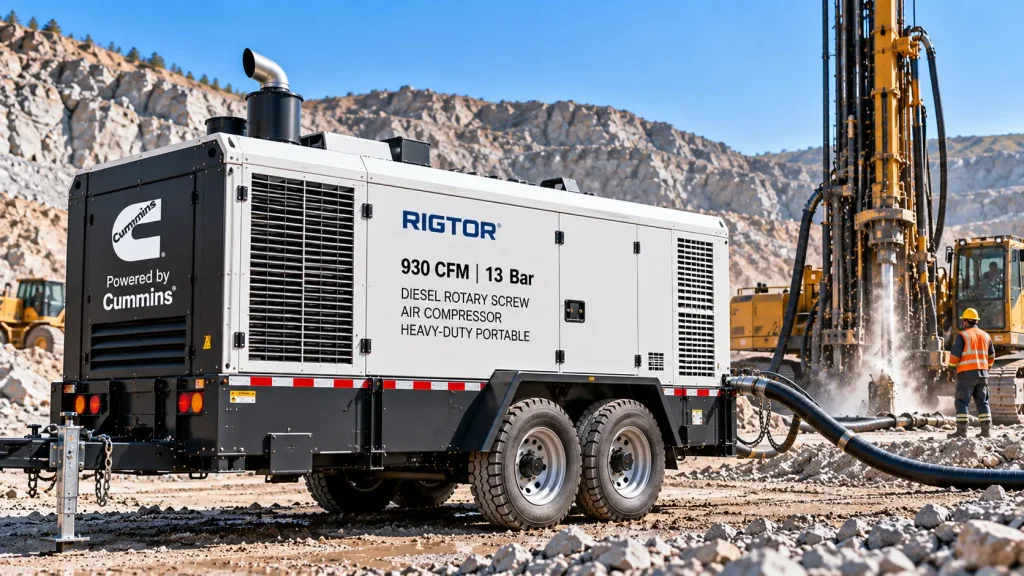
A 930 CFM 13 Bar diesel air compressor is a high-capacity compressed-air machine designed for applications where electricity may be unavailable or where equipment must move between worksites.
The compressor uses a diesel engine to drive a rotary screw compression system, producing compressed air for pneumatic tools and industrial equipment.
| Parameter | Specification |
|---|---|
| Nominal Airflow | 930 CFM |
| Metric Airflow | Approximately 26.3 m³/min |
| Nominal Working Pressure | 13 Bar |
| Pressure in PSI | Approximately 189 PSI |
| Engine Brand | Cummins |
| Compressor Type | Oil-injected rotary screw |
| Engine Cooling | Liquid-cooled |
| Configuration | Portable diesel compressor |
| Main Applications | Drilling, quarrying, sandblasting, construction |
Technical note: The 930 CFM and 13 Bar figures should be verified as a simultaneous rated operating point. Buyers should request the actual Free Air Delivery (FAD), engine model, rated power, and compressor performance data.
CFM stands for cubic feet per minute.
For compressor selection, buyers should determine whether the stated airflow represents Free Air Delivery under a recognized test condition.
A nominal capacity of 930 CFM corresponds to approximately 26.3 cubic meters per minute.
This places the equipment in a high-airflow category suitable for substantial industrial air demand.
A discharge pressure of 13 Bar is approximately 189 PSI.
This pressure range can support selected drilling and industrial applications, depending on the operating requirements of the connected equipment.
However, the pressure required by the tool is not necessarily the same as the pressure required at the compressor outlet.
Pressure losses through hoses, connections, and other system components must also be considered.
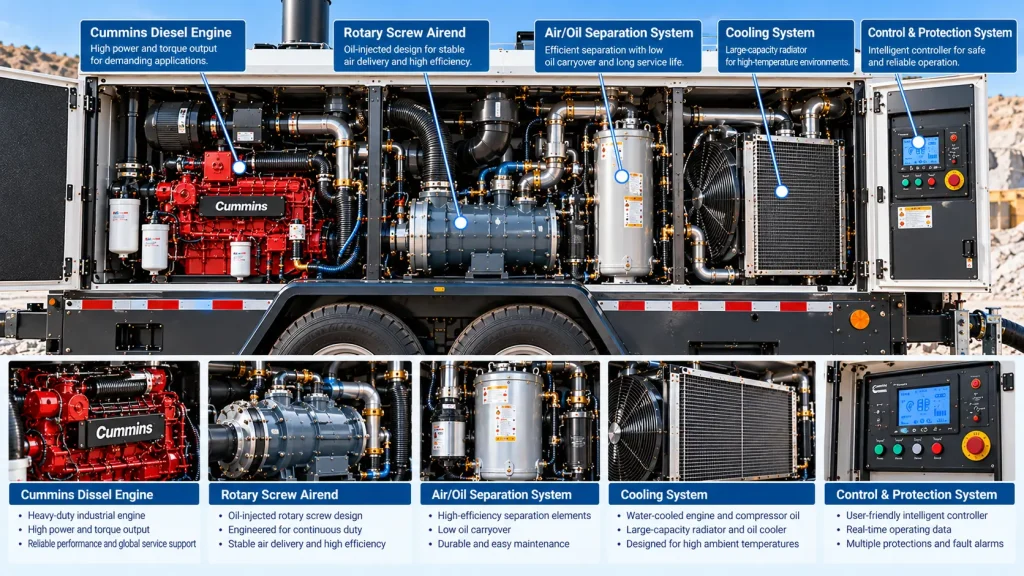
A diesel rotary screw air compressor integrates several major systems.
The diesel engine provides mechanical power to the compressor.
The specific Cummins engine model, rated output, and operating speed determine the available power.
Engine selection must account for compressor shaft-power requirements, cooling conditions, and the intended duty cycle.
The rotary screw airend compresses air using intermeshing rotors.
Compressor oil assists with lubrication, sealing, and heat removal.
The airend must be matched to the required airflow and pressure.
Incoming air passes through an intake filtration system before entering the airend.
In dusty environments such as quarries and drilling sites, filter condition is especially important.
After compression, the air/oil mixture enters a separation system.
The separator removes most of the injected lubricant before compressed air is delivered to the application.
The liquid-cooled diesel engine uses a cooling circuit to control engine temperature.
The compressor package also requires appropriate cooling for compressor oil and, where fitted, compressed air.
These are related but distinct cooling functions.
The control system manages compressor operation and monitors relevant conditions.
Depending on the equipment configuration, protection may include discharge-pressure monitoring, temperature protection, engine fault monitoring, and emergency shutdown.
A 930 CFM 13 Bar compressor can serve several industries where substantial compressed-air volume is required.
Quarries and mining sites often operate pneumatic drilling and other air-powered equipment.
A portable diesel compressor can supply air independently of fixed electrical infrastructure.
For these applications, buyers should consider:
Down-the-hole drilling uses compressed air to power a pneumatic hammer and remove drill cuttings.
A 13 Bar compressor may be appropriate for DTH hammers designed to operate within a compatible pressure range.
However, many higher-pressure DTH systems require greater pressure.
The hammer manufacturer's air-consumption and pressure specifications must determine compressor selection.
Large sandblasting operations can consume substantial compressed-air volume.
A 930 CFM compressor may support demanding surface-preparation applications, depending on nozzle size, nozzle count, blasting pressure, and other system requirements.
The compressor must deliver adequate airflow at the pressure needed at the blasting nozzle.
Major construction projects may require compressed air for pneumatic breakers, drilling equipment, cleaning, and other air-powered tools.
A high-capacity compressor may supply multiple tools simultaneously when total air consumption and operating pressure are properly calculated.
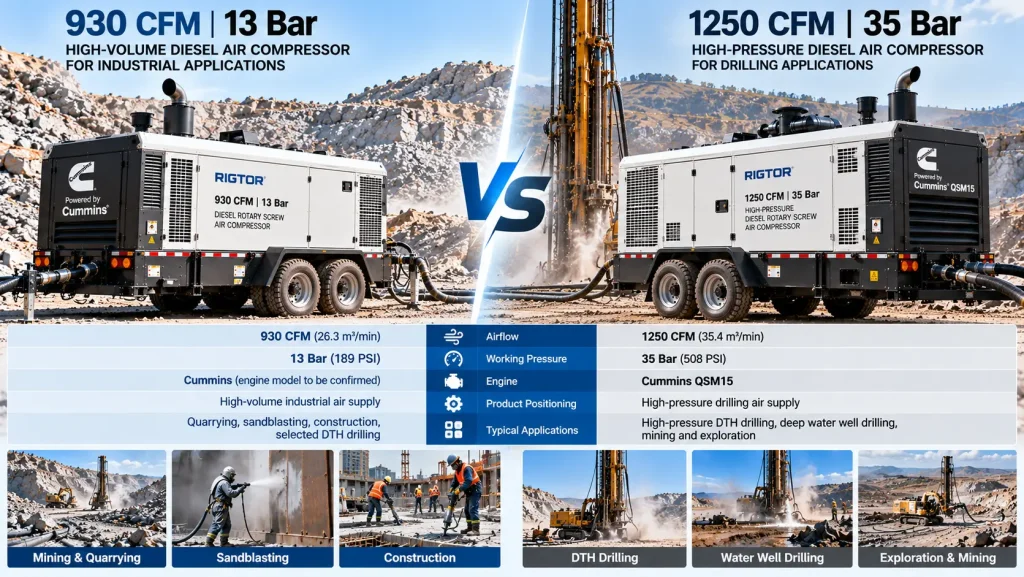
Both compressors belong to the large portable diesel air compressor category.
However, they are designed around substantially different airflow and pressure requirements.
| Parameter | 930 CFM / 13 Bar | 1250 CFM / 35 Bar |
|---|---|---|
| Nominal Airflow | 930 CFM | 1250 CFM |
| Metric Airflow | 26.3 m³/min | 35.4 m³/min |
| Nominal Pressure | 13 Bar | 35 Bar |
| Pressure in PSI | 189 PSI | 508 PSI |
| Engine | Cummins, model to be confirmed | Cummins QSM15, specified configuration to be confirmed |
| Compressor Type | Oil-injected rotary screw | Oil-injected rotary screw |
| Primary Positioning | High-volume industrial air supply | High-pressure drilling air supply |
| Typical Applications | Quarrying, selected DTH drilling, sandblasting, construction | High-pressure DTH drilling, selected deep water well and exploration drilling |
| Selection Priority | Air demand and operating pressure | High-pressure capability and drilling requirements |
Both models require confirmation that their stated airflow and pressure are achieved simultaneously at the rated operating point.
The 1250 CFM model has approximately 34% more nominal airflow than the 930 CFM model.
However, this comparison is meaningful only when the airflow ratings use equivalent measurement conditions.
For buyers, the important question is whether the compressor delivers enough air at the required working pressure.
If an application needs less than 930 CFM at a compatible pressure, additional nominal capacity may provide no practical advantage.
The 930 CFM model has a nominal working pressure of 13 Bar.
The 1250 CFM model has a nominal pressure of 35 Bar.
This is a major difference.
Higher-pressure capability is important for drilling equipment that requires elevated operating pressure.
However, an application designed for 10–13 Bar generally does not benefit from using 35 Bar at the tool.
The actual delivered pressure must remain within the tool manufacturer's limits.
The 930 CFM 13 Bar compressor may be suitable for selected medium-pressure DTH drilling applications.
The 1250 CFM 35 Bar model is positioned toward drilling systems requiring much higher air pressure.
For water well drilling, the required pressure and airflow depend on the hammer, borehole diameter, depth, groundwater conditions, and pressure losses.
Neither compressor should be selected based on drilling depth alone.
Higher airflow at significantly higher pressure can require substantially more shaft power.
Therefore, the 1250 CFM 35 Bar configuration places different demands on engine-airend matching and thermal management.
However, exact engine-power requirements cannot be established from nominal airflow and pressure figures alone.
The compressor's actual design, efficiency, operating conditions, and verified performance data must be considered.
A compressor designed for significantly higher pressure may involve more demanding compression-system and pressure-component requirements.
Nevertheless, the purchase-price difference depends on the actual equipment configurations and quotations.
Operating costs also depend on load conditions, fuel consumption, service intervals, and maintenance requirements.
A higher-pressure compressor should not automatically be assumed to consume more fuel in every operating scenario.
The correct comparison is measured fuel consumption while delivering the airflow and pressure required by the same application.
The selection should begin with the compressed-air requirement of the equipment being powered.
| Operating Requirement | Recommended Selection Approach |
|---|---|
| High airflow at approximately 10–13 Bar | Evaluate the 930 CFM / 13 Bar model |
| DTH hammer requiring pressure above 13 Bar | Evaluate a compressor rated for the higher pressure |
| High-pressure DTH drilling approaching 35 Bar | Evaluate the 1250 CFM / 35 Bar model, subject to verified performance |
| Large sandblasting operation | Calculate nozzle air consumption and required pressure |
| Multiple pneumatic tools | Calculate combined air demand and simultaneous-use factor |
| Uncertain drilling conditions | Obtain hammer specifications and drilling parameters before selecting |
A quarry contractor operates a drilling system requiring a substantial airflow supply at approximately 12 Bar.
If the total air requirement is within the compressor's verified delivery capacity, the 930 CFM 13 Bar model may be suitable.
A 35 Bar compressor is not necessary solely because it has a higher maximum pressure.
A drilling contractor uses a DTH hammer requiring operating pressure significantly above 13 Bar.
The 930 CFM compressor would not meet that pressure requirement.
A higher-pressure compressor should be considered, provided it can supply the required airflow at the hammer's working pressure.
A contractor operates several blasting nozzles simultaneously.
The primary selection factors are nozzle air consumption, operating pressure, hose losses, and total simultaneous demand.
A high-flow 13 Bar compressor may be a practical solution if its verified performance matches the blasting system.
Fuel consumption is an important consideration for diesel compressor buyers.
However, comparing two machines based only on CFM and Bar is insufficient.
Actual diesel consumption depends on:
The basic calculation is:
Hourly Fuel Cost = Fuel Consumption (L/h) × Diesel Price (per Liter)
Consider two hypothetical operating scenarios:
| Item | Compressor A | Compressor B |
|---|---|---|
| Illustrative Fuel Consumption | 45 L/h | 75 L/h |
| Illustrative Diesel Price | $1.20/L | $1.20/L |
| Calculated Hourly Fuel Cost | $54 | $90 |
| Calculated Cost for 10 Hours | $540 | $900 |
These are mathematical examples only. They are not actual fuel-consumption specifications for either compressor.
Actual comparisons must use manufacturer-provided data at defined operating conditions.
An oversized compressor may create unnecessary capital and operating costs.
An undersized compressor can cause pressure loss, reduced tool performance, and production delays.
The objective is not simply to select the smallest compressor.
It is to select the compressor that provides the required airflow and pressure with appropriate operating margins and acceptable total cost.
Portable diesel compressors frequently operate in challenging environments.
Mining, quarrying, and drilling sites may expose equipment to dust, elevated ambient temperatures, and extended operating hours.
A liquid-cooled engine uses coolant circulation and heat rejection through a radiator or other heat exchanger.
Proper cooling performance depends on coolant condition, radiator cleanliness, airflow, and the operating environment.
Oil-injected rotary screw compressors also require thermal management of the compression system.
Compressor oil absorbs heat during compression and must be cooled appropriately.
Insufficient cooling can contribute to elevated operating temperatures, protective shutdowns, and lubricant degradation.
Buyers should confirm:
The manufacturer's approved operating limits should always be followed.
Regular maintenance supports reliable operation and helps reduce unplanned downtime.
| Component | Inspection or Maintenance Focus |
|---|---|
| Cummins diesel engine | Engine oil, fuel filters, coolant, belts and hoses |
| Rotary screw airend | Lubrication, operating temperature, abnormal noise |
| Air intake filters | Dust loading and restriction |
| Compressor oil | Oil level, condition and replacement |
| Air/oil separator | Differential pressure and oil carryover |
| Cooling system | Radiator, oil cooler, fans and airflow |
| Pressure controls | Correct operation and pressure settings |
| Air hoses and connections | Damage, leakage and pressure rating |
| Safety devices | Inspection and testing according to applicable requirements |
Before operation, check fluid levels, visible leaks, filter condition, cooling airflow, hose connections, and controller warnings.
Follow the actual engine and compressor manuals for oil changes, filter replacement, separator maintenance, and other scheduled work.
Do not apply a generic maintenance interval without checking the installed equipment.
Before disconnecting hoses or opening compressor components, shut down the machine, isolate energy sources, and fully depressurize the system.
Only qualified personnel should service pressure-retaining components and protective devices.
Possible causes include excessive air demand, hose leakage, incorrect pressure settings, restricted intake, or compressor-control problems.
Compare the connected equipment's air demand with the compressor's verified output.
Potential causes include dirty coolers, inadequate ventilation, low lubricant level, cooling-system faults, or operation outside rated conditions.
Possible causes include separator problems, incorrect oil level, oil-return faults, or unsuitable operating conditions.
Possible causes include sustained high loading, unnecessary discharge pressure, air leaks, or engine maintenance problems.
Review engine and compressor fault information.
Possible causes include temperature protection, oil-pressure faults, fuel-system problems, or control-system errors.
Repairs should follow the equipment manufacturer's diagnostic procedures.
International buyers should evaluate the support arrangements before placing an order.
Confirm the exact engine model and local availability of compatible replacement parts.
Ask about air filters, oil filters, compressor lubricant, air/oil separator elements, seals, sensors, and control components.
Request operating instructions, maintenance manuals, electrical diagrams where applicable, and spare-parts information.
Clarify the supplier's process for fault diagnosis, technical assistance, and replacement-part identification.
Obtain written warranty coverage, exclusions, service requirements, and claim procedures.
The engine manufacturer's service network and the compressor supplier's after-sales responsibilities should be evaluated separately.
Before purchasing a 930 CFM 13 Bar Cummins-powered diesel compressor, verify:
If comparing the 930 CFM model with a 1250 CFM 35 Bar compressor, request performance data at equivalent operating conditions whenever possible.
A 930 CFM 13 Bar diesel compressor can supply compressed air for quarrying, selected DTH drilling, sandblasting, and large construction projects. Suitability depends on the equipment's actual airflow and pressure requirements.
Yes, for selected DTH systems operating within the compressor's verified pressure and airflow capability. The hammer manufacturer's operating requirements must be checked before selecting the compressor.
The 1250 CFM model has greater nominal airflow and substantially higher nominal pressure. The 930 CFM model is positioned toward high-volume industrial air supply at lower pressure, while the 35 Bar model targets applications requiring much higher pressure.
Neither is universally better. The correct choice depends on the DTH hammer, borehole diameter, drilling depth, groundwater conditions, and required operating pressure. A 13 Bar compressor cannot replace a higher-pressure unit when the drilling equipment requires pressure above its rated capability.
Not necessarily. Fuel consumption depends on actual operating conditions, engine configuration, delivered airflow, and pressure. A meaningful comparison requires measured fuel-consumption data at defined operating points.
A Cummins engine provides an established industrial diesel engine platform. Buyers should evaluate the exact engine model, power rating, operating characteristics, service availability, and compatibility with the compressor package.
Routine maintenance includes engine servicing, compressor oil checks, air-filter replacement, separator inspection, cooling-system maintenance, and inspection of hoses and safety devices. Exact intervals depend on the installed equipment.
Buyers should request verified airflow and pressure data, engine specifications, fuel-consumption figures, operating limits, equipment dimensions, maintenance documentation, spare-parts information, applicable emissions certification, and written warranty terms.
The 930 CFM 13 Bar portable diesel rotary screw air compressor is a high-capacity compressed-air solution for industrial applications requiring substantial airflow at moderate-to-high operating pressure.
Its Cummins diesel engine configuration and liquid-cooled design make engine-airend matching, thermal management, and maintenance accessibility important engineering considerations.
Compared with a 1250 CFM 35 Bar high-pressure diesel compressor, the 930 CFM model serves a different range of operating requirements.
For quarrying, sandblasting, construction, and compatible DTH drilling systems, a 13 Bar compressor may provide the necessary air supply without requiring a much higher-pressure configuration.
For drilling systems requiring substantially greater pressure, the 1250 CFM 35 Bar model may be more appropriate, subject to verified performance and equipment compatibility.
The best compressor is not necessarily the machine with the highest CFM or Bar rating.
It is the compressor that delivers the required airflow and pressure reliably, safely, and economically under actual operating conditions.
RIGTOR offers diesel air compressor solutions for industrial and field applications.
Contact our team with your required airflow, operating pressure, drilling equipment specifications, and project conditions to discuss an appropriate compressor configuration.

Behind Every Critical Project.
@ 2026-2026 Rigtor Industry. All Rights Reserved.
 EN
 ES
 PT
 AR