

Time: Oct 31 2026 Views: 7
A Manufacturer's Guide to 25 kW Diesel Generator Specifications, Performance, Applications, and Buyer Requirements
A 25 kW diesel generator occupies a useful position in the power generation market. It provides considerably more electrical capacity than a small portable generator while remaining relatively compact compared with large industrial generator sets.
In the United States, this power class can be considered for small commercial facilities, construction projects, agricultural operations, remote equipment, and selected standby power applications.
But why do buyers consider a 25 kW generator instead of a 15 kW, 20 kW, or 30 kW model?
The answer involves more than electrical output.
From a generator set manufacturer's perspective, the appeal of this power class lies in the balance between available power, equipment size, installation flexibility, and operating requirements.
This article examines the typical configurations of 25 kW diesel generators, their performance characteristics, applications, and the factors influencing demand in the American market.
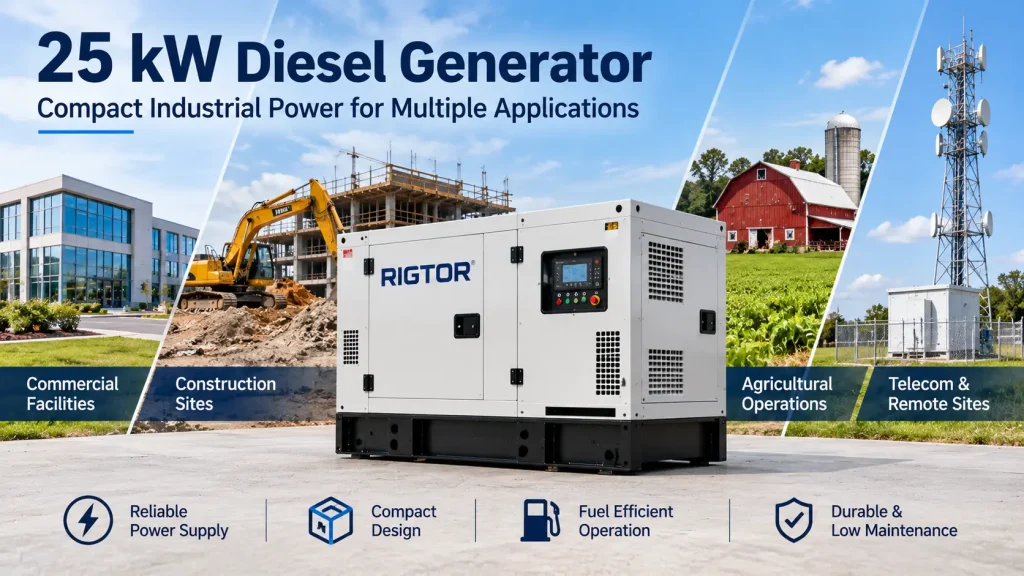
The 25 kW rating addresses a practical range of small commercial and industrial power requirements.
It is large enough to supply multiple electrical circuits or selected equipment loads, yet small enough to be considered for installations where a much larger generator would be unnecessary.
Not every business requires a 100 kW or 500 kW generator.
Small workshops, agricultural buildings, communication sites, and commercial facilities may only need to protect essential operations during a power interruption.
For these applications, a properly sized 25 kW generator may provide sufficient capacity without requiring a much larger power system.
Small portable generators are often intended for limited electrical loads.
A 25 kW industrial diesel generator can support more substantial requirements, including multiple circuits and certain three-phase equipment configurations.
However, actual performance depends on the generator's voltage, phase, power factor, duty rating, and motor-starting capability.
Many 25 kW generator sets can be packaged in relatively compact enclosures.
This can simplify site planning compared with much larger industrial power systems, although lifting equipment, ventilation, fuel storage, and electrical installation are still necessary.
The same general power class can be configured for different operating environments.
A stationary standby installation may prioritize automatic starting and weather protection.
A temporary construction application may prioritize mobility, electrical distribution, and service access.
A remote installation may require extended fuel capacity and monitoring.
This flexibility helps explain why 25 kW is a commercially relevant generator rating.
However, exact US sales rankings or market share cannot be established from equipment specifications alone.
A 25 kW generator has a rated real electrical output of 25,000 watts under its specified operating conditions.
That does not mean every combination of electrical equipment totaling 25,000 watts can be connected without further evaluation.
The generator must accommodate both normal running demand and temporary starting loads.
A 25 kW generator may be suitable for:
The final suitability depends on the actual electrical load schedule.
Consider a hypothetical small industrial facility with the following running loads:
| Electrical Load | Running Demand |
|---|---|
| Lighting and office equipment | 3 kW |
| Ventilation | 2 kW |
| Small pumps | 4 kW |
| Workshop equipment | 5 kW |
| Miscellaneous loads | 3 kW |
| Total Running Load | 17 kW |
A 25 kW generator may appear to offer sufficient running capacity.
However, if the workshop equipment or pumps use electric motors, their starting requirements must also be evaluated.
A motor can temporarily demand substantially more current during startup than during normal operation.
This may require a larger alternator, a different starting method, or a larger generator set.
Manufacturer's perspective: Generator sizing should be based on a complete load schedule, not simply the sum of equipment nameplate ratings.
There is no single universal configuration for every 25 kW generator.
Nevertheless, several technical specifications are particularly important in the US market.
| Specification | Common Selection Consideration |
|---|---|
| Rated Output | 25 kW |
| Apparent Power | 31.25 kVA at 0.8 power factor |
| Frequency | 60 Hz for standard US applications |
| Engine Speed | Often 1800 RPM with a four-pole alternator |
| Phase | Single-phase or three-phase, depending on model |
| Voltage | 120/240 V, 120/208 V, 277/480 V, or other supported configurations |
| Engine | Industrial diesel engine matched to required duty |
| Cooling | Typically liquid cooling in industrial configurations |
| Starting | Electric starting; automatic starting where configured |
| Enclosure | Open-type or sound-attenuated, depending on model |
| Duty Rating | Standby, prime, or another defined rating |
These are selection considerations, not a specification sheet for a particular RIGTOR generator.
For a three-phase generator rated at a power factor of 0.8:
25 kW ÷ 0.8 = 31.25 kVA
The generator must remain within both its real-power and apparent-power limits.
For a single-phase generator rated at unity power factor, the corresponding kVA relationship may differ.
The United States generally uses 60 Hz electrical systems.
A conventional four-pole synchronous alternator produces 60 Hz electricity at 1800 RPM.
This makes 1800 RPM a common configuration for industrial diesel generator sets intended for the US market.
Many industrial diesel generator sets use engines designed for fixed-speed operation.
An 1800 RPM configuration can be paired with a four-pole alternator to produce the required 60 Hz output.
The engine and alternator must be matched for the intended power rating and operating conditions.
A conventional two-pole alternator produces 60 Hz at 3600 RPM.
Higher-speed configurations are often found in smaller and more compact generators.
However, engine speed alone does not determine fuel efficiency, reliability, maintenance intervals, or service life.
Buyers should compare the actual engine and generator specifications.
For an industrial 25 kW generator intended for the US market, confirm:
These factors are more important than selecting a generator based on RPM alone.
Electrical configuration is one of the most important differences between buyers.
Single-phase power is common in many US residential and small-building electrical installations.
A 120/240 V single-phase generator may be appropriate where the electrical loads and distribution system require that configuration.
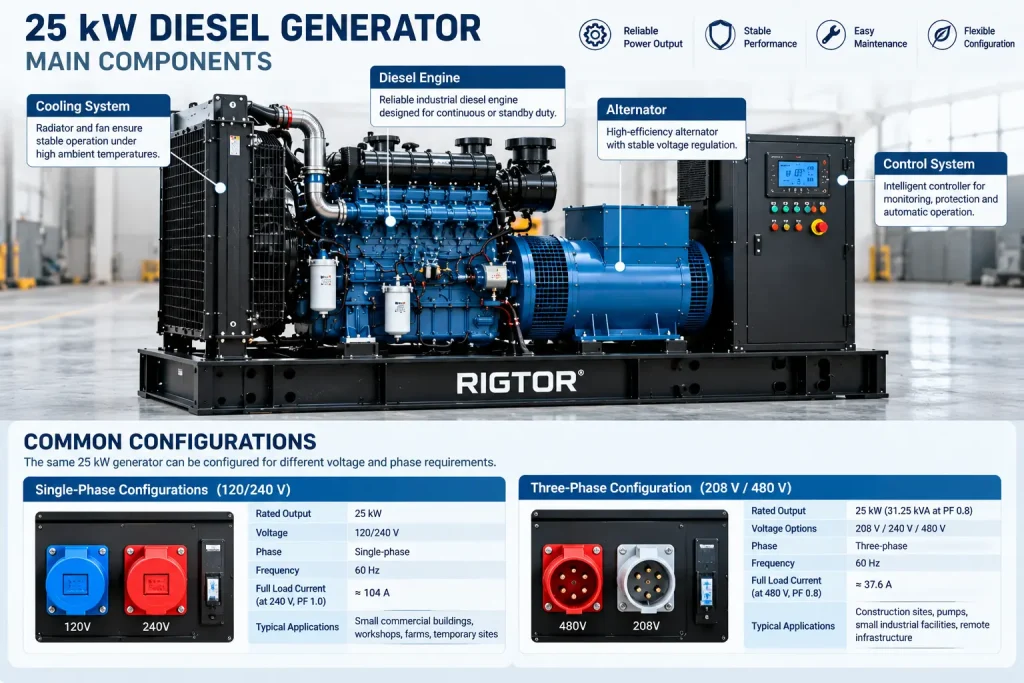
At 25 kW and unity power factor, the theoretical full-load current at 240 V is approximately 104 A.
Actual installation design must account for the generator's rated current, protection equipment, wiring, and applicable electrical codes.
Three-phase systems are common in commercial and industrial facilities.
A three-phase generator may be required for pumps, motors, and other equipment designed for three-phase power.
For a 25 kW generator rated at 0.8 power factor:
| Voltage | Approximate Full-Load Current |
|---|---|
| 208 V, three-phase | 86.7 A |
| 240 V, three-phase | 75.2 A |
| 480 V, three-phase | 37.6 A |
These are calculated examples using a 31.25 kVA apparent-power rating.
They are not a substitute for the generator manufacturer's published current ratings.
Important: Single-phase and three-phase generators are not automatically interchangeable. The configuration must match the site's electrical distribution system.
A reliable generator set depends on more than its diesel engine.
The manufacturer must select and integrate several mechanical and electrical systems.
The engine supplies the mechanical power required to drive the alternator.
Key selection factors include rated output, engine speed, fuel efficiency, cooling performance, and applicable emissions certification.
The alternator converts mechanical energy into electrical power.
It must be matched to the required voltage, frequency, phase configuration, and load characteristics.
Alternator sizing is particularly important when the generator supplies motor-driven equipment.
The AVR controls alternator excitation to help maintain output voltage within the equipment's specified performance limits.
Voltage response under changing loads depends on the complete excitation and alternator system.
The controller monitors operating conditions and provides alarms, protective functions, and operating information.
Depending on the selected configuration, the system may support automatic starting and remote monitoring.
Industrial diesel generators require adequate cooling to maintain safe operating temperatures.
Radiator sizing and ventilation design must account for the intended environment.
Fuel storage and supply arrangements depend on operating duration, installation type, and applicable safety requirements.
Longer operating periods may require larger fuel tanks or an external fuel supply arrangement.
Fuel consumption is an important consideration for 25 kW diesel generator buyers.
However, the hourly fuel consumption of one 25 kW generator cannot be assumed to apply to every other model.
Actual fuel usage depends on:
A generator operating at 50% load does not necessarily consume exactly half the fuel it would consume at 100% load.
The engine's efficiency changes across its operating range.
For accurate cost estimates, buyers should request published fuel consumption at several load points.
Suppose a generator consumes 5 liters per hour at a particular operating load.
At a hypothetical diesel price of $1.10 per liter:
Hourly Fuel Cost = 5 × $1.10 = $5.50
At 1,000 operating hours:
Annual Fuel Cost = $5,500
This is a calculation example only. The assumed fuel consumption and price are not verified specifications or current US market prices.
For extended operating periods, actual fuel consumption data can significantly affect generator selection.
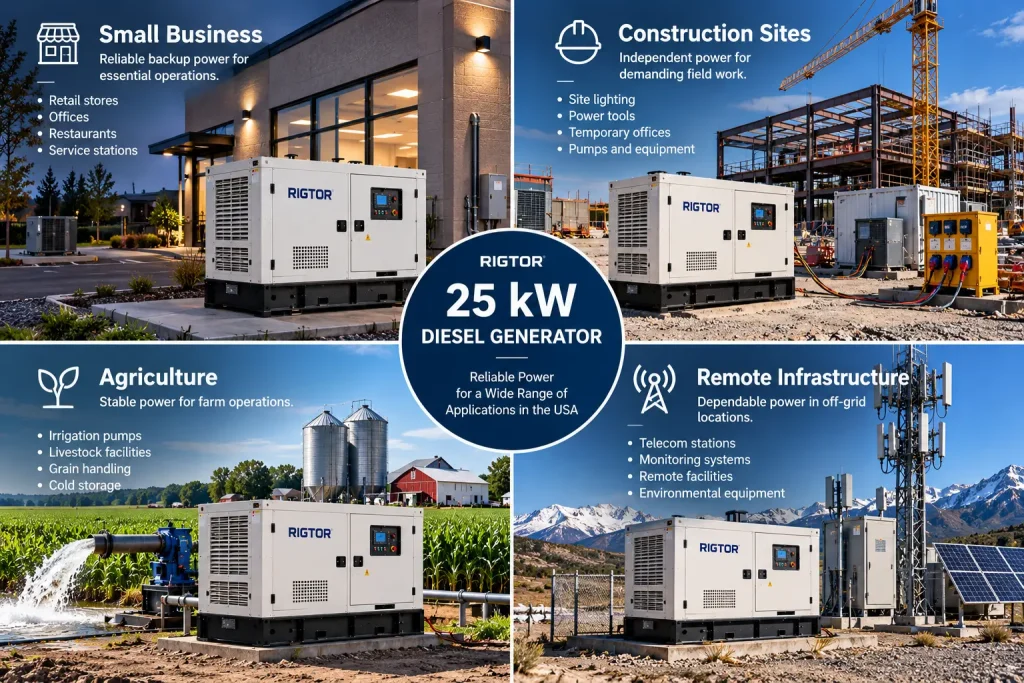
Small businesses may need standby power for essential lighting, refrigeration, communications, or other selected electrical systems.
A 25 kW generator may be suitable when the critical-load assessment supports that rating.
Temporary construction and infrastructure maintenance operations may require independent power.
A 25 kW generator can serve selected site loads, including lighting, small tools, field offices, and certain pumps.
However, large welding equipment, compressors, or motor-driven machinery may require a different generator size.
Farms may need electricity for pumps, ventilation, controls, refrigeration, or other agricultural systems.
The required generator capacity depends on the electrical loads and their starting characteristics.
Remote infrastructure may require dependable backup power where grid reliability is limited.
In these applications, fuel storage, remote monitoring, weather protection, and maintenance access may be particularly important.
Maintenance workshops and smaller industrial facilities may use a 25 kW generator for selected essential equipment.
The generator's suitability must be established through a detailed electrical load assessment.
From a manufacturer's perspective, understanding the buyer is as important as understanding the equipment.
These buyers are concerned with electrical compatibility, installation requirements, controls, protection equipment, and documentation.
They need clear technical specifications rather than broad marketing claims.
Distributors evaluate product consistency, spare parts availability, warranty support, delivery reliability, and the manufacturer's ability to supply suitable configurations.
Rental companies prioritize transportability, service access, durability, and operational flexibility.
They may also require equipment designed for temporary site use and compliant with the applicable nonroad emissions requirements.
Project contractors need generators matched to site loads, operating hours, environmental conditions, and installation schedules.
They are often concerned with reliable operation and avoiding unnecessary equipment oversizing.
Facility owners focus on maintaining essential services during power interruptions.
They typically work with electrical professionals to establish the required capacity and installation configuration.
The US market has technical and regulatory requirements that must be addressed before equipment is offered for a particular application.
The generator must provide the required frequency and voltage.
For many US industrial applications, this means a 60 Hz generator with an appropriate single-phase or three-phase configuration.
US emissions requirements depend on whether the engine is used in a stationary or nonroad application and on its specific regulatory classification.
Stationary diesel engines may be subject to EPA regulations under 40 CFR Part 60, Subpart IIII.
Nonroad diesel engines may be subject to applicable EPA standards under 40 CFR Part 1039.
A generator intended for one application is not automatically approved for the other.
Buyers should verify the applicable engine certification, installation requirements, and state or local regulations.
Depending on the project, buyers may need to confirm applicable electrical codes, equipment listing requirements, transfer equipment, and local permitting conditions.
The required documentation should be identified before ordering.
Outdoor installations may require weather-resistant enclosures.
Commercial sites may also have specific acoustic requirements.
Buyers should request noise performance data measured under clearly defined conditions.
Availability of replacement parts and technical support is particularly important for imported equipment.
Manufacturers should provide clear engine identification, component documentation, maintenance instructions, and an appropriate support plan.
From the manufacturing side, the configuration process should begin with the application rather than a fixed list of components.
Determine whether the buyer requires 25 kW standby power or 25 kW prime power.
These ratings may require different engine and alternator selections.
Choose an engine capable of delivering the required mechanical output at the specified frequency and operating conditions.
Emissions certification and destination-market requirements must be evaluated at this stage.
The alternator must meet the required voltage, phase, frequency, and load-response requirements.
Motor starting and transient voltage performance should be considered.
Possible configurations include open-type, sound-attenuated, or mobile arrangements where supported by the selected generator design.
The final package must accommodate cooling, exhaust, maintenance, and electrical connections.
Control equipment should be selected according to the application.
Requirements may include automatic starting, alarms, monitoring, and electrical protection.
The agreed inspection and testing scope should confirm that the equipment meets its specified requirements.
Buyers should request appropriate technical documentation and test records.
RIGTOR is a China-based manufacturer of diesel generator sets and temporary infrastructure equipment.
Its broader portfolio includes diesel generators, mobile lighting towers, portable diesel air compressors, and mobile surveillance systems.
For buyers evaluating a 25 kW-class generator, the most important starting point is a clear description of the intended application.
Electrical output, frequency, voltage, operating duty, environmental conditions, and emissions requirements must be reviewed before selecting a suitable configuration.
Explore RIGTOR's Diesel Generator Systems to review its power generation product range.
For US projects, buyers should confirm model availability, engine certification, and the required technical configuration before placing an order.
It may be sufficient for some homes, but the answer depends on the home's actual electrical demand, starting loads, and installation requirements.
Residential buyers should also compare diesel with natural gas and propane generator options.
The current depends on voltage, phase, and power factor.
At 240 V single-phase and unity power factor, 25 kW corresponds to approximately 104 A.
At 480 V three-phase and 0.8 power factor, the corresponding current is approximately 37.6 A.
No.
At 0.8 power factor, 25 kW corresponds to 31.25 kVA.
Only if the specific generator is rated and configured for the intended operating duty.
A standby-only generator should not automatically be used for continuous primary power.
An 1800 RPM, four-pole configuration is common in industrial 60 Hz generators.
However, the better choice depends on the engine design, operating requirements, and complete generator specifications.
There is no single specification that determines suitability.
Power rating, voltage, frequency, duty cycle, motor starting, emissions compliance, and installation requirements all matter.
The 25 kW diesel generator serves a practical range of small commercial, agricultural, construction, and industrial power requirements.
Its appeal comes from the combination of useful electrical capacity, relatively compact packaging, and flexibility across different applications.
For the US market, however, the generator must be more than appropriately sized.
Buyers must confirm electrical compatibility, operating duty, emissions compliance, installation requirements, and access to service support.
From a manufacturer's perspective, a successful 25 kW generator project begins with correct engine and alternator matching and ends with a configuration that meets the customer's actual operating conditions.
RIGTOR provides industrial diesel generator systems for construction, commercial, and remote power applications.
Explore our Diesel Generator Systems or contact our team with your electrical specifications and project requirements to discuss available generator configurations.

Behind Every Critical Project.
@ 2026-2026 Rigtor Industry. All Rights Reserved.
 EN
 ES
 PT
 AR