

Time: Nov 5 2026 Views: 2
Understand what kVA means, how it differs from kW, and why it matters when selecting diesel generators, mobile lighting towers, air compressors, and temporary power systems.
If you are comparing diesel generators or planning an electrical power system for a construction site, you have probably encountered ratings such as 50 kVA, 100 kVA, or 500 kVA.
But what is kVA, and what does it actually tell you about a generator's capacity?
More importantly, how does kVA relate to the equipment that the generator needs to power?
These questions are especially relevant to construction, mining, infrastructure maintenance, and remote industrial operations, where a single project may require generators, lighting systems, air compressors, and surveillance equipment.
kVA stands for kilovolt-amperes. It measures apparent electrical power in an alternating-current (AC) system.
Understanding kVA helps buyers compare generator specifications, estimate electrical requirements, and avoid selecting equipment that cannot support their operating loads.
This guide explains kVA in practical terms and shows how it applies to different industrial equipment and integrated temporary infrastructure systems.
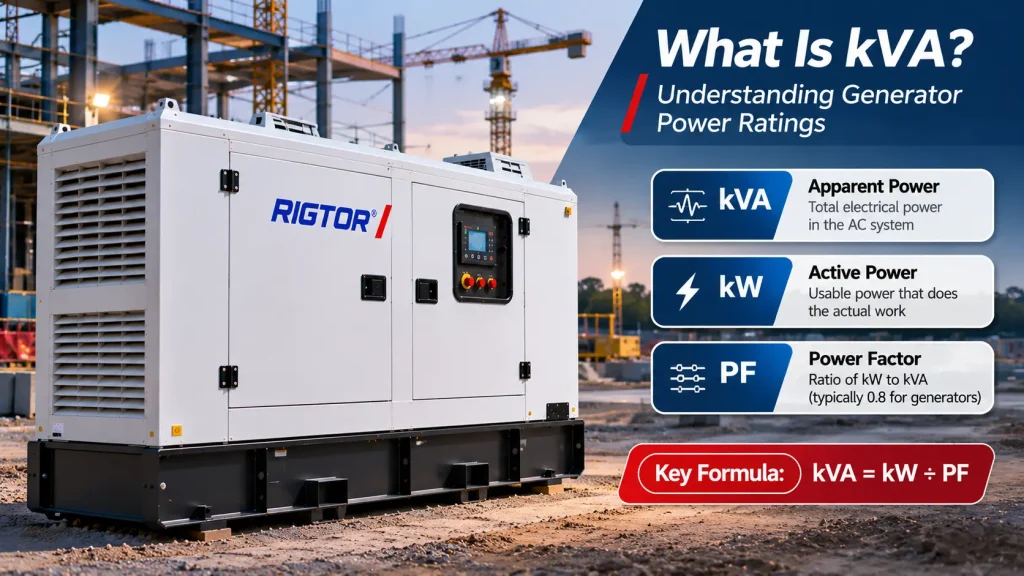
kVA means kilovolt-amperes, a unit of apparent power.
One kVA equals 1,000 volt-amperes (VA).
In an AC electrical system, apparent power represents the combined effect of voltage and current.
Three electrical quantities are particularly important:
| Electrical Term | Unit | Meaning |
|---|---|---|
| Active Power | kW | Power used to perform useful work |
| Reactive Power | kVAr | Power associated with energy exchanged by reactive electrical components |
| Apparent Power | kVA | Combined magnitude of active and reactive power |
| Power Factor | PF | Ratio of active power to apparent power |
For a sinusoidal AC system, these quantities form a power triangle.
The relationship between active power and apparent power is:
Power Factor = kW ÷ kVA
Therefore:
kVA = kW ÷ Power Factor
For example, if an electrical load requires 80 kW at a power factor of 0.8:
80 ÷ 0.8 = 100 kVA
The electrical system must therefore supply 80 kW of active power and 100 kVA of apparent power.
For loads containing harmonics, true power factor also reflects distortion effects, so simple reactive-power assumptions may not fully describe the system.
Although kVA and kW are closely related, they are not interchangeable.
kW describes active power.
It indicates the electrical power converted into useful output, such as mechanical work, heating, or lighting.
kVA describes apparent power.
It represents the electrical loading associated with voltage and current, including the effects of power factor.
Consider a diesel generator rated at 100 kVA with a rated power factor of 0.8.
Its corresponding rated active-power output is:
100 kVA × 0.8 = 80 kW
A buyer should not assume that this generator can deliver 100 kW simply because its nameplate says 100 kVA.
The following examples assume a power factor of 0.8.
| Apparent Power | Active Power at 0.8 PF |
|---|---|
| 20 kVA | 16 kW |
| 50 kVA | 40 kW |
| 75 kVA | 60 kW |
| 100 kVA | 80 kW |
| 150 kVA | 120 kW |
| 200 kVA | 160 kW |
| 250 kVA | 200 kW |
| 500 kVA | 400 kW |
| 750 kVA | 600 kW |
| 1000 kVA | 800 kW |
These are mathematical conversions, not recommendations for specific generator models.
Actual equipment ratings must be checked against the manufacturer's published specifications.
Diesel generators are commonly specified using both kVA and kW.
This is because the diesel engine and alternator are affected by different aspects of electrical demand.
The engine supplies mechanical power that the alternator converts into electrical active power.
The alternator must also carry the electrical current associated with the load's apparent power.
For example, two installations may each require 80 kW, but their power factors may differ.
| Installation | Active Power | Power Factor | Apparent Power |
|---|---|---|---|
| Site A | 80 kW | 1.0 | 80 kVA |
| Site B | 80 kW | 0.8 | 100 kVA |
| Site C | 80 kW | 0.7 | 114.3 kVA |
All three installations require the same active power.
However, their apparent-power requirements are different.
This affects alternator loading and generator selection.
For this reason, buyers should check both the kW and kVA ratings when comparing diesel generators.
Suppose a construction project needs 70 kW of running power at 0.8 power factor.
The apparent-power requirement is:
70 ÷ 0.8 = 87.5 kVA
A generator rated at 100 kVA and 80 kW would meet these preliminary steady-state requirements, assuming the ratings apply to the required operating duty and site conditions.
However, this calculation does not confirm that the generator can start every connected motor or handle sudden load changes.
Motor starting performance, voltage dip, operating duty, and environmental derating must also be evaluated.
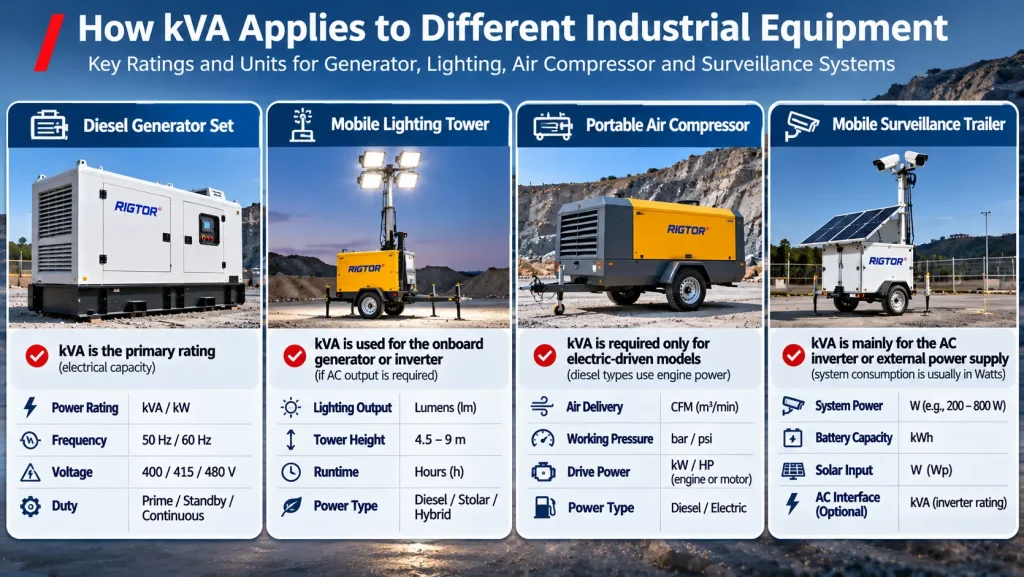
Mobile lighting towers are widely used in construction, mining, infrastructure maintenance, and emergency response.
However, not every lighting tower has a kVA rating.
The relevance of kVA depends on the lighting tower's power system.
A diesel lighting tower may incorporate an engine-driven generator that supplies electrical power to LED lighting fixtures.
In this configuration, kVA may be relevant to the generator or alternator supplying the lighting system.
For example, suppose a lighting tower has four LED floodlights rated at 300 W of electrical input power each.
Total active lighting load:
4 × 300 W = 1.2 kW
If the combined input power factor is 0.95:
1.2 ÷ 0.95 = 1.26 kVA, approximately.
This is the steady-state apparent-power requirement of the lighting load under the stated assumptions.
It is not necessarily the lighting tower's alternator rating.
LED driver characteristics, startup current, auxiliary equipment, and operating conditions must also be considered.
Solar lighting towers may use photovoltaic panels, batteries, charge controllers, and LED fixtures.
These systems are often described using different ratings:
If the lighting tower uses a DC battery system without an AC inverter, kVA may not be the most useful measure of its power capacity.
Hybrid lighting towers may combine solar generation, batteries, and a diesel generator.
In this case, kVA may describe the AC generator or inverter output, while kWh describes stored battery energy.
These measurements serve different purposes.
For lighting tower selection, buyers should evaluate illumination performance, power consumption, runtime, and energy configuration rather than comparing kVA alone.
Air compressors are another important category of industrial equipment, but their power ratings require careful interpretation.
A portable diesel air compressor and an electrically driven air compressor have different electrical requirements.
A portable diesel screw air compressor normally uses a diesel engine to drive the compressor directly.
Its main performance specifications commonly include:
For example, a portable diesel compressor rated at 375 CFM describes its compressed-air delivery capacity.
It does not mean the compressor requires a 375 kVA generator.
If the compressor is independently diesel-driven, its main compressor drive does not need electrical power from an external generator.
An electric air compressor uses an electric motor.
In this case, kVA becomes important when determining the electrical supply requirement.
Suppose an electric compressor has:
The approximate electrical input power is:
30 ÷ 0.90 = 33.3 kW
The running apparent power is:
33.3 ÷ 0.85 = 39.2 kVA
This is the estimated steady-state apparent-power requirement.
Motor starting may require substantially more apparent power, depending on the starting method.
A generator supplying this compressor must therefore be evaluated for both running and starting conditions.
When planning compressed-air operations, buyers should first determine whether the compressor is:
This distinction prevents unnecessary generator capacity from being assigned to independently powered equipment.
Mobile surveillance trailers are used for temporary construction security, remote asset protection, and infrastructure monitoring.
These systems may include:
For many surveillance systems, the primary electrical requirement is relatively small compared with industrial motors.
Power consumption is commonly expressed in watts.
Battery capacity is expressed in watt-hours or kilowatt-hours.
However, kVA may become relevant when an AC inverter or generator supplies the system.
Suppose a surveillance system has a combined AC electrical input of 500 W and a true power factor of 0.9.
Apparent power:
0.5 kW ÷ 0.9 = 0.56 kVA, approximately.
This calculation describes its running apparent-power demand.
It does not determine battery autonomy or the complete inverter specification.
For battery-powered systems, the more important questions may be:
For mobile surveillance systems, kVA is relevant mainly to AC supply and inverter capacity, while watts and kWh are often more useful for energy planning.
The formula depends on the electrical configuration.
For a single-phase AC circuit:
kVA = Voltage × Current ÷ 1,000
For example, a 230V single-phase load drawing 20A requires:
230 × 20 ÷ 1,000 = 4.6 kVA
For a balanced three-phase AC system:
kVA = √3 × Line Voltage × Line Current ÷ 1,000
For example, a three-phase system operating at 400V and drawing 100A requires:
1.732 × 400 × 100 ÷ 1,000 = 69.3 kVA
These formulas calculate apparent power.
To calculate active power, the relevant true power factor must also be considered.
Industrial generator configurations vary by market and application.
Examples include:
| Electrical Configuration | Typical Application Context |
|---|---|
| 400/230V, 50Hz | Common UK and international industrial systems |
| 415/240V, 50Hz | Some industrial and regional systems |
| 480/277V, 60Hz | Common North American industrial systems |
Generator voltage, frequency, phase configuration, and rated current must match the electrical distribution requirements.
A 100 kVA generator at 400V does not have the same rated line current as a 100 kVA generator at 480V.
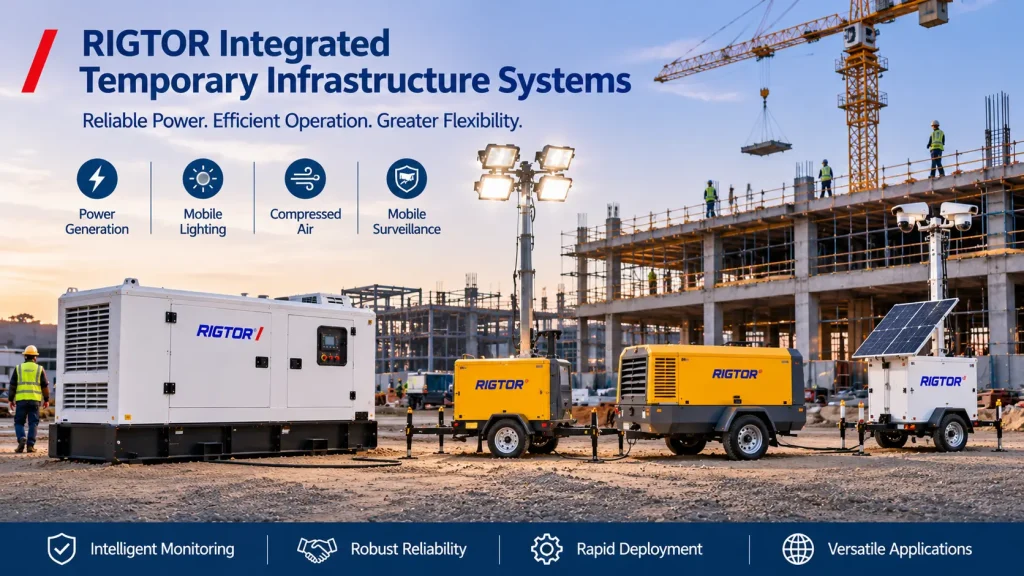
A construction or mining project may use several types of equipment together.
RIGTOR supplies temporary infrastructure equipment across four main product categories:
| RIGTOR Product Category | Main Function | Where kVA Matters |
|---|---|---|
| Diesel Generator Sets | Electrical power generation | Generator and alternator capacity |
| Mobile Lighting Systems | Temporary illumination | AC generator or inverter capacity, where fitted |
| Portable Diesel Air Compressors | Compressed-air supply | External electrical demand only if applicable |
| Mobile Surveillance Systems | Temporary security and monitoring | AC supply or inverter sizing, where applicable |
The key point is that not every system needs to be powered by the main diesel generator.
Consider a temporary construction site using:
The diesel lighting towers, compressor, and solar surveillance trailer may operate independently of the main generator.
Therefore, their full mechanical or lighting ratings should not automatically be added to the generator's electrical load schedule.
The main generator should be sized for the equipment actually connected to its electrical output.
This may include:
An effective temporary infrastructure design considers both electrical and non-electrical power requirements.
For example:
These parameters cannot simply be added together.
Each system must be evaluated according to its function and energy source.
A 100 kVA generator rated at 0.8 power factor typically corresponds to 80 kW of rated active output.
Always check both ratings.
kVA is an electrical power unit.
It does not describe compressed-air delivery, lighting output, or battery energy storage.
A generator may have enough capacity for an electric motor's normal operation but insufficient transient capability to start it.
Motor starting kVA and acceptable voltage dip should be evaluated separately.
kVA measures apparent electrical power.
kWh measures energy.
For example, a battery storing 10 kWh of energy is not equivalent to a generator rated at 10 kVA.
Diesel-driven compressors, standalone solar lighting towers, and battery-powered surveillance trailers may operate independently.
Only actual electrical loads connected to the generator should be included in its load schedule.
A generator's standby, prime, and continuous ratings may differ.
The relevant rating should match the intended application and operating conditions.
Understanding kVA is the first step toward selecting suitable electrical equipment.
For industrial projects, the next step is matching the power supply to the actual operating requirements.
RIGTOR supplies diesel generator sets and complementary temporary infrastructure systems for construction, mining, emergency response, and remote industrial operations.
Depending on project requirements, RIGTOR can discuss:
For mobile lighting towers, selection should focus on:
For portable diesel air compressors, the primary parameters include:
For mobile surveillance systems, important considerations include:
RIGTOR's equipment offering allows industrial customers to discuss multiple temporary infrastructure requirements through one supplier.
Generator projects may involve engine-alternator integration, enclosure construction, electrical controls, assembly inspection, and agreed factory testing.
The objective is to select equipment that performs the required function without unnecessary capacity or incompatible system configurations.
kVA stands for kilovolt-amperes. It is a unit of apparent electrical power in an AC system.
It depends on power factor. At 0.8 PF, 1 kVA corresponds to 0.8 kW.
A generator rated at 100 kVA and 0.8 power factor typically has a corresponding rated output of 80 kW.
Generator alternators must carry electrical current associated with apparent power, while the engine supplies the mechanical power needed for active electrical output. Both kVA and kW are therefore important.
No. kVA measures apparent power, while electricity consumption over time is generally measured in kWh.
Some diesel lighting towers incorporate AC generators with kVA ratings. Solar and battery-powered models may instead use ratings such as watts, kWh, or inverter VA.
A directly diesel-driven compressor normally uses its own engine to drive the compressor and does not require an external generator for that function. Auxiliary electrical requirements depend on the equipment configuration.
Determine its electrical input kW and true power factor, then divide kW by power factor. Motor efficiency must be included if the available kW rating represents mechanical shaft output.
kVA measures apparent power. kWh measures electrical energy over time.
Calculate the maximum simultaneous electrical demand in kW and kVA, then assess motor starting, transient loads, duty rating, and environmental conditions.
A 100 kVA generator rated at 0.8 PF typically has an 80 kW rated active output. Whether it can support a particular 80 kW installation depends on the operating duty, load power factor, motor starting, and other conditions.
RIGTOR supplies diesel generator sets, mobile lighting systems, portable diesel air compressors, and mobile surveillance systems. Customers can submit their application and operating requirements for configuration review.
kVA is one of the most important electrical terms to understand when selecting diesel generators and planning temporary power systems.
It represents apparent electrical power and is closely related to kW through power factor.
However, kVA is not a universal measure of industrial equipment capacity.
For diesel generators, it is a fundamental rating.
For mobile lighting towers, it may describe an integrated AC generator or inverter.
For diesel-driven air compressors, compressed-air delivery and working pressure are usually more important.
For mobile surveillance systems, power consumption, battery capacity, and operating autonomy may be the primary considerations.
Understanding these differences helps industrial buyers select the right equipment and avoid unnecessary electrical capacity.
RIGTOR supports construction, mining, remote industrial, and temporary infrastructure projects with generator sets and complementary field equipment.
Integrated Temporary Infrastructure Solutions from RIGTOR
Whether your project requires a diesel generator, mobile lighting tower, portable air compressor, or surveillance system, selecting the right configuration begins with understanding the operating requirements.
Share your required electrical loads, site conditions, operating hours, and deployment needs.
Contact RIGTOR for Equipment Configuration & Quotation.

Behind Every Critical Project.
@ 2026-2026 Rigtor Industry. All Rights Reserved.
 EN
 ES
 PT
 AR