

Time: Nov 5 2026 Views: 3
Learn how to size a diesel generator using running kW, kVA, motor starting requirements, power factor and operating conditions. Includes practical examples for construction and industrial projects.
Choosing the right diesel generator size is one of the most important decisions when planning a temporary or permanent power supply.
An undersized generator may struggle to start motors, experience excessive voltage drops or fail to support critical equipment. An oversized generator can increase initial investment, fuel consumption and maintenance concerns, especially when it operates at very low loads for extended periods.
So, what size diesel generator do you actually need?
The answer depends on more than adding up the power ratings of your equipment.
A proper generator sizing calculation considers running power, apparent power, starting current, load sequencing, operating duty and environmental conditions.
In this guide, RIGTOR explains the generator sizing process step by step, with practical examples for construction sites, mining operations and industrial facilities.
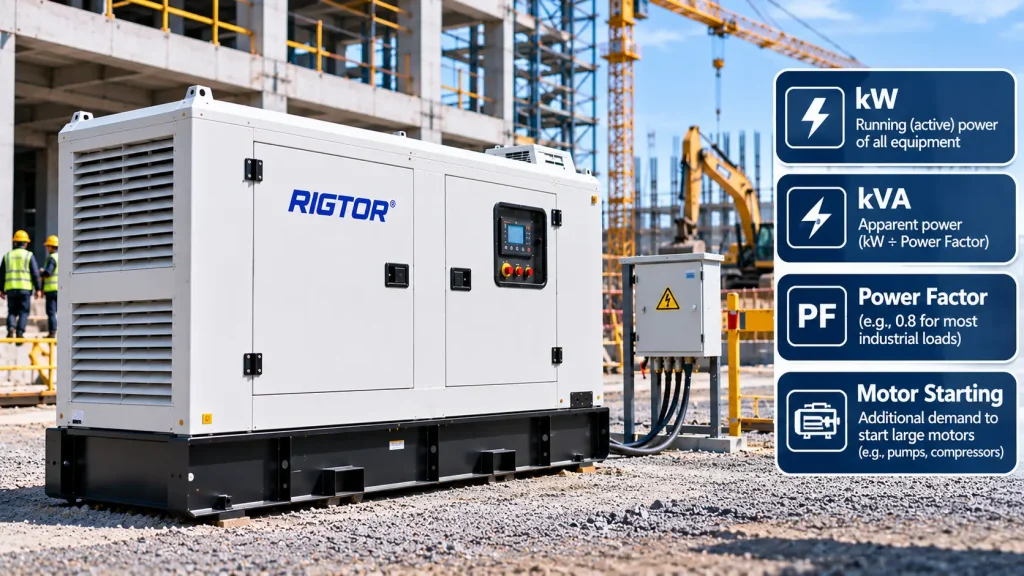
Generator sizing is the process of determining the electrical capacity required to power a particular group of equipment under defined operating conditions.
A generator must support two important requirements:
Running load: The electrical power required while connected equipment operates normally.
Starting and transient load: The additional electrical demand or rapid load change that occurs when motors start or equipment switches on.
For example, a construction site may have a total running demand of 80 kW.
However, if a large electric motor starts while other equipment is operating, the generator may need additional starting capability to maintain acceptable voltage and frequency.
This is why a generator rated for 80 kW is not automatically suitable for every 80 kW installation.
Diesel generator ratings commonly include both kilowatts (kW) and kilovolt-amperes (kVA).
| Parameter | Meaning | Why It Matters |
|---|---|---|
| kW | Active electrical power | Determines the real power the generator must supply |
| kVA | Apparent electrical power | Helps determine alternator and current-carrying requirements |
| Power Factor | Ratio of active to apparent power | Connects kW and kVA |
| Voltage | Electrical potential | Must match connected equipment |
| Frequency | AC cycles per second | Typically 50Hz or 60Hz |
| Phase | Single-phase or three-phase | Affects electrical distribution and load balance |
The basic relationship is:
kVA = kW ÷ Power Factor
For example:
A load requires 80 kW at a power factor of 0.8.
80 ÷ 0.8 = 100 kVA
This means the running load requires 80 kW of active power and 100 kVA of apparent power.
Many three-phase industrial diesel generators are rated at 0.8 lagging power factor.
A generator rated at 100 kVA and 0.8 PF therefore typically has a corresponding rated active power of 80 kW.
However, the load power factor may differ from the generator's rated power factor. Both the kW and kVA requirements must be checked against the generator's actual capability.
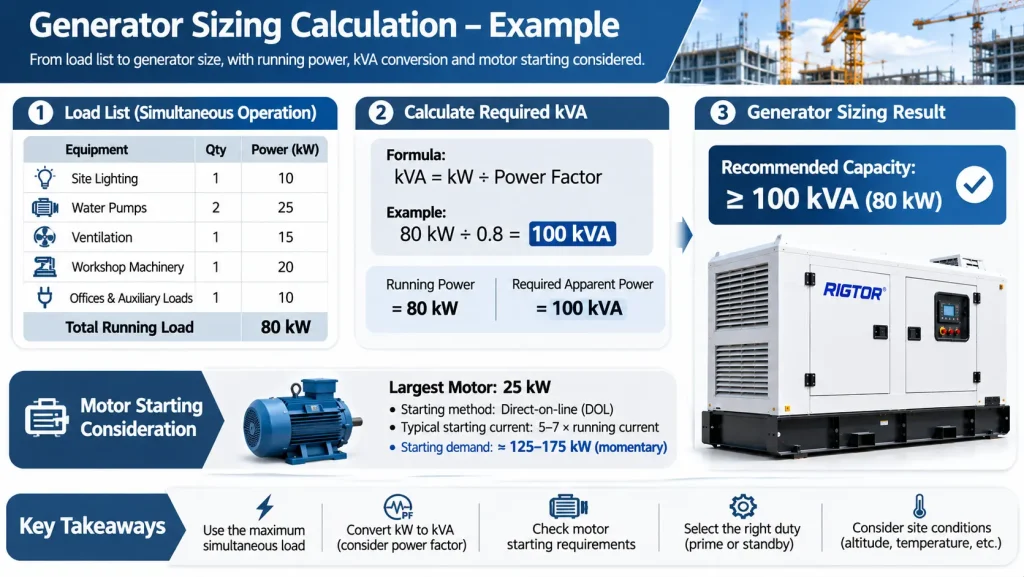
The following process provides a practical starting point for industrial generator sizing.
Start by preparing a complete load schedule.
For each piece of equipment, record:
For electric motors, check whether the nameplate kW represents mechanical shaft output rather than electrical input.
Motor efficiency must be considered when converting shaft power into electrical demand.
Not every connected machine necessarily operates at the same time.
For example, a temporary construction site may have the following electrical requirements:
| Equipment | Running Electrical Power |
|---|---|
| Site lighting | 10 kW |
| Water pumps | 25 kW |
| Ventilation equipment | 15 kW |
| Workshop machinery | 20 kW |
| Site offices and auxiliary loads | 10 kW |
| Total | 80 kW |
This example assumes all listed equipment operates simultaneously and that the figures represent electrical input power.
The maximum simultaneous running demand is therefore 80 kW.
If actual operating schedules show that some loads never operate together, a documented diversity assessment may reduce the required running capacity.
Do not apply an arbitrary diversity factor without understanding the equipment operating sequence.
Suppose the combined load operates at a true power factor of 0.8.
Required kVA = 80 ÷ 0.8
Running apparent power = 100 kVA
At this stage, the electrical system requires at least:
A 100 kVA generator rated at 80 kW would be fully loaded under these assumptions, leaving no spare steady-state capacity.
It would also still need to pass motor-starting and transient-performance checks.
Motor starting is one of the most important factors in diesel generator sizing.
An induction motor started directly across the line can draw several times its normal running current.
The exact starting demand depends on motor design, starting method and driven equipment.
Common starting arrangements include:
| Starting Method | General Characteristics |
|---|---|
| Direct-on-line (DOL) | High starting current |
| Star-delta | Reduced starting current, with reduced starting torque |
| Soft starter | Controlled voltage and current during acceleration |
| Variable-frequency drive (VFD) | Controlled acceleration, with additional electrical compatibility considerations |
A generator must provide sufficient starting capability without causing unacceptable voltage or frequency disturbances.
For example, a 25 kW pump motor may have a starting requirement substantially higher than its normal running demand.
Simply adding the pump's running kW to other loads will not reveal whether the generator can start it successfully.
The generator's alternator reactance, excitation system, engine response and permitted voltage dip must be considered.
A generator may need to start several motors and then support their combined running load.
Starting all motors simultaneously can produce a much higher transient demand than starting them in a controlled sequence.
Where the application allows it, staged motor starting may reduce the required generator capacity.
For example:
The appropriate sequence depends on the load profile, control system and any operational or safety requirements.
Diesel generators may be specified for different operating duties.
Standby Power
Used for backup power during interruptions to the normal supply.
Standby ratings are intended for defined emergency or backup operating conditions and should not automatically be used for continuous site power.
Prime Power
Used where the generator is a primary power source, generally supplying variable electrical loads over extended operating periods within the manufacturer's rating conditions.
Continuous Power
Used for applications requiring sustained electrical output under the applicable continuous-duty rating.
The definitions, permissible average loading and overload capability depend on the relevant rating standard and manufacturer's published data.
For example, a remote construction site operating a diesel generator every day may require a prime-rated configuration rather than a standby-only selection.
Generator output can be affected by installation conditions.
At high altitude, reduced air density may affect engine performance.
High ambient temperatures can reduce cooling margins and influence engine or alternator capability.
Other important conditions include:
Where applicable, use the engine and generator manufacturer's derating data rather than a generic percentage.
Projects may expand after installation.
Additional equipment, longer operating hours or changing duty requirements can increase electrical demand.
A reasonable capacity allowance may be appropriate, but simply choosing the largest available generator is not always beneficial.
The final generator should be checked for:
Final generator sizing should be based on the performance of the complete generator set, not only a simple arithmetic calculation.
Consider a construction project requiring electrical power for pumps, lighting, ventilation and workshop equipment.
| Parameter | Example |
|---|---|
| Running active power | 80 kW |
| Combined load power factor | 0.8 |
| Running apparent power | 100 kVA |
| Voltage | 400V |
| Frequency | 50Hz |
| Phase | Three-phase |
| Largest motor | 25 kW |
| Motor starting method | Direct-on-line |
| Operating duty | Prime power |
| Installation | Outdoor construction site |
The running apparent-power requirement is:
80 kW ÷ 0.8 = 100 kVA
The corresponding three-phase line current at 400V is approximately:
100,000 ÷ (√3 × 400) = 144.3 A
These figures establish the steady-state electrical demand.
A typical 100 kVA, 0.8 PF generator has an 80 kW rated active-power output.
Under the example's assumed running conditions, it would already be operating at its rated active and apparent power.
In addition, the 25 kW motor could impose a significant starting demand.
The generator must be assessed for the actual starting sequence and acceptable voltage dip.
A larger generator may be required, but it would be misleading to specify an exact rating without the motor's starting data and the generator's transient-performance information.
The final selection could also change if the motor uses a soft starter or VFD, or if loads are started in stages.
RIGTOR recommends using the preliminary calculation to establish the load requirement, followed by a model-specific engineering review before selecting the generator.
The following table shows the relationship between generator kVA and kW ratings at 0.8 power factor.
| Generator Rating | Rated kW at 0.8 PF |
|---|---|
| 20 kVA | 16 kW |
| 30 kVA | 24 kW |
| 50 kVA | 40 kW |
| 75 kVA | 60 kW |
| 100 kVA | 80 kW |
| 125 kVA | 100 kW |
| 150 kVA | 120 kW |
| 200 kVA | 160 kW |
| 250 kVA | 200 kW |
| 300 kVA | 240 kW |
| 400 kVA | 320 kW |
| 500 kVA | 400 kW |
| 750 kVA | 600 kW |
| 1000 kVA | 800 kW |
Note: This is a mathematical rating reference, not a list of confirmed RIGTOR generator models or a final sizing recommendation.
Actual model availability, prime/standby ratings and operating conditions must be verified.
An undersized generator may experience:
These problems can interrupt construction or industrial operations and potentially affect connected equipment.
An oversized generator may create different challenges:
Diesel engines operated for prolonged periods at very low loads may experience incomplete combustion and related maintenance issues, depending on the engine and operating conditions.
The goal is not to select the smallest or largest generator.
The goal is to select the generator that reliably supports the actual load profile throughout its intended operating life.
Construction projects commonly require power for lighting, pumping, ventilation, welding equipment and temporary facilities.
Generator sizing must consider changing loads, motor starting and the possibility of equipment being added during the project.
Sound-attenuated generator configurations may be appropriate when the site operates near occupied buildings or other noise-sensitive areas.
Mining projects may use diesel generators for remote equipment, maintenance facilities, pumping systems and auxiliary infrastructure.
Motor starting, site altitude, dust exposure and extended operating hours can influence the required configuration.
Remote industrial sites may rely on diesel generators as their main electrical supply.
The generator should be evaluated for prime or continuous duty as appropriate, along with fuel logistics, maintenance access and operating reliability.
Emergency backup systems must supply designated loads when normal power is unavailable.
Generator sizing should account for load restoration sequence, starting demand, required transfer arrangements and applicable project requirements.
Temporary infrastructure work may require mobile or packaged power systems that can be installed and relocated efficiently.
Electrical connections, enclosure design and deployment conditions are important alongside generator capacity.
Generator sizing is not only about choosing a number from a capacity table.
The selected diesel engine, alternator, control system, enclosure and operating duty must work together.
RIGTOR supplies diesel generator solutions for construction, mining, remote industrial operations and temporary infrastructure projects.
Depending on the required power range and project specification, RIGTOR can discuss configurations using engine platforms such as Cummins, Volvo, Perkins and Kubota.
The engine and alternator must be selected according to the required electrical output, operating frequency, duty rating and transient-load characteristics.
Different markets and applications use different electrical standards.
Project specifications may require configurations such as:
The actual voltage and frequency options depend on the selected generator model and alternator configuration.
RIGTOR's diesel generator solutions include sound-attenuated and open-type configurations.
A silent diesel generator may be appropriate for outdoor construction, temporary facilities and noise-sensitive industrial installations.
Open-type configurations may be suitable for dedicated generator rooms or protected industrial environments.
Depending on project requirements, generator configurations may incorporate digital controllers, electrical protection, automatic transfer interfaces and remote monitoring provisions.
These systems should be matched to the operating sequence and electrical distribution requirements.
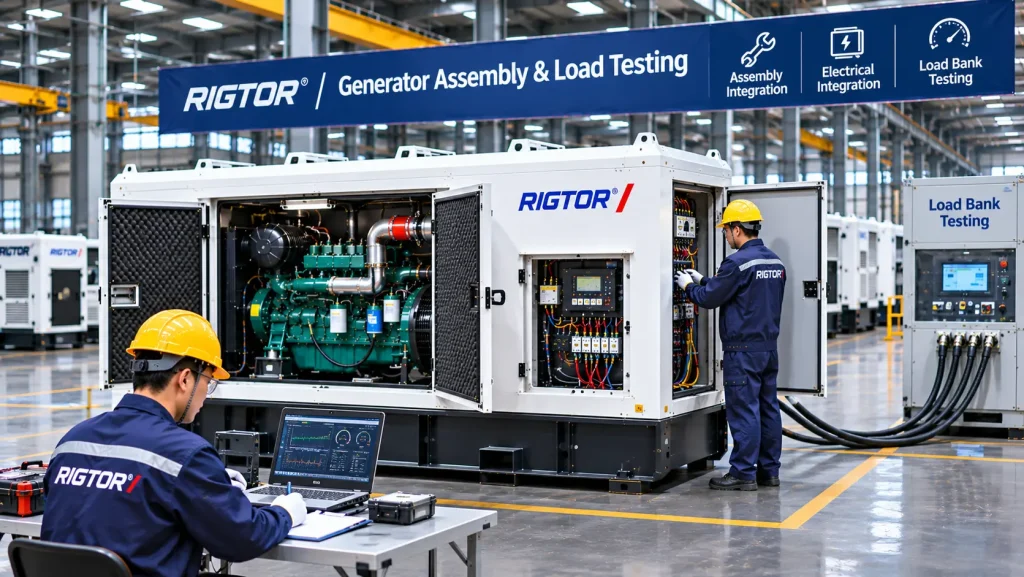
Generator manufacturing requires coordination between mechanical assembly, electrical integration and equipment inspection.
The factory acceptance scope should be agreed before production.
Depending on the project, verification may include:
Where transient motor-starting performance is critical, the required acceptance criteria and verification method should be specified separately.
A conventional steady-state load-bank test does not, by itself, demonstrate that a generator can start every connected motor.
Some industrial projects require more than a standalone generator.
RIGTOR's temporary infrastructure portfolio includes diesel generator sets, mobile lighting towers, portable diesel air compressors and mobile surveillance systems.
These products may be purchased individually or coordinated as part of a wider deployment package.
For example, a remote construction site may require:
| System | Function |
|---|---|
| Diesel Generator Set | Main electrical power |
| Mobile Lighting Towers | Temporary site lighting |
| Mobile Surveillance Systems | Security and remote monitoring |
| Portable Diesel Air Compressors | Compressed air for pneumatic equipment |
However, not every piece of equipment needs to be connected to the generator.
Diesel-driven compressors may supply compressed air using their own engines.
Solar or self-powered lighting and surveillance equipment may have separate energy systems.
When calculating generator capacity, include only the actual electrical loads that the generator must supply.
This prevents unnecessary oversizing and improves the accuracy of the overall power plan.
A detailed enquiry helps the supplier review the correct generator configuration.
| Information | Example |
|---|---|
| Application | Temporary construction power |
| Total running load | 80 kW |
| Load power factor | 0.8 |
| Voltage | 400V |
| Frequency | 50Hz |
| Phase | Three-phase |
| Largest motor | 25 kW |
| Motor starting method | DOL |
| Duty rating | Prime |
| Operating hours | 12 hours/day |
| Installation | Outdoor |
| Enclosure | Silent type |
| Special requirements | Remote monitoring |
Where possible, provide equipment nameplates, electrical drawings or a complete load schedule.
These details help identify the generator's electrical and mechanical requirements before quotation.
Start by calculating the maximum simultaneous running kW and kVA. Then evaluate motor starting requirements, transient loads, duty rating and environmental conditions before selecting a generator model.
An 80 kW load at 0.8 power factor requires 100 kVA of running apparent power. However, the final generator may need additional capability for motor starting, load changes or environmental derating.
A three-phase generator rated at 100 kVA and 0.8 power factor typically has an 80 kW rated active-power output.
kW represents active power, while kVA represents apparent power. Both are needed to evaluate generator capacity.
Yes. Motor starting can impose substantially higher electrical demand than normal operation and may determine the required generator size.
Yes. Oversizing can increase costs and lead to prolonged low-load operation, which may be undesirable for certain diesel engines.
Choose according to the actual operating duty. Prime ratings are generally intended for primary power applications with varying loads, while standby ratings are intended for defined backup applications.
Yes. High altitude and ambient temperature may reduce available generator output. Use the applicable manufacturer derating data.
There is no universal percentage suitable for every project. The allowance should reflect load uncertainty, future expansion, starting requirements and the selected generator's performance.
A generator sizing calculator can provide an initial estimate. Complex motor loads, nonlinear equipment and critical installations require model-specific engineering verification.
RIGTOR can review the customer's electrical requirements and discuss suitable diesel generator configurations, including power rating, voltage, frequency, enclosure type and operating conditions.
Correct diesel generator sizing requires more than adding up the kW ratings of connected equipment.
A reliable selection must account for running power, apparent power, motor starting, transient loads, operating duty and site conditions.
An undersized generator can create operational problems, while an oversized generator may increase costs and lead to inefficient operation.
RIGTOR supplies diesel generator solutions for construction, mining, industrial and temporary infrastructure applications.
By reviewing the complete electrical load profile and generator configuration, customers can make more informed purchasing decisions.
Diesel Generator Solutions Matched to Your Project Requirements
Share your electrical load schedule, voltage, frequency, operating duty and installation conditions with RIGTOR.
Our team can help review suitable generator configurations, including silent and open-type diesel generator systems.
Contact RIGTOR for Generator Sizing Support & Quotation.

Behind Every Critical Project.
@ 2026-2026 Rigtor Industry. All Rights Reserved.
 EN
 ES
 PT
 AR