

Time: Nov 5 2026 Views: 2
A Manufacturer's Guide to Diesel Generator Noise Control, Acoustic Enclosures, Cooling Design and Industrial Applications
When selecting a diesel generator for a construction site, industrial facility, equipment rental fleet or temporary power project, one of the first decisions is whether to choose a silent diesel generator or an open-type diesel generator.
Both systems use a diesel engine to drive an alternator and generate electricity. The main difference is how the generator set is packaged, protected and engineered to control noise.
An open-type diesel generator provides direct access to its engine, alternator and cooling components. A silent diesel generator integrates these components within a specially designed acoustic enclosure.
However, selecting the right generator involves more than comparing enclosure styles.
Buyers must also consider operating noise, ventilation, ambient temperature, maintenance access, installation requirements and total ownership costs.
As a diesel generator set manufacturer, RIGTOR provides diesel power generation solutions for construction, industrial and temporary infrastructure applications, including silent generator configurations tailored to project requirements.
This guide explains the differences between silent and open-type diesel generators and the manufacturing considerations behind a reliable sound-attenuated generator set.
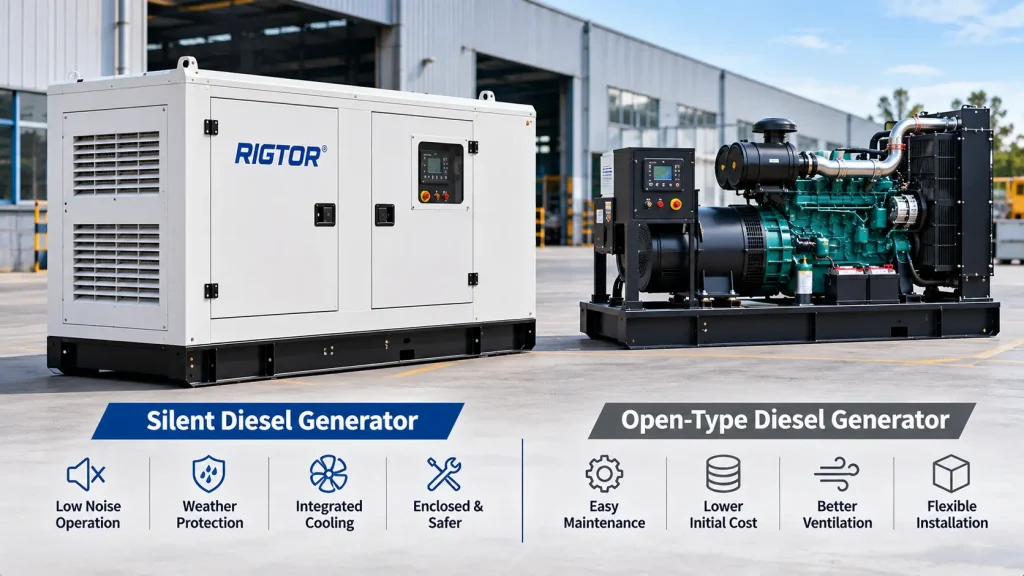
A silent diesel generator, also called a soundproof diesel generator or sound-attenuated diesel genset, is a generator set equipped with an enclosure designed to reduce noise emissions.
The word silent is an industry term. It does not mean that the generator operates without sound.
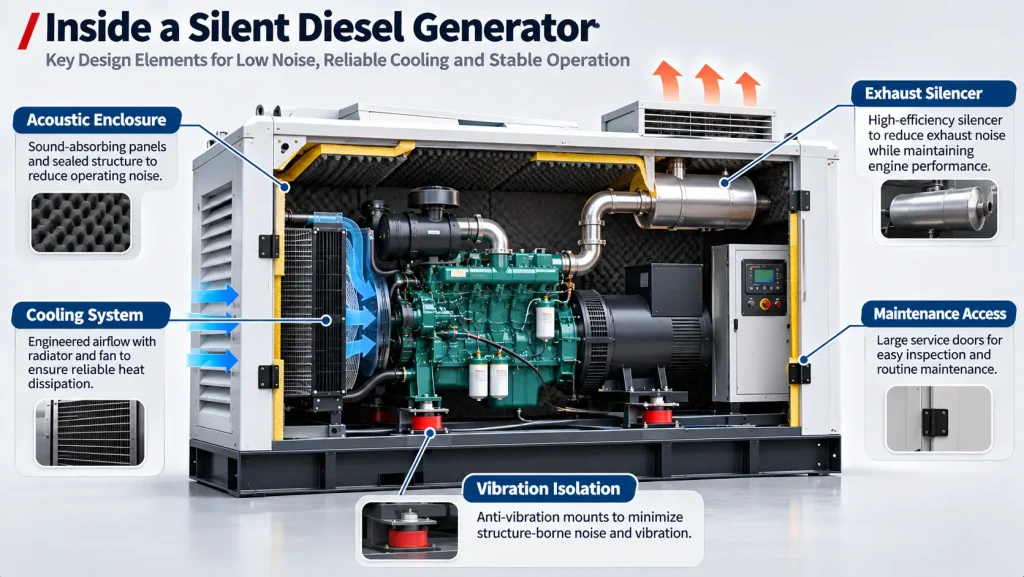
A typical silent generator integrates several noise-control elements:
The enclosure must reduce noise while allowing the engine, alternator and radiator to operate within their required temperature limits.
This balance between acoustic performance and cooling efficiency is one of the most important aspects of silent generator manufacturing.
An open-type diesel generator is a generator set mounted on a structural base frame without a complete acoustic enclosure.
Its main components are generally accessible, including:
Open-type generators are frequently installed in dedicated generator rooms, industrial facilities or locations where a separate enclosure or building provides environmental and acoustic protection.
They are also suitable for projects where easy component access, installation flexibility and initial equipment cost are important.
An open-type generator should not automatically be treated as suitable for unprotected outdoor installation.
Weather protection, ventilation and exhaust arrangements must be addressed according to the installation conditions.
| Comparison | Silent Diesel Generator | Open-Type Diesel Generator |
|---|---|---|
| Generator principle | Diesel engine driving an alternator | Same |
| Acoustic enclosure | Integrated sound-attenuating enclosure | Normally not included |
| Operating noise | Designed for reduced noise emissions | Typically higher without additional acoustic treatment |
| Cooling system | Requires carefully engineered enclosure airflow | More direct airflow access |
| Maintenance access | Through service doors and removable panels | Direct access to major components |
| Equipment dimensions | Usually larger for the same generator platform | Usually more compact |
| Equipment weight | Generally heavier | Generally lighter |
| Initial cost | Usually higher | Usually lower |
| Outdoor protection | Depends on enclosure design and rating | Requires suitable protection |
| Typical applications | Urban construction, rental, temporary power, noise-sensitive sites | Generator rooms, industrial plants, controlled installations |
Neither configuration is inherently more fuel-efficient or electrically superior.
When the engine, alternator and operating conditions are equivalent, the main performance differences arise from enclosure design, ventilation, auxiliary loads and installation conditions.
Noise performance is one of the main reasons buyers choose silent diesel generators.
However, not every silent generator produces the same noise level.
The sound pressure level depends on several factors:
Generator noise is commonly reported in A-weighted decibels, or dB(A).
A-weighting approximates the frequency sensitivity of human hearing.
Decibels use a logarithmic scale. A reduction of 10 dB represents a tenfold reduction in sound intensity, although perceived loudness also depends on frequency and other factors.
A generator advertised at 70 dB(A) at 7 meters cannot be compared directly with another generator advertised at 70 dB(A) at 1 meter.
Measurement distance, load and test method must be consistent.
For example, a specification might state:
Sound Pressure Level: XX dB(A) at 7m, 75% Load
The actual value must come from testing or validated manufacturer data for the specific generator configuration.
When comparing silent generators, ask suppliers to provide:
A reliable manufacturer should be able to explain how the reported noise value was obtained.
A sound-attenuated enclosure is an engineered component rather than a simple metal cover.
Its design must address multiple noise sources.
Enclosure panels help reduce the transmission of engine and mechanical noise.
Depending on the design, the enclosure may incorporate sound-absorbing linings, suitable panel construction and sealing details.
Panel thickness alone does not determine acoustic performance.
A diesel generator requires continuous airflow for combustion and cooling.
Open ventilation paths can also allow noise to escape.
Silent generator designs may use specially arranged air passages, acoustic baffles or attenuation structures to reduce sound transmission.
These structures must be designed without creating excessive airflow resistance.
Engine exhaust is an important noise source.
An appropriately selected exhaust silencer reduces exhaust noise while maintaining acceptable exhaust backpressure.
Excessive backpressure can negatively affect engine operation.
Engine and alternator vibration can travel through the base frame and enclosure.
Suitable mounting and isolation arrangements help limit structure-borne noise.
Poorly fitted doors and panel gaps can reduce the effectiveness of an acoustic enclosure.
Door construction, sealing and fastening arrangements therefore matter.
Manufacturer's perspective: Effective generator noise reduction requires coordinated engineering of the enclosure, cooling system, exhaust system and structural assembly.
A silent generator cannot simply be built by placing an open-type generator inside a sealed metal box.
Diesel engines and alternators generate heat during operation.
The enclosure must provide adequate airflow for:
Increasing acoustic attenuation can increase airflow resistance.
Insufficient airflow may lead to:
For each generator configuration, enclosure design should consider:
| Engineering Parameter | Why It Matters |
|---|---|
| Engine heat rejection | Determines cooling requirements |
| Radiator airflow | Supports heat removal |
| Cooling fan performance | Must overcome system resistance |
| Air inlet area | Affects incoming airflow |
| Air outlet arrangement | Controls discharge and recirculation |
| Ambient temperature | Influences cooling margin |
| Acoustic baffles | Affect both noise and airflow |
| Exhaust routing | Influences heat and backpressure |
The final configuration must be assessed against the engine and alternator manufacturers' requirements.
For hot-climate applications, cooling design deserves particular attention.
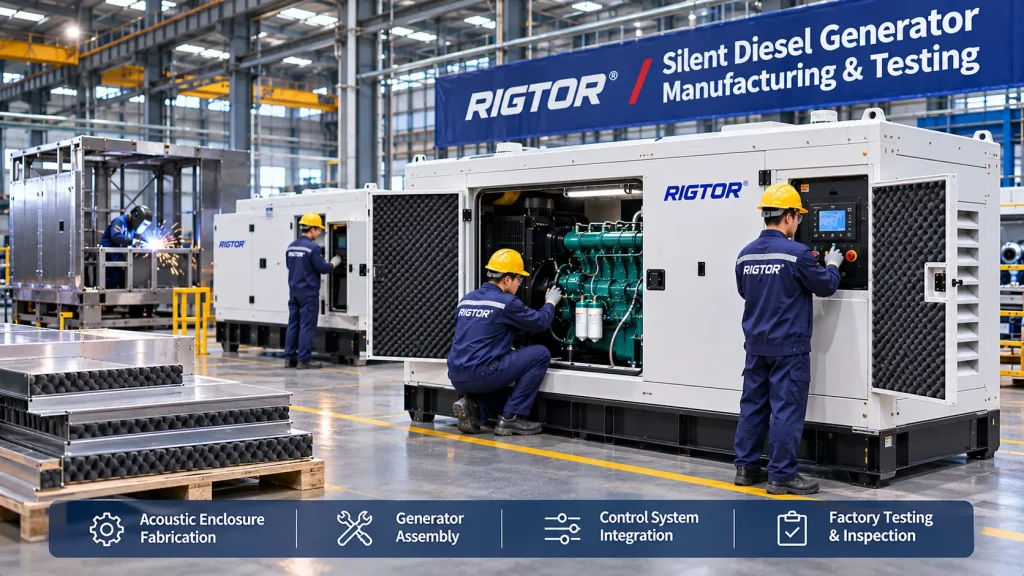
RIGTOR approaches silent diesel generator production as an integrated manufacturing and configuration process.
Rather than focusing only on the engine brand or the external appearance of the enclosure, we consider the complete generator package and its intended operating conditions.
The generator set begins with the required electrical output and operating profile.
Key selection parameters include:
RIGTOR can discuss engine-platform options, including Cummins, Volvo, Perkins and Kubota, subject to model availability and the required power range.
The selected engine and alternator must be matched to the project's electrical and mechanical requirements.
The enclosure design is evaluated around:
A properly configured enclosure must allow both reliable operation and practical maintenance.
The radiator, fan, air passages and exhaust silencer must work together.
The design objective is to control noise without compromising the generator's required cooling and exhaust performance.
Depending on project requirements, generator control functions may include:
The exact functions depend on the selected controller and agreed system configuration.
The base frame, engine mounting, enclosure and service access points must be assembled with attention to mechanical alignment and operational reliability.
RIGTOR can evaluate project requirements such as:
All requested options should be confirmed during technical review and quotation.
For industrial buyers, manufacturing quality should be supported by inspection and testing.
A silent generator requires more than checking whether the engine starts.
The complete generator package should be evaluated.
Relevant checks may include:
Depending on the agreed acceptance procedure, testing may cover:
The manufacturer should assess operating temperatures and cooling performance under the specified test conditions.
Where a noise performance requirement is included in the purchase specification, the acceptance plan should define the test method, operating load and measurement locations.
A general factory running test should not be represented as proof of a particular dB(A) level unless appropriate acoustic measurements have been performed.
Buyers may request, as applicable:
RIGTOR's manufacturing value lies in delivering an integrated generator package configured around the customer's operating requirements—not merely supplying individual engine and alternator components.
Construction projects near residential or commercial areas may face strict operating-hour and noise restrictions.
Silent diesel generators can help reduce noise from temporary power equipment.
However, the complete site's noise impact must still be assessed against local requirements.
Rental fleets frequently serve customers with different installation conditions.
Sound-attenuated generator sets can be attractive because they offer greater flexibility for noise-sensitive projects.
Rental buyers should also evaluate transportability, service access, durability and fleet maintenance requirements.
Hotels, office buildings and certain backup-power installations may benefit from reduced generator noise.
Site-specific requirements for ventilation, exhaust, fire safety and emissions remain essential.
Industrial maintenance, commissioning and shutdown operations may require temporary electricity.
Silent generator sets can help reduce noise in areas where multiple contractors and machines operate simultaneously.
Telecommunications sites, pipeline projects and temporary field facilities may require dependable power generation.
The choice between silent and open-type equipment depends on the site's noise limits, weather exposure, maintenance arrangements and project duration.
Open-type generators can be suitable for protected installations where noise is not the primary concern.
Silent configurations may be preferred near occupied facilities or where equipment must operate close to personnel.
A silent diesel generator usually has a higher initial manufacturing cost than an equivalent open-type unit.
The difference can include:
However, the lowest purchase price does not necessarily produce the lowest total installed cost.
An open-type generator may require a separate generator room, weather enclosure or acoustic treatment.
| Cost Factor | Silent Generator | Open-Type Generator |
|---|---|---|
| Initial generator package | Usually higher | Usually lower |
| Separate acoustic structure | Often less necessary | May be required |
| Site installation | Depends on configuration | Depends on infrastructure |
| Maintenance | Requires enclosure access | Direct access |
| Transportation | May be heavier and larger | Often more compact |
| Noise compliance measures | Integrated attenuation may help | May require separate measures |
The most economical choice depends on the complete installation, not just the generator's purchase price.
Not necessarily.
If two generators use the same engine and alternator, operate at the same load and maintain equivalent operating conditions, their fuel consumption may be similar.
The acoustic enclosure itself does not inherently make the engine more fuel-efficient.
However, differences in cooling fan arrangements, auxiliary loads, exhaust backpressure or operating conditions can affect performance.
Buyers should compare manufacturer fuel-consumption data at the same load points.
For example:
Fuel consumption should be expressed in comparable units and conditions.
Avoid comparing one generator's fuel consumption at 50% load with another's at 100% load.
Before requesting a quotation, prepare the following information.
| Information Required | Example |
|---|---|
| Required power | 100kW |
| Electrical frequency | 50Hz |
| Voltage | 400/230V |
| Duty rating | Prime power |
| Installation | Outdoor temporary site |
| Operating hours | 10 hours per day |
| Noise requirement | Project-specific dB(A) limit |
| Measurement distance | 7m |
| Ambient temperature | Site-specific maximum |
| Starting loads | Motors or compressors |
| Control requirements | Manual or automatic |
| Transport requirements | Fixed skid or mobile arrangement |
These are example enquiry parameters, not specifications for a particular RIGTOR model.
Choose a silent diesel generator when:
Choose an open-type diesel generator when:
For some projects, a sound-attenuated containerized generator or purpose-built generator room may be more appropriate than either standard configuration.
Silent and open-type diesel generators use the same basic electricity-generation principle.
Their differences lie mainly in acoustic treatment, structural packaging, ventilation, service access and installation requirements.
For silent generators, the critical manufacturing challenge is achieving effective noise reduction without compromising cooling, engine operation or maintenance.
That requires coordinated design of the enclosure, airflow paths, exhaust system, vibration isolation and generator package.
RIGTOR manufactures and configures diesel generator sets for industrial and temporary power applications, with silent generator solutions developed around customer requirements.
By evaluating power demand, noise expectations, environmental conditions and operating requirements together, buyers can select equipment that is better suited to their projects.
A silent diesel generator includes an acoustic enclosure designed to reduce noise. An open-type generator generally has exposed engine and alternator components and may require separate environmental or acoustic protection.
No. It produces engine, cooling fan, exhaust and mechanical noise. The enclosure reduces sound emissions but does not eliminate them.
There is no universal value. Noise depends on generator size, enclosure design, operating load and measurement conditions. Buyers should request verified model-specific data.
Not inherently. Fuel consumption depends primarily on engine characteristics, electrical load and operating conditions.
Many are designed for outdoor applications, but suitability depends on enclosure protection, ambient temperature, ventilation and the manufacturer's specifications.
Yes, they are frequently considered for temporary construction power, particularly where noise reduction is important. Local noise restrictions and site requirements must still be assessed.
They often provide more direct access to major components. Well-designed silent enclosures can also provide practical maintenance access through appropriately arranged service doors.
A project can specify a target noise level, measurement distance, load and test method. The manufacturer must assess feasibility and confirm the agreed performance requirements.
RIGTOR offers diesel generator solutions for 50Hz and 60Hz applications, subject to engine, alternator and model selection.
Provide required power, voltage, frequency, operating duty, noise requirement, installation location, ambient conditions, expected loads and any special control or enclosure requirements.
Silent Diesel Generator Sets for Industrial and Temporary Power Applications
Looking for a generator that combines dependable power generation with reduced operating noise?
RIGTOR can help evaluate engine options, acoustic enclosure requirements, cooling arrangements and project-specific configurations.
Send us your required power output, frequency, installation conditions and noise target.
Contact RIGTOR for a Silent Diesel Generator Configuration & Quotation.

Behind Every Critical Project.
@ 2026-2026 Rigtor Industry. All Rights Reserved.
 EN
 ES
 PT
 AR