Time: Nov 3 2026 Views: 4
Integrated Equipment Supply, Rental-Focused Customization, Quality Control and After-Sales Support
For an equipment rental company, purchasing a generator, lighting tower or air compressor is not simply an equipment acquisition decision.
It is an investment in a revenue-generating asset.
Every machine added to a rental fleet must be capable of serving different customers, operating under varying site conditions and withstanding repeated transportation, deployment and maintenance.
Rental businesses therefore evaluate equipment differently from individual end users.
They consider not only purchase price and technical specifications, but also equipment utilization, serviceability, spare-parts availability, fleet standardization and long-term operating costs.
A machine that is difficult to maintain or repeatedly unavailable for rental can affect fleet profitability, even if its initial purchase price is attractive.
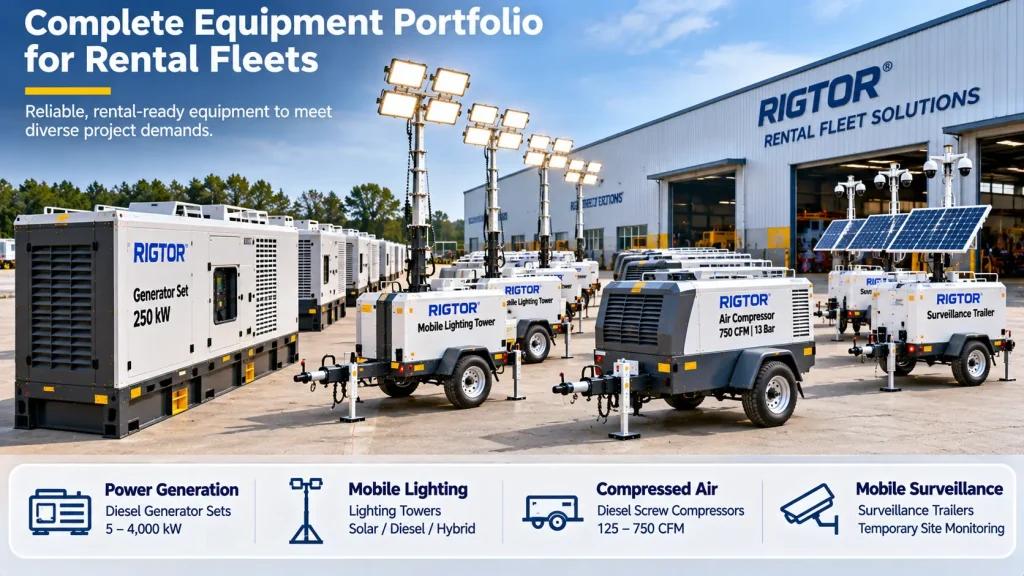
RIGTOR supplies diesel generators, mobile lighting towers, portable diesel air compressors and mobile surveillance systems for equipment rental businesses and other temporary infrastructure applications.
Our manufacturing and supply approach focuses on helping rental companies build practical equipment fleets, configure machines for their markets and establish appropriate maintenance and after-sales arrangements.
Rental companies frequently serve construction contractors, infrastructure maintenance teams, industrial operators, mining projects and emergency response organizations.
These customers may need different equipment types at the same worksite.
For rental businesses, sourcing complementary equipment from a coordinated supplier can simplify purchasing and fleet planning.
| Equipment Category | Rental Applications | Fleet Purchasing Considerations |
|---|---|---|
| Diesel Generator Sets | Temporary power for construction, industry and field operations | Power ratings, voltage, frequency, noise, service access |
| Mobile Lighting Towers | Nighttime construction, roadwork and industrial maintenance | Mast configuration, light output, energy source, transport design |
| Portable Diesel Air Compressors | Pneumatic tools, construction and selected drilling applications | Airflow, working pressure, engine, service requirements |
| Mobile Surveillance Systems | Temporary construction and equipment-area monitoring | Power autonomy, camera configuration, communications |
A rental company expanding into a new region may need generators, lighting towers and compressors at the same time.
Working with a supplier offering multiple complementary equipment categories can help coordinate:
This does not mean every machine uses identical components or maintenance procedures.
The value lies in coordinating fleet procurement and equipment configuration rather than managing each product category entirely separately.
For rental companies seeking to expand their product offering, RIGTOR can be considered as a manufacturing and supply partner across several temporary infrastructure equipment categories.
Rental equipment faces operating conditions that differ from those of machines purchased for a single fixed application.
A generator may be used at a construction site one month and an industrial maintenance project the next.
A lighting tower may move repeatedly between roadworks, temporary facilities and outdoor work zones.
Rental equipment must therefore be configured for its intended customer base and operating environment.
Depending on model availability and engineering review, configuration requirements may include:
Relevant configuration options may include:
Rental customers may require:
Potential requirements include camera arrangements, power-system design, communications interfaces and monitoring functionality.
All options depend on the selected product model, component compatibility and agreed manufacturing scope.
Customization should not be viewed only as adding optional features.
For rental companies, it can support three important objectives:
Market Fit: Equipment specifications can be selected around local customer demand.
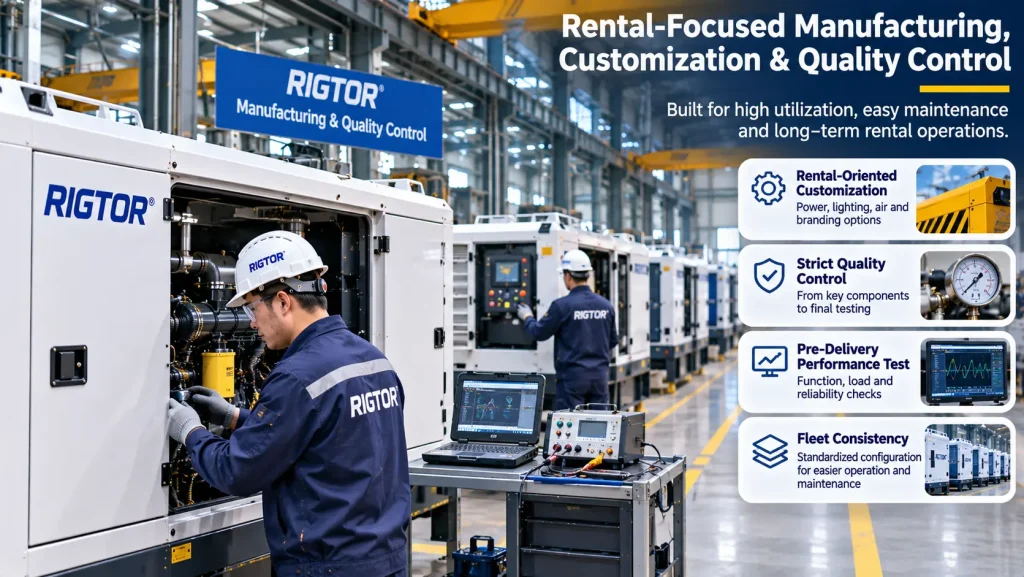
Fleet Consistency: Standardized configurations can simplify operator familiarization, inspection and maintenance planning.
Brand Recognition: Consistent equipment colors, identification and branding can help establish a recognizable rental fleet.
RIGTOR works from customer-supplied technical and commercial requirements to evaluate appropriate equipment configurations.
Rental equipment may be operated by different customers over its service life.
It is also subject to repeated loading, unloading, towing, positioning and return inspections.
These conditions make manufacturing quality and equipment consistency particularly important.
A rental company needs machines that meet the agreed specifications and can be inspected and maintained efficiently.
Engine, alternator, compressor airend, electrical components and structural assemblies must be selected for the intended equipment design.
Component compatibility matters as much as individual component specifications.
For example, a compressor engine and airend must be appropriately matched to deliver the required airflow at the specified working pressure.
Important quality-control considerations include:
Depending on the equipment type and agreed inspection scope, testing may include:
Diesel Generators: Electrical output, controls, protection functions and operating checks.
Air Compressors: Pressure-control operation, relevant performance checks, leak inspection and safety-device verification.
Lighting Towers: Mast operation, stabilizer function, electrical operation and lighting-system checks.
Surveillance Systems: Power-system operation, camera functionality and communications checks.
Testing procedures and documentation should be defined in the purchase agreement.
A rental company purchasing multiple machines needs predictable equipment configurations and repeatable manufacturing quality.
A successful factory demonstration of one machine is useful, but it does not replace appropriate inspection and acceptance procedures for subsequent orders.
For rental fleets, consistency across batches can help reduce unexpected differences in equipment operation, maintenance and spare-parts planning.
Equipment availability is one of the most important operational concerns for rental companies.
A machine awaiting a replacement component or technical diagnosis cannot generate rental revenue during that period.
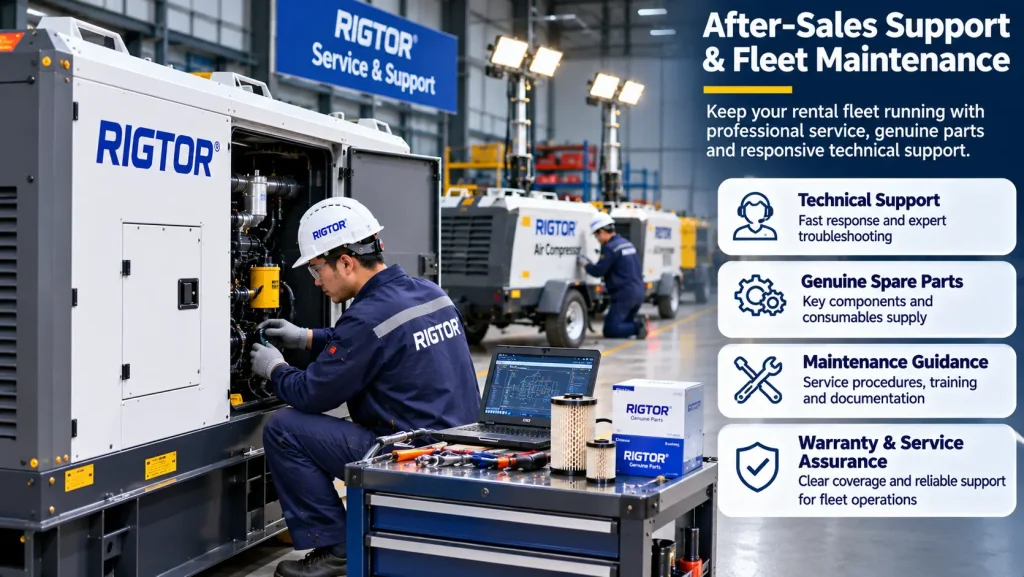
This makes after-sales support an important part of the equipment purchasing decision.
Rental companies should identify critical consumables and commonly replaced components before equipment enters service.
Depending on the equipment category, these may include:
RIGTOR can discuss spare-parts requirements as part of the equipment supply process.
Specific parts availability, stocking arrangements, prices and lead times should be confirmed for each model and market.
Rental businesses benefit from clear equipment information that can be shared with their maintenance teams.
Relevant documentation may include operating instructions, maintenance schedules, parts information and equipment-specific technical documents.
The documents supplied should be agreed according to the equipment configuration.
When equipment requires troubleshooting, accurate information can help the manufacturer and rental company's maintenance team identify the problem.
Useful information includes:
Clear technical communication can reduce unnecessary troubleshooting steps.
Rental companies can establish preventive maintenance procedures based on operating hours, equipment condition and manufacturer recommendations.
For RIGTOR customers, maintenance requirements should be reviewed during equipment selection and order preparation.
The objective is not simply to sell equipment, but to help rental customers prepare for its ongoing operation.
Warranty terms, remote technical support, spare-parts commitments and response times should be confirmed in writing rather than assumed.
A manufacturer serving rental companies needs to understand that the end user and the purchasing customer are often different organizations.
The rental company buys and owns the equipment.
Its customers operate or use that equipment for temporary projects.
The rental company must therefore balance two sets of requirements.
End users generally want equipment that is:
Fleet managers focus on:
A supplier that understands both perspectives can help rental businesses evaluate equipment beyond the initial purchase price.
RIGTOR's experience supplying rental-market customers is an important part of its positioning.
Rental customers frequently raise practical questions about repeated deployment, component selection, maintenance access, fleet branding and future equipment expansion.
These requirements can inform discussions about product configuration and supply arrangements.
RIGTOR aims to apply this rental-market understanding when working with equipment rental businesses in different markets.
Verified rental-customer numbers, years of experience, repeat-order data and geographic coverage can be added here to substantiate this capability.
As rental fleets grow, equipment variety can become a maintenance and management challenge.
A company operating many different generator control systems or compressor configurations may need to manage more service procedures and spare-parts references.
Fleet standardization can help address these challenges.
Rental companies can define preferred equipment specifications for recurring purchases.
Examples include preferred voltage configurations, control arrangements, connection types and equipment identification standards.
Rental equipment can be configured with appropriate company colors, logos and identification labels when included in the agreed manufacturing scope.
Where equipment models share approved components or service requirements, maintenance planning and parts management may become simpler.
However, parts commonality must be verified; equipment from different categories should not be assumed to share interchangeable components.
A consistent procurement specification can make future equipment purchasing more straightforward.
For a rental company planning regional expansion, this can be more valuable than treating each purchase as an isolated transaction.
Some rental companies purchase equipment under the original manufacturer's brand.
Others may require private-label products or specific distributor configurations.
RIGTOR can evaluate branding and configuration requirements for suitable equipment models.
Potential requirements include:
Private-Label Appearance
Equipment colors, logos and identification arrangements.
Market-Specific Specifications
Electrical configurations, connections and other technical requirements appropriate to the destination market.
Fleet Identification
Model identification, serial-number records and equipment labels.
Procurement Documentation
Agreed specifications, inspection documents and supporting product information.
Private-label arrangements must preserve required manufacturer identification, safety warnings and regulatory labeling.
Regulatory compliance and available OEM services should be verified for the specific equipment and destination market.
For rental businesses, the purchase price of equipment is only one part of the financial decision.
A simplified rental asset evaluation can consider:
Annual Rental Revenue = Billable Rental Days × Average Daily Rental Rate
Annual Operating Contribution = Rental Revenue − Direct Operating and Maintenance Costs
This contribution is not the same as net profit or investment return.
Financing, depreciation, overhead, transport, taxes and other costs may also apply.
Consider a rental company evaluating a diesel generator.
The following figures are hypothetical and do not represent actual RIGTOR equipment prices or customer performance.
| Metric | Illustrative Value |
|---|---|
| Equipment purchase cost | $18,000 |
| Average daily rental revenue | $140 |
| Billable rental days per year | 150 |
| Annual rental revenue | $21,000 |
| Annual direct operating and maintenance costs | $5,000 |
| Annual operating contribution | $16,000 |
This simplified example excludes depreciation, financing, taxes, overhead, transport and residual value.
It demonstrates why rental companies need to evaluate both rental demand and operating expenses.
A lower purchase price can improve the initial investment calculation, but only if equipment suitability, quality and support remain appropriate.
Supplier selection can influence several elements of fleet economics:
The impact should be evaluated using actual quotations, maintenance records and fleet utilization data.
For rental companies considering a manufacturing partner, RIGTOR's value proposition is built around five areas.
| RIGTOR Capability | Value for Rental Companies |
|---|---|
| Complementary Equipment Portfolio | Source multiple temporary infrastructure equipment categories through one supplier relationship |
| Rental-Focused Customization | Configure suitable machines for market requirements, branding and fleet specifications |
| Manufacturing Quality Control | Define component, inspection and functional testing requirements for equipment orders |
| After-Sales & Spare-Parts Planning | Prepare maintenance documentation, parts requirements and technical communication procedures |
| Rental-Market Understanding | Discuss equipment decisions in terms of fleet operation, serviceability and long-term procurement |
Our goal is to build supply relationships based on suitable equipment specifications, consistent manufacturing requirements and practical support arrangements.
For rental businesses, the right supplier should contribute to fleet development beyond the initial equipment transaction.
Before placing a fleet order, purchasing managers should clarify several questions.
Product Range: Can the supplier provide the required equipment categories and specifications?
Customization: Which configurations are available, and which require engineering review?
Quality Control: What inspection and testing procedures are included?
Spare Parts: Which components can be supplied, at what price and with what lead times?
Documentation: What manuals, parts information and inspection records are included?
Warranty: What is covered, and how are claims handled?
Fleet Expansion: Can future orders follow the same agreed specifications?
Rental-Market Experience: Can the supplier provide relevant, verifiable customer references or project experience?
These questions help rental companies compare manufacturers on a consistent basis.
Equipment rental companies depend on assets that can serve customers repeatedly, be maintained efficiently and remain commercially useful throughout their service life.
Choosing a manufacturer therefore involves more than comparing equipment prices.
Product range, configuration flexibility, manufacturing quality, spare-parts planning and rental-market understanding all influence the purchasing decision.
RIGTOR supplies diesel generators, mobile lighting towers, portable diesel air compressors and mobile surveillance systems for temporary infrastructure applications.
By working with rental companies on equipment specifications, fleet configurations, inspection requirements and after-sales arrangements, RIGTOR aims to support practical, long-term equipment procurement.
For rental companies expanding their fleets or developing new equipment categories, a coordinated manufacturing partner can provide value beyond individual machine purchases.
RIGTOR supplies diesel generator sets, mobile lighting towers, portable diesel air compressors and mobile surveillance systems for temporary field applications.
RIGTOR can evaluate model-specific customization requirements, including electrical configurations, equipment arrangements, branding and selected control features. Availability depends on the model and agreed engineering scope.
Private-label and fleet-branding requirements can be discussed for suitable products. The available scope, minimum order quantities and labeling requirements should be confirmed before ordering.
Quality requirements can include component verification, assembly inspection and functional testing. The exact inspection procedures, acceptance criteria and documentation should be specified in the purchase agreement.
Customers can discuss spare-parts requirements, technical documentation, maintenance planning and troubleshooting procedures. Specific warranty coverage, service commitments and parts lead times must be confirmed for each order.
Yes. RIGTOR's product portfolio includes complementary temporary infrastructure equipment categories. Purchasing, manufacturing and delivery arrangements depend on the products and order requirements.
Standardized specifications may simplify equipment familiarization, maintenance procedures, spare-parts planning and future procurement. The benefits depend on the models selected and the level of actual component commonality.
Rental equipment is frequently transported, deployed and operated across different projects. Rental companies therefore place particular emphasis on serviceability, fleet consistency, equipment availability and total ownership costs.
RIGTOR positions rental-market supply as part of its business. Customers evaluating this experience should request relevant project references and verified information about customer relationships, supplied equipment and markets served.
Rental companies should consider acquisition cost, expected utilization, rental revenue, maintenance, spare parts, transport, financing, depreciation and residual value rather than relying on purchase price alone.
Generators. Lighting Towers. Air Compressors. Surveillance Systems.
Explore equipment configurations, fleet customization and manufacturing supply options for your rental business.
Contact RIGTOR to Discuss Your Fleet Requirements.

Behind Every Critical Project.
@ 2026-2026 Rigtor Industry. All Rights Reserved.
 EN
 ES
 PT
 AR