

Time: Oct 31 2026 Views: 5
A 1250 CFM 35 Bar portable diesel rotary screw air compressor is a high-capacity compressed-air solution designed for demanding drilling and industrial field operations.
Equipped with a Cummins QSM15 diesel engine, this class of compressor is intended for applications requiring substantial airflow, elevated discharge pressure, and independent operation in remote locations.
Typical applications include water well drilling, down-the-hole (DTH) drilling, mining, quarrying, and selected exploration projects.
However, selecting a high-pressure diesel compressor requires more than comparing maximum airflow and pressure.
Buyers must evaluate the compressor's verified operating point, engine-airend matching, drilling equipment compatibility, fuel consumption, cooling capacity, high-pressure safety systems, and maintenance requirements.
From a manufacturer's perspective, reliable performance begins with correctly matching the complete compressed-air system to the drilling application.
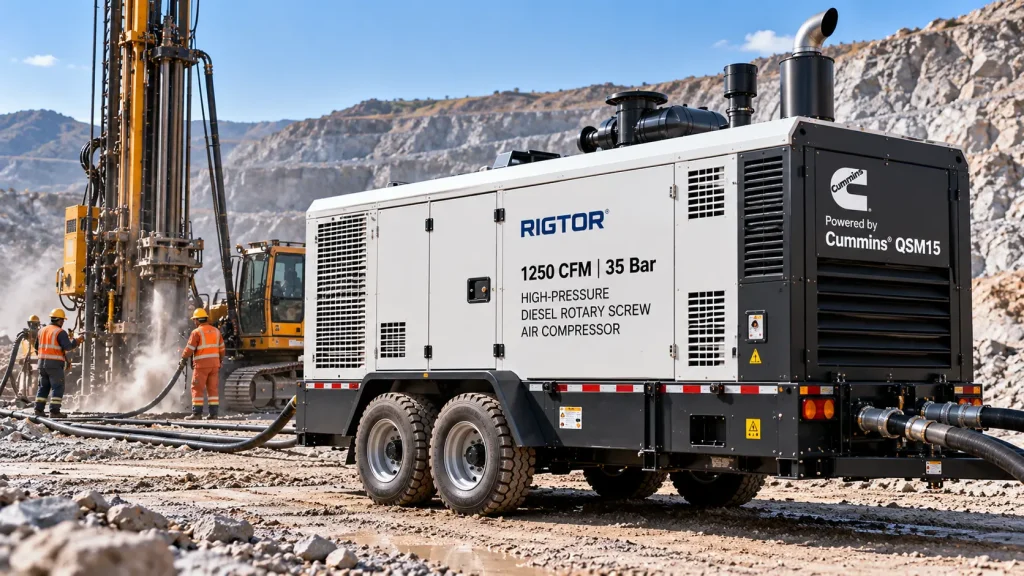
The two headline specifications describe the compressor's nominal airflow and pressure capability.
| Technical Parameter | Description |
|---|---|
| Nominal Airflow | 1250 CFM / approximately 35.4 m³/min |
| Nominal Pressure | 35 Bar / approximately 508 PSI |
| Compressor Technology | Oil-injected rotary screw |
| Diesel Engine | Cummins QSM15 |
| Engine Displacement | Approximately 15 liters |
| Equipment Configuration | Portable high-pressure compressor |
| Primary Applications | DTH drilling, water well drilling, mining and exploration |
Important specification note: Buyers must confirm whether the machine delivers 1250 CFM of Free Air Delivery (FAD) at 35 Bar simultaneously. Some compressors have different maximum airflow and maximum pressure ratings under separate operating conditions.
The final rated operating point should be supported by the manufacturer's performance documentation.
Airflow determines the volume of compressed air available for drilling equipment.
Pressure determines the ability of that air to overcome system resistance and meet the operating requirements of the drilling tool.
For DTH drilling, pressure influences hammer operation, while sufficient airflow is necessary for hammer performance and removal of cuttings from the borehole.
A high-pressure rating alone does not guarantee that the compressor can support a particular drill.
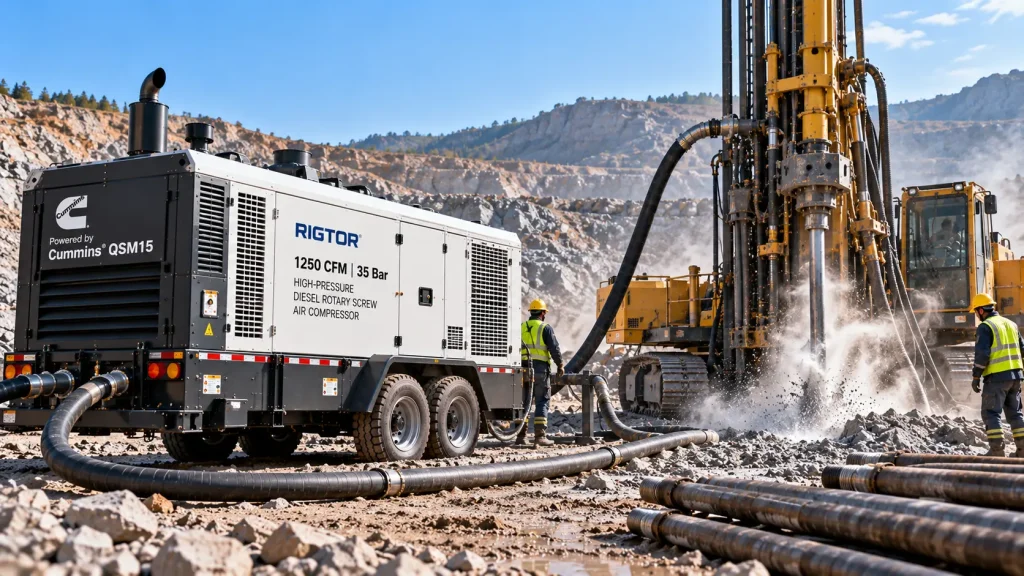
Drilling conditions vary according to rock formation, hole diameter, depth, drilling method, and equipment configuration.
As drilling depth increases, the air system may need to overcome greater pressure losses and more challenging borehole conditions.
A high-pressure compressor can be considered where the drilling system requires elevated air pressure and substantial airflow.
DTH drilling uses compressed air to operate a pneumatic hammer positioned near the drill bit.
The compressed air drives the hammer and helps transport rock cuttings out of the borehole.
The compressor must be matched to:
A 35 Bar compressor may be suitable for selected high-pressure DTH systems, but compatibility must be confirmed using the hammer manufacturer's specifications.
Water well drilling can require substantial compressed-air capacity, especially when pneumatic DTH methods are used.
Airflow and pressure requirements depend on drilling depth, formation characteristics, groundwater conditions, and the selected drilling equipment.
The compressor should be sized for the actual drilling program rather than selected by nominal CFM alone.
Mining and quarry operations may require compressed air for blast-hole drilling, exploration drilling, and related field activities.
A high-capacity diesel compressor provides an independent air source where centralized compressed-air infrastructure is unavailable.
Some geothermal and exploration drilling methods use compressed air for drilling and cuttings removal.
The suitability of a compressor depends on the drilling technique, well conditions, and required operating pressure.
The Cummins QSM15 is a heavy-duty diesel engine platform used in industrial and off-highway applications.
Its approximately 15-liter displacement provides a foundation for high-output industrial engine configurations.
However, QSM15 engines are available in different power ratings, operating speeds, and emissions configurations.
The exact engine specification must be confirmed for the compressor being purchased.
A large high-pressure air compressor places substantial mechanical demand on its prime mover.
The diesel engine must provide sufficient power across the compressor's operating range.
Important selection factors include:
Power and Torque
The engine must deliver the required shaft power at the compressor's operating speed.
Load Response
Drilling demand can change during operation. The engine and compressor controls must respond appropriately to changing load conditions.
Cooling Performance
The engine cooling system must handle sustained thermal loads under the expected ambient conditions.
Fuel Efficiency
Fuel consumption should be evaluated at verified compressor operating points rather than using engine specifications alone.
Service Availability
The availability of engine service information and replacement parts is important for international drilling contractors.
The Cummins brand may support access to an established engine service ecosystem, but actual local coverage and compressor-package support should be verified.
A high-pressure diesel compressor requires careful integration of mechanical, thermal, lubrication, and control systems.
The airend compresses incoming air using intermeshing rotors.
Oil injection assists with sealing, lubrication, and heat removal.
For a high-pressure compressor, manufacturers must verify the airend arrangement, pressure capability, shaft-power requirements, and operating limits.
Some high-pressure compressor systems use multiple compression stages or specialized arrangements.
The actual configuration should be confirmed from the equipment's technical documentation.
Engine-airend matching is one of the most important engineering considerations.
The compressor's required shaft power depends on airflow, pressure ratio, compression efficiency, and system losses.
The manufacturer must confirm that the installed engine can support the required operating point without exceeding its permissible rating.
A compressor's maximum airflow and maximum pressure should not be treated as a verified simultaneous operating point unless supported by test data.
High-pressure compression generates significant heat.
A compressor package may include an engine cooling circuit, compressor oil cooling, intercooling between stages where applicable, and an aftercooler where specified.
The cooling system must be evaluated for the intended duty cycle and ambient temperature.
Oil-injected compressors require an effective air/oil separation system.
At elevated operating pressures, separator vessels, fittings, and associated components must be suitable for the applicable pressure and temperature conditions.
High-pressure compressors require appropriate operating controls and safety protection.
Depending on the equipment configuration, these may include:
Safety devices must be correctly specified, installed, inspected, and maintained.
Compressor selection should begin with the drilling equipment rather than the compressor catalog.
Obtain the hammer manufacturer's recommended operating pressure and air consumption.
Different hammer sizes and designs can have substantially different requirements.
Hole diameter influences the annular space through which cuttings must travel.
Adequate airflow is necessary to maintain effective cuttings removal.
Longer drill strings and deeper boreholes may introduce additional pressure losses.
The required compressor discharge pressure must account for these losses.
Water entering the borehole can significantly affect drilling performance and the pressure needed to maintain effective air circulation.
Confirm the compressor's delivered airflow at the required pressure.
Do not select the equipment based only on separate maximum airflow and maximum pressure figures.
Review the engine rating, cooling capacity, duty recommendations, and operating environment.
The selected compressor must be capable of supporting the intended drilling schedule within its rated limits.
Fuel consumption is one of the largest recurring costs for high-capacity diesel compressors.
Actual fuel consumption depends on:
Hourly Fuel Cost = Fuel Consumption (L/h) × Diesel Price (per Liter)
For example, if a project uses an assumed 70 liters of diesel per hour at an assumed price of $1.20 per liter:
Hourly fuel cost = 70 × $1.20 = $84 per hour
For a ten-hour operating day, the calculated fuel cost would be $840.
These figures are hypothetical and are not verified fuel-consumption data for a Cummins QSM15-powered 1250 CFM compressor.
Buyers should request actual fuel-consumption figures for the specified compressor operating point.
Correct compressor sizing is the first step.
Operating at unnecessarily high pressure can increase energy demand.
Air leaks, restricted filters, unsuitable operating settings, and poor maintenance may also increase fuel consumption.
For drilling contractors, compressor efficiency should be evaluated alongside drilling productivity, rather than fuel consumption alone.
A large high-pressure compressor may be designed for transport between drilling projects.
However, portability does not necessarily mean that the equipment can be towed on public roads without additional requirements.
Buyers should confirm operating weight, transport dimensions, lifting points, and the approved handling method.
The compressor should be placed on stable ground with sufficient clearance for cooling airflow, exhaust discharge, and maintenance.
High-pressure air hoses, couplings, manifolds, and fittings must be rated for the intended operating pressure.
Appropriate hose restraints, pressure controls, and safe connection procedures are essential.
Dust, high temperatures, altitude, and remote operating conditions can affect engine and compressor performance.
Manufacturers should evaluate these conditions during equipment selection.
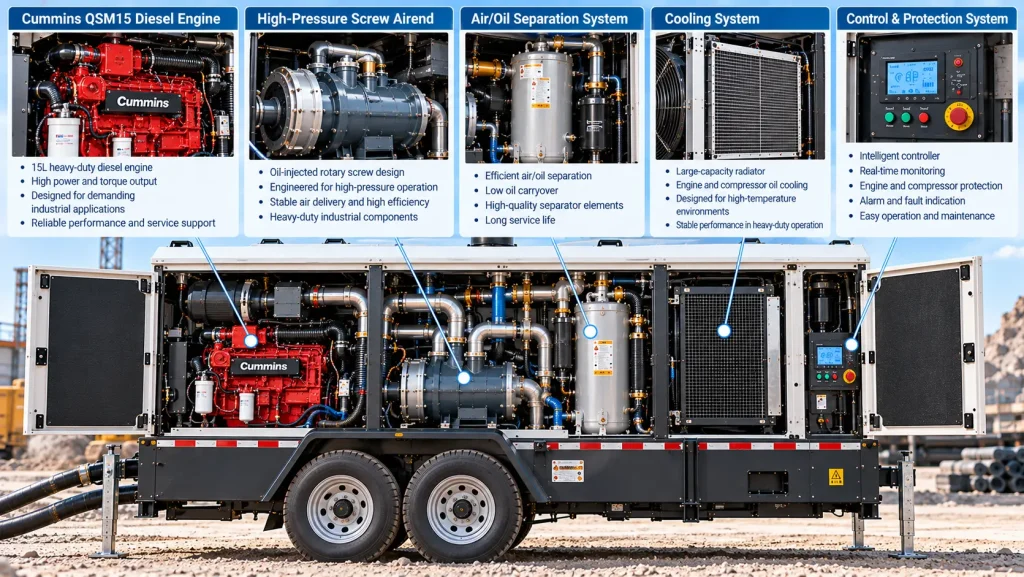
Maintenance is especially important for compressors operating under high thermal and mechanical loads.
| Component | Maintenance Focus | Importance |
|---|---|---|
| Cummins QSM15 engine | Oil, filters, fuel system, cooling circuit | Protects engine reliability |
| Rotary screw airend | Lubrication, temperature, vibration, operating condition | Protects compression components |
| Compressor lubricant | Correct grade, level, contamination | Supports lubrication and cooling |
| Air intake filters | Dust restriction and filter condition | Reduces contamination |
| Air/oil separator | Differential pressure and oil carryover | Maintains separation performance |
| Cooling system | Radiator, coolers, hoses, coolant | Helps prevent overheating |
| High-pressure hoses | Wear, damage, leaks, connection security | Reduces pressure-related hazards |
| Safety devices | Pressure-relief and protective functions | Supports safe operation |
| Control system | Alarms, fault history, sensor readings | Supports early fault detection |
Check fluid levels, visible leaks, air intake condition, cooling passages, hose condition, and warning indicators.
Inspect high-pressure connections before starting the compressor.
Engine oil, compressor lubricant, filters, separator elements, and other consumables must be serviced according to the applicable engine and compressor manuals.
High-pressure components and safety devices may also require periodic inspection or testing under applicable standards.
Before servicing the compressor, shut down the equipment, isolate energy sources, allow hot components to cool, and fully depressurize the system.
Never disconnect a pressurized hose or open a pressurized separator vessel.
Only qualified personnel should inspect or repair pressure-retaining components and safety devices.
Possible causes include excessive air demand, hose leakage, incorrect pressure settings, pressure losses, or compressor faults.
Verify the actual hammer air requirement and compressor output at the operating pressure.
Potential causes include restricted cooling airflow, dirty coolers, inadequate lubricant, cooling-system faults, or operation outside rated conditions.
Repeated overheating should be investigated before restarting.
Possible causes include separator faults, incorrect lubricant level, oil return-system problems, or unsuitable operating conditions.
Inspect the air/oil separation system according to the service manual.
Possible causes include fuel-system issues, coolant-temperature protection, engine oil-pressure faults, electrical problems, or controller shutdown events.
Review diagnostic information before attempting repairs.
Fuel consumption may increase because of sustained heavy loading, unnecessary discharge pressure, system leaks, or maintenance problems.
Compare measured consumption at the same delivered airflow and pressure.
For drilling contractors, equipment downtime can interrupt an entire project.
Before purchasing, buyers should evaluate the manufacturer's service arrangements.
Confirm the exact engine model and whether authorized engine service and parts are available in the destination country.
Engine service arrangements should not be confused with support for the complete compressor package.
Ask about availability of compressor oil filters, air filters, separator elements, seals, sensors, valves, and airend-related components.
Request operating manuals, maintenance instructions, component lists, and applicable control-system documentation.
Clarify whether the supplier provides fault-code assistance, technical guidance, and support for identifying replacement components.
Obtain written warranty terms covering the engine, compressor package, and any major components.
Confirm exclusions, operating-hour limits, maintenance obligations, and the process for warranty claims.
Before purchasing a 1250 CFM 35 Bar high-pressure compressor, verify:
This class of high-pressure diesel compressor is intended for demanding applications such as DTH drilling, water well drilling, mining, quarrying, and selected exploration projects. Suitability depends on the actual airflow and pressure requirements of the connected equipment.
That depends on the compressor's verified performance rating. Buyers should confirm whether 1250 CFM FAD and 35 Bar are achieved simultaneously and whether the equipment is rated for continuous operation at that point.
The Cummins QSM15 is a heavy-duty diesel engine platform used in industrial equipment. Its suitability depends on the specific power rating, operating speed, emissions configuration, and the compressor's shaft-power requirements.
A 35 Bar compressor may be suitable for selected high-pressure DTH systems. Buyers must verify the hammer's operating pressure, air consumption, hole diameter, drilling depth, and pressure losses before selecting the compressor.
Fuel consumption varies with engine rating, working pressure, delivered airflow, and operating conditions. Buyers should request measured fuel-consumption data for the intended compressor operating point rather than relying on generic estimates.
Routine maintenance includes diesel engine servicing, compressor lubricant checks, filter replacement, air/oil separator inspection, cooling-system maintenance, and inspection of high-pressure components. Service intervals must follow the actual equipment manuals.
Common problems include insufficient discharge pressure, overheating, excessive oil carryover, engine shutdowns, and high fuel consumption. Troubleshooting should begin with operating data, fault codes, and inspection of the relevant mechanical systems.
Buyers should verify simultaneous airflow and pressure ratings, engine specifications, drilling compatibility, fuel consumption, safety systems, transport requirements, spare-parts availability, emissions compliance, and written warranty terms.
A 1250 CFM 35 Bar portable diesel rotary screw air compressor represents a high-capacity compressed-air solution for demanding drilling and industrial field applications.
The Cummins QSM15 engine platform can be considered for heavy-duty compressor packages when its specific power rating is correctly matched to the compression system.
However, reliable performance depends on the complete engineering design.
Verified airflow at the required pressure, appropriate engine-airend matching, cooling performance, high-pressure safety, fuel efficiency, and service accessibility are all essential considerations.
For drilling contractors and equipment buyers, selecting the right compressor means matching the machine to the actual drilling requirement while accounting for long-term operating and maintenance costs.
Need a High-Pressure Diesel Air Compressor for Your Drilling Project?
Contact RIGTOR to discuss your DTH hammer requirements, drilling depth, borehole diameter, operating pressure, airflow demand, and preferred engine configuration. Final equipment specifications and performance ratings should be verified before ordering.

Behind Every Critical Project.
@ 2026-2026 Rigtor Industry. All Rights Reserved.
 EN
 ES
 PT
 AR