

Time: Oct 31 2026 Views: 6
A 185 CFM portable diesel rotary screw air compressor is a practical compressed-air solution for construction contractors, equipment rental companies, road maintenance crews, and industrial service providers.
Powered by a diesel engine, this type of compressor can operate independently of the electrical grid. Its portable configuration makes it suitable for jobsites where equipment must be transported, repositioned, and operated under changing field conditions.
However, choosing the right 185 CFM compressor involves more than comparing rated airflow and purchase price.
Buyers also need to understand working pressure, pneumatic tool compatibility, fuel consumption, cooling performance, maintenance requirements, and spare-parts availability.
From a manufacturer's perspective, these factors determine whether a compressor can deliver reliable performance while remaining economical to operate throughout its service life.
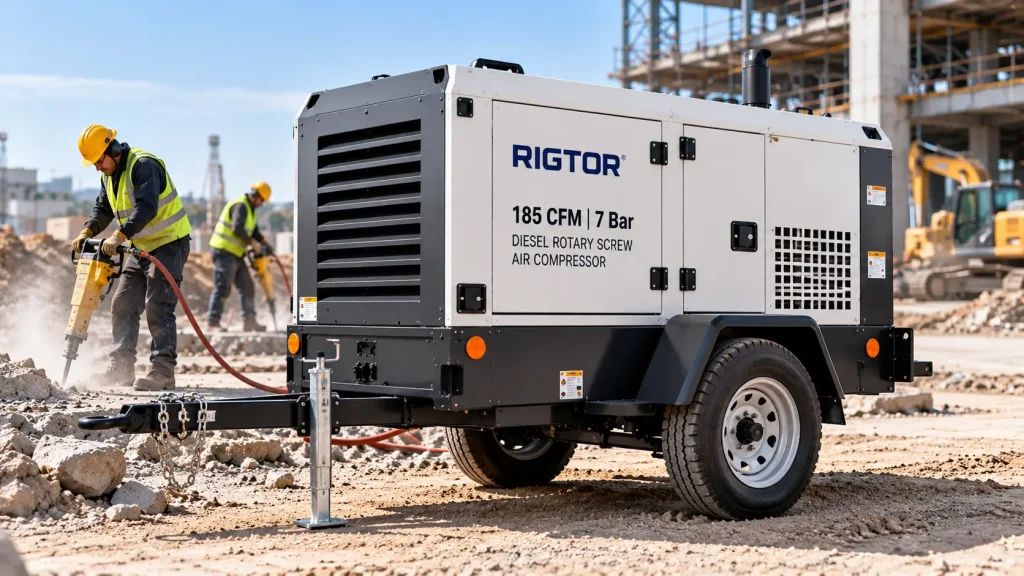
A 185 CFM diesel compressor uses a diesel engine to drive an oil-injected rotary screw airend, producing compressed air for pneumatic equipment and industrial applications.
The term 185 CFM refers to a nominal airflow of approximately 5.24 m³/min.
For accurate equipment selection, buyers should confirm whether the published airflow represents Free Air Delivery (FAD), the rated working pressure, and the applicable test conditions.
| Specification | Description |
|---|---|
| Rated Airflow | 185 CFM / approximately 5.24 m³/min |
| Working Pressure | Model-dependent; confirm the rated pressure |
| Compressor Technology | Oil-injected rotary screw |
| Power Source | Diesel engine |
| Engine Cooling | Liquid-cooled diesel engine |
| Installation | Portable or trailer-mounted, depending on configuration |
| Primary Applications | Construction, road maintenance, equipment rental, industrial servicing |
The actual engine model, fuel consumption, weight, dimensions, and rated pressure should be verified against the manufacturer's technical datasheet.
The 185 CFM class offers a useful balance between airflow capacity and equipment portability for many general-purpose pneumatic applications.
Its value is especially clear in operations where compressed air is needed at multiple locations.
A portable compressor can be transported between construction projects, maintenance locations, and temporary worksites.
Depending on the chassis configuration, features may include a towing arrangement, lifting points, protective enclosure, and accessible service panels.
Buyers should confirm the machine's actual transport dimensions, operating weight, towing requirements, and road compliance.
A diesel-driven compressor does not require an external electrical supply for its primary compression function.
This makes it useful for roadwork, remote maintenance, and construction locations where electrical infrastructure is unavailable.
Rotary screw compressors produce a relatively continuous compressed-air flow.
Oil injection helps lubricate the airend, seal internal clearances, and remove compression heat.
Correct engine-airend matching and adequate cooling are essential for sustained operation.
Portable equipment may be serviced at jobsites rather than in dedicated workshops.
Accessible filters, lubricant service points, cooling components, and diagnostic controls can reduce the time required for routine maintenance.
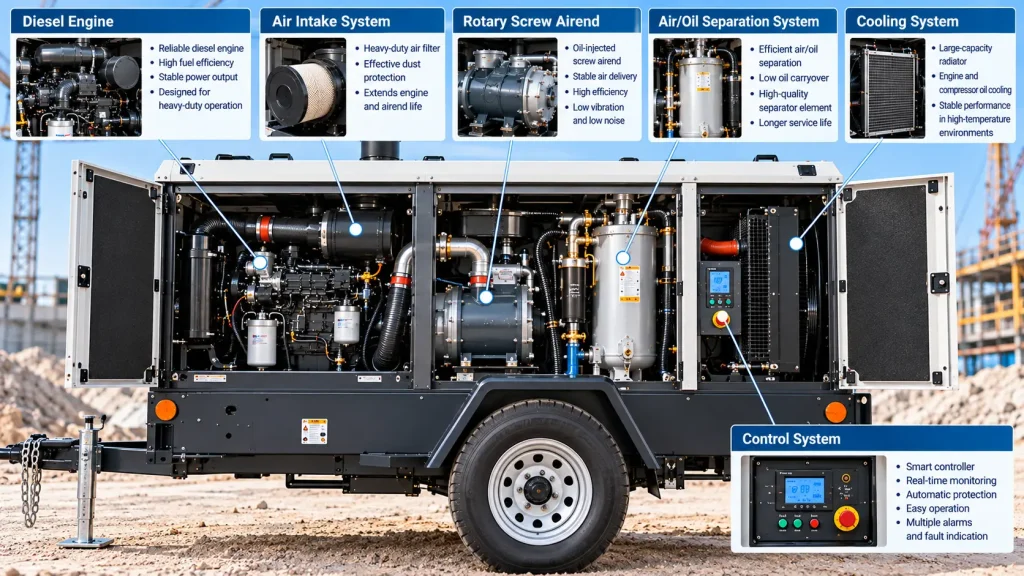
A portable diesel screw compressor combines several mechanical systems into one integrated package.
The diesel engine supplies mechanical power to the rotary screw airend.
Engine selection must account for the compressor's required operating pressure, airflow, duty cycle, and environmental conditions.
Fuel efficiency and service availability are important considerations for contractors and rental companies.
Inside the airend, two intermeshing rotors progressively compress incoming air.
Lubricating oil is injected into the compression chamber to assist with sealing, cooling, and lubrication.
The airend's operating speed and design must be matched to the intended airflow and discharge pressure.
An air intake filter helps prevent dust and debris from entering the compressor.
This is particularly important on construction sites, where airborne particles can accelerate component wear and increase maintenance requirements.
After compression, the air/oil mixture passes through a separation system.
Recovered oil is returned to the lubrication circuit, while compressed air is delivered through the outlet system.
The separator element must be maintained according to the manufacturer's service requirements.
A liquid-cooled diesel engine typically uses coolant, a radiator, and a cooling fan.
The compressor package also requires oil cooling, and some configurations include an air aftercooler.
Adequate cooling airflow is essential, particularly in hot or dusty operating environments.
Depending on the model, the control system may provide pressure regulation, engine monitoring, compressor temperature protection, operating-hour indication, and fault alerts.
Buyers should verify the actual controller functions included in the equipment.
Portable diesel compressors are widely used to supply compressed air for selected pneumatic breakers, chipping hammers, and other construction tools.
The appropriate number of tools depends on their individual air consumption and required pressure.
The 185 CFM class can be suitable for rental fleets serving construction contractors and maintenance crews.
Rental buyers should pay particular attention to transportability, service access, operating-hour tracking, fuel consumption, and the availability of replacement parts.
Portable compressors can provide temporary compressed air during plant shutdowns, equipment maintenance, and industrial repair operations.
The required air quality should be checked before connecting sensitive equipment.
Diesel compressors may support road infrastructure maintenance, pipeline work, and remote utility projects.
Independent operation is useful where electrical power is unavailable or temporary electrical installation is impractical.
Selected abrasive blasting and surface-cleaning applications may use compressors in this airflow class.
However, nozzle size, operating pressure, abrasive type, and air consumption must be evaluated before choosing a 185 CFM compressor.
This is one of the most important questions for contractors.
The number of tools depends on three factors:
For example, consider the following hypothetical tool requirements:
| Tool | Assumed Air Consumption | Quantity | Total Demand |
|---|---|---|---|
| Pneumatic chipping hammer | 25 CFM | 2 | 50 CFM |
| Pneumatic impact wrench | 20 CFM | 2 | 40 CFM |
| Air blow gun | 15 CFM | 1 | 15 CFM |
| Combined demand | 105 CFM |
These figures are illustrative, not universal tool ratings. Actual consumption varies by tool model and duty cycle.
The compressor must also provide sufficient pressure after accounting for hoses, fittings, and distribution losses.
For high-demand tools, the available airflow margin may be substantially smaller.
Manufacturer's recommendation: Always select the compressor using the connected equipment's actual air-consumption data rather than relying only on the number of tools.
Fuel consumption is a major operating-cost consideration, particularly for equipment rental companies and contractors running compressors for extended periods.
Actual diesel consumption depends on:
A single fuel-consumption figure is not sufficient for every application.
Hourly Fuel Cost = Diesel Consumption per Hour × Diesel Price per Liter
For example, if a compressor consumes an assumed 8 liters per hour and diesel costs an assumed $1.20 per liter:
Hourly fuel cost = 8 × $1.20 = $9.60 per hour
For an eight-hour operating period, the estimated fuel cost would be $76.80.
This is a calculation example only, not a verified fuel-consumption specification for a RIGTOR 185 CFM compressor.
Buyers should request measured fuel-consumption data at defined operating conditions.
Avoid unnecessary discharge pressure, repair compressed-air leaks, maintain clean filters, and select a compressor that matches the actual air demand.
Oversizing a compressor may result in extended unloaded operation and unnecessary fuel consumption.
Confirm the compressor's FAD at its rated discharge pressure.
A 185 CFM airflow rating alone does not establish whether the compressor is suitable for a particular pneumatic tool.
Request the engine manufacturer, engine model, airend specifications, and applicable service documentation.
For international buyers, access to engine and compressor spare parts is particularly important.
Check the rated ambient-temperature range, cooling arrangement, and ventilation requirements.
Portable compressors operating in dusty or hot environments may require more frequent cooling-system inspection.
Confirm the machine's dimensions, operating weight, towing or lifting arrangement, and transport requirements.
If the unit is trailer-mounted, road-use compliance must be verified for the destination market.
Ask for noise data measured under a stated test method and operating condition.
Noise limits may influence where and when the compressor can be used.
For buyers in the United States, verify the applicable diesel engine emissions requirements before importing the equipment.
A portable diesel compressor may be subject to nonroad engine requirements depending on its configuration and use.
Compliance must be established for the actual engine and equipment, not assumed from the compressor's airflow rating.
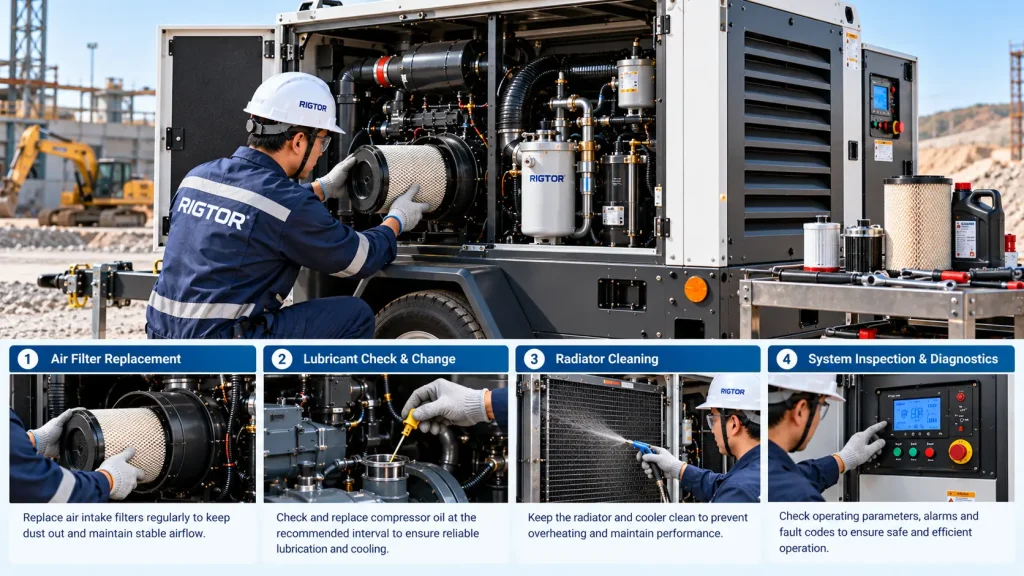
Regular maintenance helps protect the diesel engine, rotary screw airend, and cooling system.
| Maintenance Item | Recommended Inspection | Purpose |
|---|---|---|
| Engine oil and filter | Check level, condition, and service interval | Protects the diesel engine |
| Compressor lubricant | Check level and condition | Supports airend lubrication and cooling |
| Air intake filter | Inspect for dust and restriction | Protects internal components |
| Air/oil separator | Monitor pressure loss and oil carryover | Maintains separation performance |
| Cooling system | Inspect radiator, hoses, coolant, and oil cooler | Helps prevent overheating |
| Fuel filters | Inspect and replace as specified | Protects fuel injection system |
| Air hoses and fittings | Inspect for wear and leaks | Maintains pressure and airflow |
| Controller | Review fault indicators and operating hours | Supports preventive maintenance |
Before starting the compressor, inspect fluid levels, visible leaks, warning indicators, and cooling-air passages.
Check the equipment for signs of damage or loose connections.
Replace engine oil, compressor lubricant, filters, and separator elements according to the relevant service manuals.
Operating conditions such as dust, heat, and prolonged high loading may affect maintenance requirements.
Before servicing pressurized components, stop the machine, isolate energy sources, allow hot components to cool, and fully depressurize the system according to the manufacturer's instructions.
Repairs involving pressure vessels, safety valves, and electrical components should be performed by qualified personnel.
Possible causes include excessive tool demand, air leaks, restricted filters, incorrect pressure settings, or compressor system faults.
Start by checking the connected equipment's total air demand.
Potential causes include dirty cooling surfaces, inadequate ventilation, low fluid levels, cooling-system faults, or operation outside the rated ambient conditions.
Repeated overheating requires diagnosis before the machine is returned to service.
Possible causes include separator problems, incorrect oil level, oil return-system faults, or unsuitable operating conditions.
Inspect the lubrication and separation systems according to the service manual.
Excessive fuel use may be associated with compressed-air leaks, unnecessarily high pressure, prolonged heavy loading, or poor engine maintenance.
Compare fuel consumption at equivalent operating conditions when evaluating different machines.
Possible causes include battery condition, fuel supply restrictions, engine protection events, or controller faults.
Review the engine and controller fault information before attempting repairs.
For overseas contractors and rental companies, maintenance support is an important purchasing factor.
Buyers should request a list of routine replacement parts, including engine filters, compressor oil filters, intake filters, separator elements, seals, and model-specific consumables.
The supplier should identify which manuals, parts lists, wiring information, and service instructions are available for the purchased configuration.
Ask whether the manufacturer provides remote technical assistance, fault-code guidance, and support for identifying replacement components.
Clarify warranty duration, operating-hour limitations, exclusions, maintenance requirements, and the procedure for submitting a claim.
The engine and compressor airend may have different service arrangements.
Buyers should verify whether local service providers can support the installed engine and whether compressor-specific parts must be obtained from the equipment supplier.
The initial equipment price is only part of the total ownership cost.
Total Cost of Ownership = Purchase Cost + Fuel Cost + Maintenance + Repairs + Downtime
For rental businesses, additional considerations include equipment utilization, transport costs, turnaround time between rentals, and repair expenses.
A compressor with accessible service components and dependable spare-parts support may offer better long-term value than a lower-priced unit that is difficult to maintain.
A 185 CFM diesel air compressor is commonly used for construction, road maintenance, pneumatic tools, industrial servicing, and temporary compressed-air supply. Its portable design is useful where electricity is unavailable or equipment must be relocated frequently.
The number depends on each tool's air consumption and required operating pressure. A 185 CFM compressor may operate multiple smaller pneumatic tools or fewer high-demand tools. Calculate the combined air requirements and allow for pressure losses and operating margins.
Fuel consumption depends on the diesel engine, working pressure, compressor load, and operating conditions. Buyers should request fuel-consumption data at rated load and typical partial-load conditions to estimate operating costs.
A correctly specified rotary screw compressor can support extended operation within its rated duty and environmental limits. Continuous operation depends on engine performance, cooling capacity, maintenance condition, and the manufacturer's operating recommendations.
A 220 CFM compressor has approximately 19% greater nominal airflow than a 185 CFM model. However, the correct choice also depends on working pressure, mounting configuration, and actual air demand. Higher airflow does not automatically mean better efficiency.
Maintenance intervals depend on the engine and compressor models, operating hours, lubricant specifications, and environmental conditions. Routine servicing includes engine oil, compressor lubricant, air filters, oil filters, separator elements, and cooling-system inspections.
Common problems include restricted air filters, overheating, air leaks, excessive oil carryover, fuel-system issues, and insufficient discharge pressure. Preventive maintenance helps reduce unexpected breakdowns.
Buyers should verify rated airflow and pressure, diesel engine model, airend specifications, fuel consumption, cooling system, transport configuration, maintenance requirements, spare-parts availability, warranty terms, and applicable emissions requirements.
A 185 CFM portable diesel rotary screw air compressor provides independent compressed-air supply for construction, equipment rental, industrial maintenance, and remote field operations.
Its main advantages lie in portability, practical airflow capacity, and the ability to operate without external electrical power.
However, reliable performance depends on more than the nominal 185 CFM rating.
Buyers should evaluate the working pressure, engine-airend integration, fuel consumption, cooling design, maintenance accessibility, and long-term service support.
For contractors and rental companies, selecting a properly matched compressor can improve equipment utilization, reduce unnecessary operating costs, and help minimize downtime.
Looking for a 185 CFM Portable Diesel Air Compressor?
Contact RIGTOR to discuss your required working pressure, pneumatic tools, operating environment, engine preferences, and transport requirements. Final specifications and available configurations should be confirmed before ordering.

Behind Every Critical Project.
@ 2026-2026 Rigtor Industry. All Rights Reserved.
 EN
 ES
 PT
 AR