

Time: Oct 31 2026 Views: 7
A 220 CFM 8 Bar diesel rotary screw air compressor provides an independent source of compressed air for construction projects, industrial maintenance, equipment integration, and remote operations.
Unlike electric compressors, diesel-driven systems can operate without an external electrical supply. A skid-mounted configuration also eliminates the need for a dedicated towing chassis, making it suitable for installation on steel platforms, service vehicles, and temporary equipment stations.
However, selecting a reliable diesel compressor requires more than comparing airflow and working pressure.
From a manufacturer's perspective, the most important considerations include engine-airend matching, cooling performance, fuel consumption, installation requirements, maintenance accessibility, and spare-parts support.
This guide explains how a 220 CFM 8 Bar oil-injected diesel screw compressor works, where it is most useful, and what industrial buyers should confirm before placing an order.
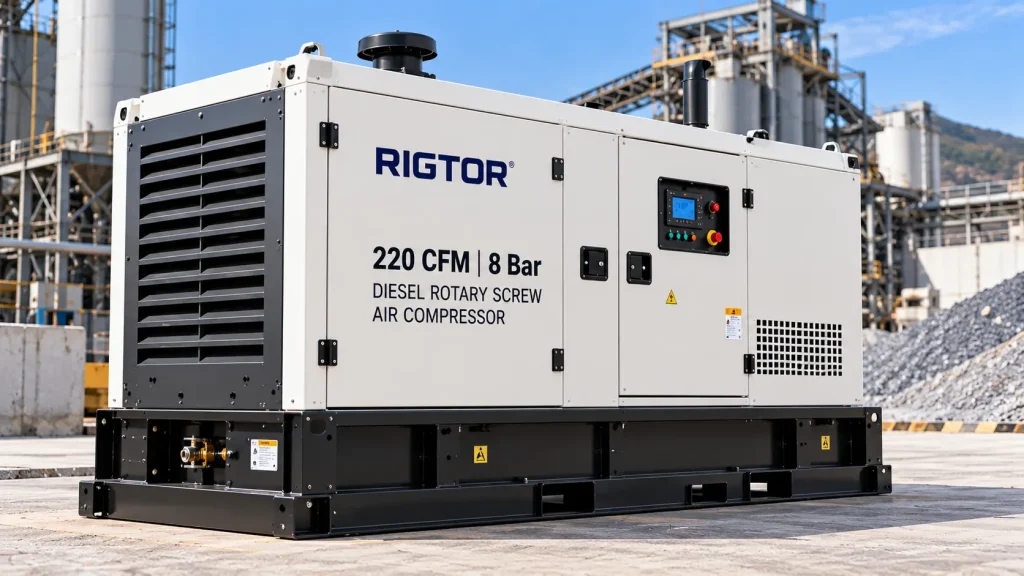
The compressor's two primary ratings describe its nominal air delivery and working pressure.
| Technical Parameter | Description |
|---|---|
| Air Delivery | 220 CFM, approximately 6.23 m³/min |
| Working Pressure | 8 Bar, approximately 116 PSI |
| Compressor Type | Oil-injected rotary screw |
| Power Source | Diesel engine |
| Mounting Configuration | Fixed-base or skid-mounted, subject to model design |
| Air Supply | Independent of external electrical power |
| Typical Applications | Construction, industrial maintenance, temporary installations, remote operations |
The quoted 220 CFM should be verified as Free Air Delivery (FAD) at the specified working pressure and test conditions.
CFM stands for cubic feet per minute.
For industrial compressor selection, the important value is the volume of usable air delivered at the required operating pressure.
A compressor rated at 220 CFM should not automatically be assumed to deliver 220 CFM at every pressure setting.
Manufacturers should provide the rated airflow, pressure, measurement conditions, and relevant test standard.
An 8 Bar compressor is suitable for many general-purpose pneumatic applications, provided the required pressure and air consumption fall within the equipment's capabilities.
However, pressure losses occur through hoses, fittings, filters, and distribution piping.
For example, a tool requiring 7 Bar at its inlet may need a higher compressor discharge pressure to compensate for system losses.
The correct compressor must therefore be selected according to the actual pressure available at the point of use.
A skid-mounted compressor is installed on a structural base rather than a road-towing trailer.
This arrangement can be useful for customers who require compressed air at a designated operating location or want to integrate the compressor into another equipment system.
Without a dedicated trailer chassis, a skid-mounted compressor may be easier to incorporate into:
The final installation must account for equipment dimensions, weight, vibration, ventilation, and safe maintenance access.
A diesel engine allows the compressor to operate where electricity is unavailable or where electrical infrastructure would be expensive to install.
This is particularly useful for temporary projects and remote industrial operations.
Depending on the design, the compressor can be installed on a prepared foundation or integrated into a larger equipment package.
However, skid-mounted does not automatically mean permanently stationary.
The equipment's actual operating arrangement and intended relocation schedule should be established during the purchasing process.
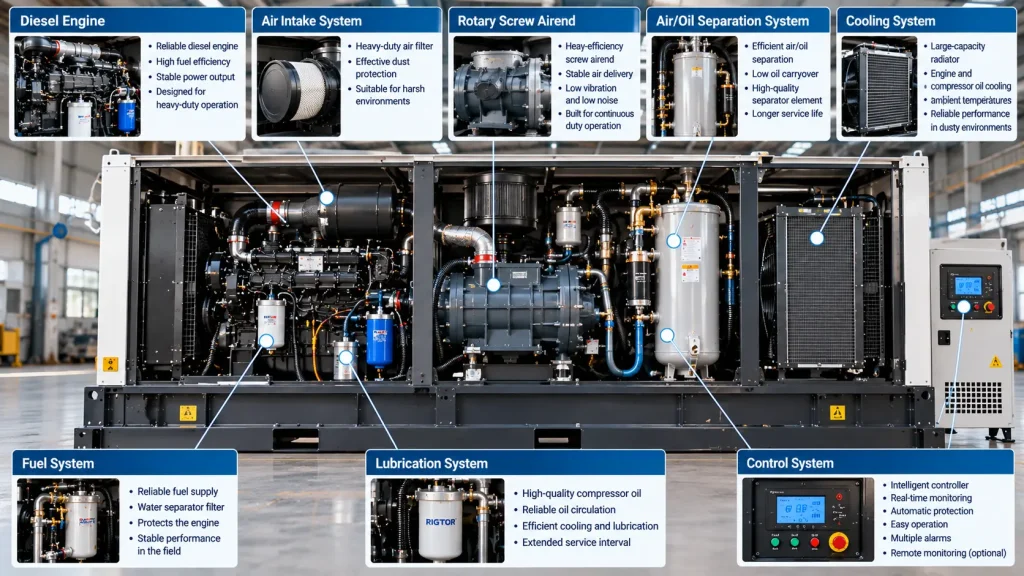
A diesel screw compressor is an integrated mechanical system.
Its reliability depends on how effectively the engine, compressor airend, cooling system, filtration, oil separation, and controls work together.
The diesel engine supplies the mechanical power required to operate the rotary screw airend.
Manufacturers must match engine performance to the compressor's operating requirements.
Important factors include:
An oversized engine may increase acquisition cost and create inefficient operating conditions. An undersized engine may struggle to maintain the required compressor output.
Correct power matching is therefore essential.
The oil-injected rotary screw airend contains two intermeshing rotors.
As the rotors turn, air enters the compression chamber and is progressively compressed.
Lubricating oil is injected to assist with sealing, lubrication, and heat removal.
Compared with intermittent compression technologies, rotary screw systems provide a relatively continuous airflow.
The airend must be selected for the intended pressure, airflow, operating speed, and duty requirements.
Diesel engines and screw compressors generate substantial heat during operation.
A typical compressor package may use:
Manufacturers must consider airflow through the enclosure, cooler capacity, and the operating environment.
Cooling-system design becomes especially important in hot climates and dusty industrial locations.
Oil-injected compressors require an air/oil separation system to recover lubricating oil from the compressed air.
A properly maintained separator helps control oil carryover and system pressure loss.
The separator element, oil return system, and lubricant condition should all be considered in preventive maintenance planning.
A practical compressor control system should support safe operation and appropriate monitoring.
Depending on the model, functions may include pressure control, engine monitoring, compressor temperature protection, operating-hour recording, and fault indication.
Buyers should request a list of the actual controller functions rather than assuming that every diesel compressor includes remote monitoring or automatic diagnostics.
Diesel compressors can provide compressed air for pneumatic tools, equipment cleaning, and temporary construction operations.
A fixed-base design may be useful when equipment remains in one working area for extended periods.
Industrial maintenance contractors sometimes require an independent compressed-air supply during plant shutdowns, equipment replacement, or temporary maintenance projects.
A diesel compressor can support selected operations without relying on the plant's existing compressed-air network.
Compressed air is commonly used for maintenance, cleaning, and selected pneumatic tools in mining environments.
However, high-pressure drilling equipment may require a different compressor specification.
Buyers should verify the actual air demand of the connected equipment.
Skid-mounted compressors can be considered for remote utility packages, service vehicles, and equipment installations where independent compressed air is needed.
The mounting arrangement, fuel storage, ventilation, and access for servicing should be designed around the intended installation.
Buyers should confirm the rated FAD at 8 Bar and the operating conditions under which that rating is achieved.
They should also request information about continuous-duty recommendations and ambient-temperature limitations.
The engine and airend are two of the most important components.
Ask the manufacturer to identify the engine brand, engine model, airend specification, and service requirements.
Component selection affects spare-parts availability, maintenance convenience, and long-term operating cost.
Fuel consumption depends on compressor loading, discharge pressure, engine efficiency, and operating conditions.
Buyers should request fuel-consumption data at defined load points.
For long-running equipment, operating fuel cost can be a major factor in total ownership cost.
A skid-mounted compressor can be integrated into certain enclosed installations, but this requires engineering evaluation.
The installation must provide sufficient cooling airflow, combustion air, exhaust discharge, access for maintenance, and protection against excessive temperatures.
Diesel exhaust must be routed safely outdoors.
The physical footprint is only part of the installation requirement.
Additional clearance may be necessary for opening service panels, removing filters, servicing the engine, and maintaining cooling airflow.
Buyers should request a general arrangement drawing before finalizing the installation.
The manufacturer should confirm the air filtration system, cooling arrangement, and maximum rated ambient temperature.
Dust accumulation can restrict intake airflow and reduce cooling performance.
Additional protective measures may be needed in severe operating environments.
Possible engineering requirements include alternative mounting arrangements, different engine specifications, protective enclosures, air outlets, or control options.
However, any modification must be evaluated against compressor performance, cooling requirements, structural integrity, and applicable regulations.
Customization should be based on documented operating requirements rather than appearance alone.
Correct installation helps protect the compressor and supports reliable operation.
The supporting structure must accommodate the equipment's operating weight and dynamic loads.
The manufacturer should specify suitable mounting points and any required vibration-isolation arrangements.
Adequate ventilation is essential.
Hot discharge air should not be allowed to recirculate into the cooling-air inlet.
For enclosed installations, ventilation must be evaluated using the actual engine and compressor heat-rejection data.
Diesel exhaust must be discharged safely away from personnel, building openings, and air intakes.
Indoor operation without properly engineered exhaust and ventilation systems presents serious hazards, including carbon monoxide exposure.
Fuel storage and supply arrangements must comply with applicable local requirements.
Installations should also provide safe access for refueling, leak inspection, and emergency shutdown.
The installation should allow technicians to access filters, lubricant service points, cooling components, and the control system.
A compact installation that prevents routine maintenance may increase downtime and operating costs.
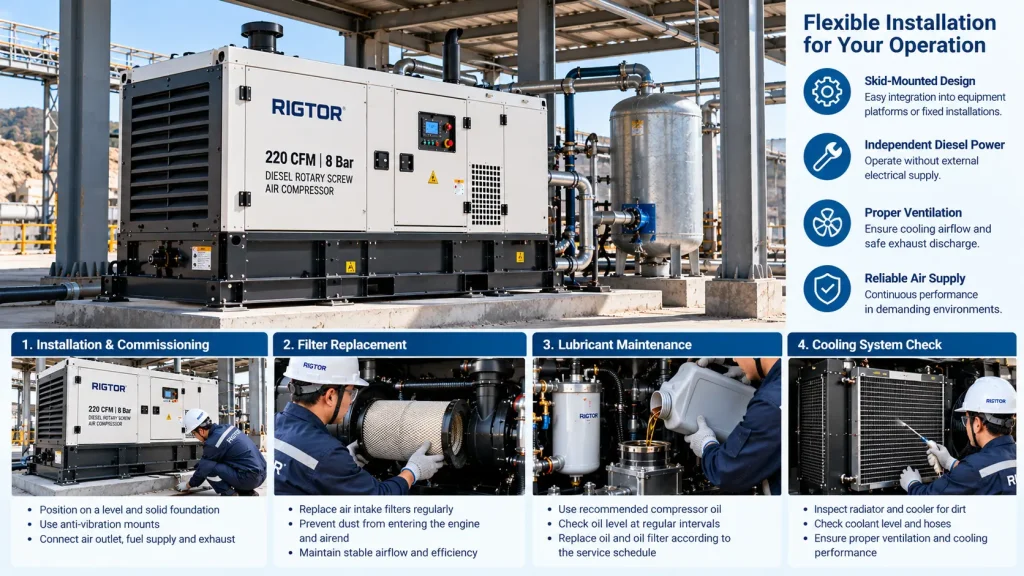
Preventive maintenance is essential for protecting both the diesel engine and rotary screw airend.
| Maintenance Component | Main Inspection | Purpose |
|---|---|---|
| Engine oil and filter | Oil level, condition, replacement schedule | Engine protection |
| Compressor oil | Level, quality, contamination | Airend lubrication and cooling |
| Air intake filters | Dust accumulation and restriction | Protects engine and compressor |
| Air/oil separator | Pressure loss and oil carryover | Maintains separation performance |
| Radiator and oil cooler | Dirt, blockage, leaks | Prevents overheating |
| Fuel filters | Contamination and replacement interval | Protects fuel system |
| Hoses and fittings | Wear, leaks, loose connections | Reduces air and fluid loss |
| Control system | Fault indicators and protective functions | Supports safe operation |
Operators should inspect fluid levels, visible leaks, warning indicators, and cooling-air passages before operation.
Engine oil, compressor lubricant, filters, and separator elements must be replaced according to the relevant service manuals.
Maintenance frequency may need adjustment for dusty environments, high temperatures, and severe duty cycles.
Before opening any pressurized component, shut down the machine, isolate energy sources, allow hot components to cool, and fully release system pressure using the prescribed procedure.
Maintenance involving pressure vessels, safety valves, and electrical systems should be performed by qualified personnel.
Possible causes include excessive connected air demand, air leaks, restricted intake filters, incorrect pressure settings, or compressor faults.
Start by confirming the actual air consumption of connected equipment.
Potential causes include dirty coolers, inadequate ventilation, insufficient lubricant, cooling-system problems, or excessive ambient temperature.
Repeated overheating requires diagnosis rather than repeated restarts.
Potential causes include a damaged separator element, incorrect oil level, oil return-system problems, or unsuitable operating conditions.
The oil separation system should be inspected according to the service manual.
High fuel use may result from unnecessary discharge pressure, compressed-air leaks, sustained heavy loading, or engine maintenance issues.
Fuel efficiency should be evaluated against actual air delivered at the required pressure.
Possible causes include battery issues, fuel restrictions, engine protection events, or controller faults.
Fault codes and engine-specific troubleshooting instructions should be reviewed before repairs.
For overseas buyers, a compressor's long-term value depends partly on how easily it can be maintained.
Before purchasing, ask the manufacturer the following questions.
Are routine spare parts available?
Request a recommended spare-parts list for engine filters, compressor filters, separator elements, seals, sensors, and other model-specific components.
Can local technicians perform maintenance?
Confirm which tasks can be completed by trained local technicians and which require specialized support.
What happens if the engine or airend fails?
Clarify diagnostic procedures, warranty coverage, replacement-part availability, and responsibility for shipping and labor.
Is remote troubleshooting available?
Ask whether technical documentation, fault-code assistance, and remote engineering guidance are included in the supplier's support package.
What are the warranty terms?
The warranty should identify its duration, any operating-hour limits, maintenance requirements, exclusions, and claims procedure.
Buyers should obtain these terms in writing.
| Comparison | Skid-Mounted | Trailer-Mounted |
|---|---|---|
| Mounting | Structural base | Towing chassis |
| Relocation | Requires suitable lifting or transport equipment | Designed for towing when appropriately equipped |
| Integration | Suitable for equipment platforms and engineered installations | Convenient for frequently changing jobsites |
| Installation | Requires mounting and ventilation planning | Requires safe positioning and stabilization |
| Typical Buyer | Equipment integrators, industrial users, contractors | Rental fleets, mobile contractors |
| Key Consideration | Installation compatibility | Transport and road compliance |
Neither configuration is universally better.
The correct choice depends on how frequently the equipment will move and how it will be installed.
For buyers importing diesel-powered compressors into the United States, engine emissions compliance is an essential purchasing consideration.
A skid-mounted compressor is not automatically classified as a stationary engine simply because it has no wheels.
Regulatory classification depends on the equipment's intended and actual use, mobility, operating location, and other applicable conditions.
Buyers should verify whether the engine must meet nonroad diesel standards or stationary compression-ignition engine requirements.
The engine manufacturer, model year, emissions certification, and intended application should be confirmed before shipment.
The purchase price is only one part of the cost of operating a diesel air compressor.
Long-term costs include fuel, routine maintenance, replacement parts, repairs, and equipment downtime.
For contractors and industrial users, unexpected compressor failure can delay an entire operation.
When comparing suppliers, buyers should evaluate:
A properly specified compressor with accessible maintenance components may offer better long-term value than a lower-priced unit that is difficult to service.
Before ordering a 220 CFM 8 Bar diesel rotary screw compressor, confirm:
A 220 CFM 8 Bar diesel rotary screw air compressor is a practical solution for customers requiring independent compressed air without a dedicated towing chassis.
Its skid-mounted configuration can support equipment integration, temporary industrial installations, and remote field operations.
However, reliable performance depends on more than rated airflow and pressure.
Engine-airend matching, cooling-system design, installation planning, fuel consumption, service accessibility, and after-sales support all affect the compressor's long-term operating value.
For industrial buyers, the best compressor is not simply the one with the lowest purchase price. It is the one that meets the required air demand, fits the installation environment, and can be maintained efficiently throughout its service life.
Need a 220 CFM 8 Bar Diesel Air Compressor for Your Project?
Contact RIGTOR to discuss your operating pressure, required airflow, installation arrangement, diesel engine preferences, and maintenance requirements. Final specifications and available configurations should be confirmed before ordering.

Behind Every Critical Project.
@ 2026-2026 Rigtor Industry. All Rights Reserved.
 EN
 ES
 PT
 AR