

Time: Oct 31 2026 Views: 5
A 285 CFM 10 Bar diesel rotary screw air compressor is designed to provide compressed air for construction sites, industrial maintenance, mining support, and remote operations where a reliable electrical supply may not be available.
For equipment buyers, however, airflow and working pressure are only the starting points. The long-term performance of a diesel air compressor depends on the integration of its diesel engine, rotary screw airend, cooling system, oil separation system, and controls.
From a manufacturer's perspective, selecting the right compressor means understanding not only how much compressed air it can deliver, but also how consistently it performs, how easily it can be serviced, and what support is available throughout its operating life.
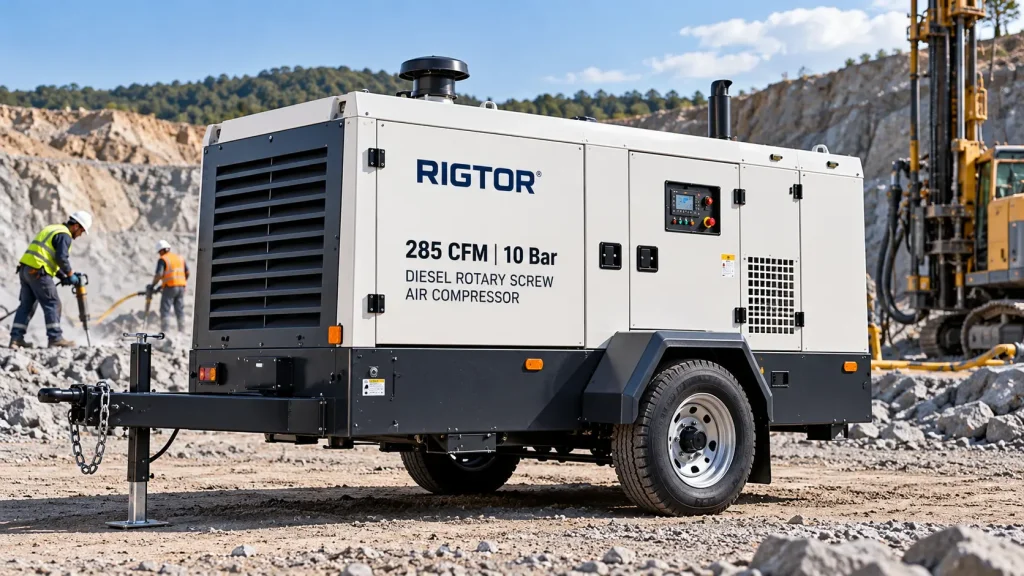
The two primary specifications describe the compressor's intended air delivery and operating pressure.
| Specification | Description |
|---|---|
| Air Delivery | 285 CFM (approximately 8.07 m³/min) |
| Rated Working Pressure | 10 Bar (approximately 145 PSI) |
| Compressor Technology | Oil-injected rotary screw |
| Power Source | Diesel engine |
| Engine Cooling | Liquid-cooled diesel engine, subject to model configuration |
| Installation Options | Skid-mounted or trailer-mounted, depending on design |
| Typical Applications | Construction, industrial maintenance, mining support, and field operations |
What does 285 CFM mean?
CFM stands for cubic feet per minute. In compressor specifications, buyers should confirm whether the quoted value represents Free Air Delivery (FAD), the rated discharge pressure, and the applicable test standard.
A compressor rated at 285 CFM should not automatically be assumed to deliver that same airflow at every pressure setting.
Why choose 10 Bar instead of 7 Bar?
A 10 Bar compressor offers a higher nominal working pressure for equipment that requires it. However, higher pressure does not automatically improve every pneumatic application.
The correct selection depends on the required pressure at the tool, pressure losses in hoses and fittings, and total air consumption.
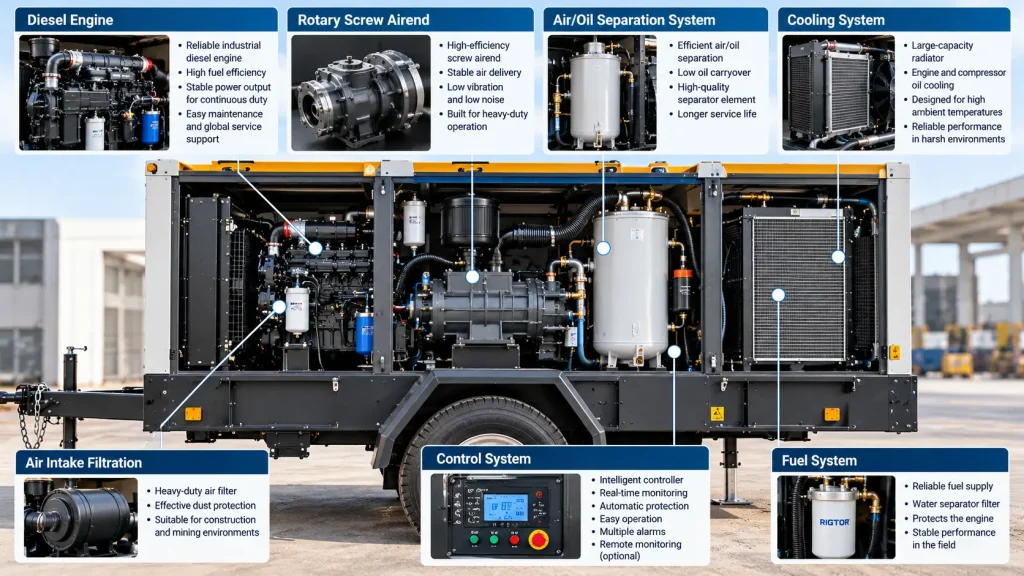
A dependable compressor is the result of correctly matching several mechanical and control systems.
The diesel engine must provide sufficient power to drive the compressor under its rated operating conditions.
Engine selection should consider:
An engine that is poorly matched to the compressor may experience excessive loading, reduced efficiency, or unstable operation.
The rotary screw airend is the central compression component.
Two intermeshing rotors compress air continuously as they rotate. Lubricating oil is introduced into the compression chamber to help seal internal clearances, lubricate components, and remove heat.
The airend should be selected according to the required airflow, pressure, rotational speed, and duty cycle.
For buyers, airend quality is important, but the complete compressor system matters just as much.
A diesel-powered screw compressor produces heat in both the engine and compression process.
A typical system may include a liquid-cooled diesel engine, engine radiator, compressor oil cooler, and an air aftercooler where specified.
Manufacturers must consider airflow through the enclosure, radiator capacity, cooler cleanliness, and the expected ambient operating temperature.
Buyers should confirm whether the term "water-cooled" refers only to the diesel engine or also to other compressor cooling circuits.
In an oil-injected screw compressor, compressed air and lubricating oil must be separated before the air is delivered to the outlet.
The oil separation system affects oil carryover, pressure loss, and maintenance requirements.
Intake air filtration is equally important, particularly at dusty construction sites and mining locations.
A practical industrial compressor should provide operating controls and protective functions appropriate to its configuration.
These may include:
The exact functions depend on the installed controller and engine system.
Construction contractors use diesel compressors to supply air for pneumatic tools, cleaning equipment, and other temporary site operations.
A diesel-driven system is especially useful where grid power is unavailable or temporary electrical installation is impractical.
Compressed air is used for equipment maintenance, cleaning, and selected pneumatic operations.
For drilling applications, the required pressure and airflow must be checked carefully. Some drilling methods require substantially higher pressure than 10 Bar.
Compressed air powers abrasive blasting equipment used in surface preparation.
A 285 CFM compressor may support selected blasting configurations, but suitability depends on nozzle diameter, operating pressure, abrasive type, and the condition of the air supply system.
Portable compressors can support plant shutdowns, maintenance contractors, and temporary compressed-air requirements.
For sensitive instruments, breathing air, or processes requiring low oil content, additional treatment and application-specific equipment may be necessary.
Buyers should request the rated FAD, operating pressure, test conditions, and relevant performance documentation.
The rated airflow and pressure should be stated together rather than presented as unrelated maximum values.
Ask for the engine manufacturer, engine model, rated power, airend manufacturer or model, and the service availability of both major components.
Recognizable component brands may help with service access, but system integration and manufacturer support remain essential.
Fuel consumption varies with engine efficiency, compressor loading, working pressure, and operating conditions.
A meaningful comparison should include fuel consumption at defined load points, rather than an unsupported single figure.
For long-running operations, the cost of fuel can be more important than a small difference in initial purchase price.
Rotary screw compressors are suitable for sustained compressed-air demand when correctly sized and operated within their rated limits.
Buyers should confirm the manufacturer's operating-duty recommendations, ambient-temperature rating, cooling performance, and maintenance requirements.
Ask about the air filtration arrangement, radiator accessibility, enclosure ventilation, protection systems, and operating-temperature limits.
For severe conditions, the manufacturer may need to evaluate additional filtration, cooling capacity, or protective measures.
A trailer-mounted compressor is convenient for projects requiring frequent relocation.
A skid-mounted compressor may be more suitable for installation on equipment platforms, service vehicles, or semi-permanent sites.
Trailer compliance, braking, lighting, and road-registration requirements depend on the destination market.
A professional procurement package should identify the equipment configuration and provide relevant documents such as:
Buyers should confirm these deliverables before ordering.
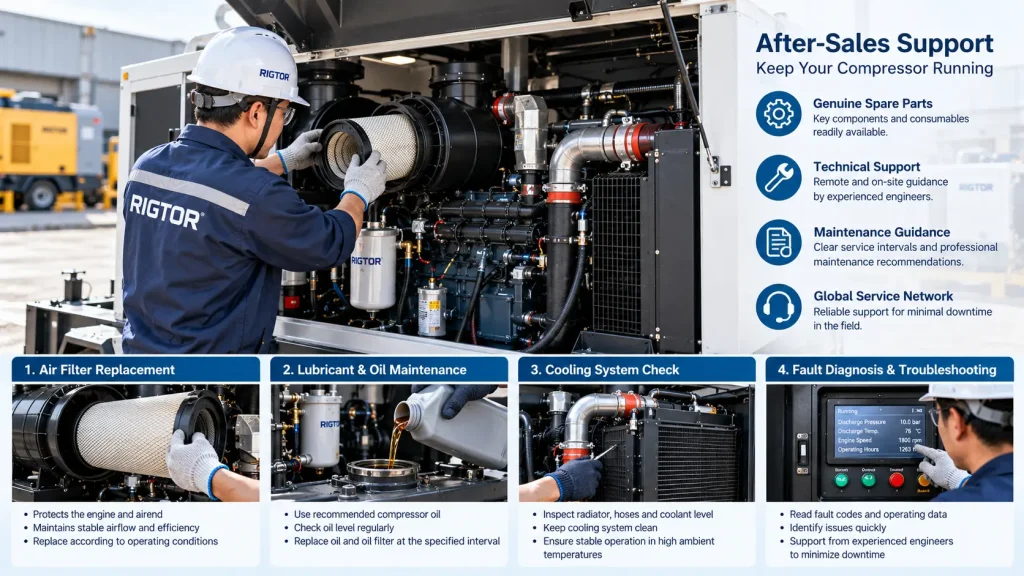
Routine maintenance is one of the most important factors affecting the service life and operating cost of a diesel screw air compressor.
| Maintenance Item | What to Check | Why It Matters |
|---|---|---|
| Engine oil and filter | Condition, level, and replacement interval | Protects the diesel engine |
| Compressor lubricant | Level, condition, and correct oil specification | Supports airend lubrication, sealing, and cooling |
| Air intake filter | Restriction and dust accumulation | Reduces contamination and excessive intake restriction |
| Air/oil separator | Differential pressure and oil carryover | Maintains separation performance |
| Cooling system | Coolant level, radiator cleanliness, hoses, and leaks | Helps prevent overheating |
| Belts and couplings | Wear, alignment, and condition, where fitted | Supports reliable power transmission |
| Fuel system | Filter condition, leaks, and fuel quality | Supports reliable engine operation |
| Hoses and connections | Leaks, wear, and secure fittings | Reduces air loss and unexpected failures |
| Control system | Fault history, indicators, and protective functions | Helps identify developing problems |
Important: Service intervals must follow the actual engine and compressor manufacturer's manuals. Operating hours alone should not be used to establish a universal oil-change or separator-replacement schedule.
Before starting the compressor, the operator should check fluid levels, visible leaks, intake and cooling airflow paths, warning indicators, and the general condition of the machine.
The compressor should be operated according to the manufacturer's start-up and shutdown procedures.
Maintenance planning should account for operating hours, environmental dust levels, ambient temperatures, fuel quality, and actual duty cycle.
Dusty or high-temperature environments may require more frequent inspection.
Before servicing pressurized components, shut down the equipment, isolate the energy sources, allow hot components to cool, and fully depressurize the system according to the manufacturer's procedures.
Pressure vessels, safety valves, and electrical systems should be serviced by qualified personnel.
Possible causes include excessive air demand, leaks, restricted intake airflow, incorrect pressure-control settings, or compressor system faults.
First confirm that the connected equipment is not consuming more air than the compressor can supply.
Potential causes include dirty radiators or coolers, insufficient ventilation, low or degraded fluids, cooling-system faults, and operation outside the rated ambient conditions.
Repeated overheating should be investigated rather than addressed only by restarting the machine.
Possible causes include separator problems, incorrect lubricant level, oil return-system faults, or operation outside recommended conditions.
Oil carryover should be assessed against the compressor's specified performance and application requirements.
Possible causes include prolonged high-load operation, air leaks, unnecessary discharge pressure, poor engine maintenance, and inefficient operating practices.
The most useful comparison is fuel consumption measured at the same delivered airflow and pressure.
Potential causes include battery problems, fuel-system faults, restricted filters, engine protection events, or control-system issues.
The operator should review fault codes and the engine manual before attempting repairs.
For overseas distributors, rental companies, and equipment owners, after-sales support can be just as important as the purchase price.
Before purchasing, request a recommended spare-parts list covering the engine filters, compressor oil filter, intake filter, separator element, belts where applicable, sensors, seals, and other model-specific consumables.
The manufacturer should explain which maintenance tasks can be completed by trained local technicians and which require specialized service.
Engine support may be available through the engine brand's authorized network, but compressor-specific parts and controls may still require support from the equipment manufacturer.
Buyers should clarify the diagnostic procedure, warranty assessment process, replacement-part availability, and responsibilities for shipping and labor.
Ask whether the supplier offers fault-code interpretation, maintenance guidance, wiring documentation, and remote troubleshooting.
The availability and scope of these services should be confirmed in writing.
A warranty should clearly define the coverage period, operating-hour limits if applicable, excluded consumables, maintenance obligations, claim procedures, and the treatment of freight and labor costs.
Do not assume that the engine, airend, and complete compressor package share identical warranty terms.
The lowest initial quotation does not always represent the lowest operating cost.
A more complete purchasing evaluation considers:
Total Cost of Ownership = Purchase Cost + Fuel Cost + Scheduled Maintenance + Repairs + Downtime Cost
For rental fleets and contractors, downtime can have significant consequences, particularly when equipment is operating at remote sites.
A well-matched compressor with accessible service components and dependable spare-parts support may provide better long-term value than a cheaper machine with uncertain service arrangements.
Before finalizing a 285 CFM 10 Bar diesel compressor purchase, confirm the following:
A 285 CFM 10 Bar diesel rotary screw air compressor is a practical solution for industrial users who need independent compressed-air supply at construction sites, maintenance projects, and remote operating locations.
However, buyers should evaluate more than nominal airflow and pressure.
Engine-airend matching, cooling design, fuel efficiency, maintenance accessibility, spare-parts availability, and after-sales support all influence long-term equipment performance.
For manufacturers and equipment buyers alike, the objective is to select a compressor that meets the actual operating requirement while remaining practical to maintain throughout its service life.
Looking for a 285 CFM 10 Bar diesel air compressor?
Contact RIGTOR to discuss your required airflow, working pressure, operating environment, engine preferences, mounting configuration, and project requirements. Final technical specifications and available configurations should be confirmed before ordering.

Behind Every Critical Project.
@ 2026-2026 Rigtor Industry. All Rights Reserved.
 EN
 ES
 PT
 AR